Can Japan's 3.4% basic wage growth rate be sustained? What will be the Bank of Japan's next move?
2026-08-05 08:24:51
On Wednesday (August 5) in early Asian trading, the USD/JPY pair traded in a narrow range, currently hovering around 157.65. Recent data releases have added new variables to the yen's short-term trend. Official data released on Wednesday showed that real wages in Japan rose 1.6% year-on-year in June, marking the sixth consecutive month of positive growth and matching the revised increase in May. This continued wage growth provides solid macroeconomic data support for further interest rate hikes by the Bank of Japan. 
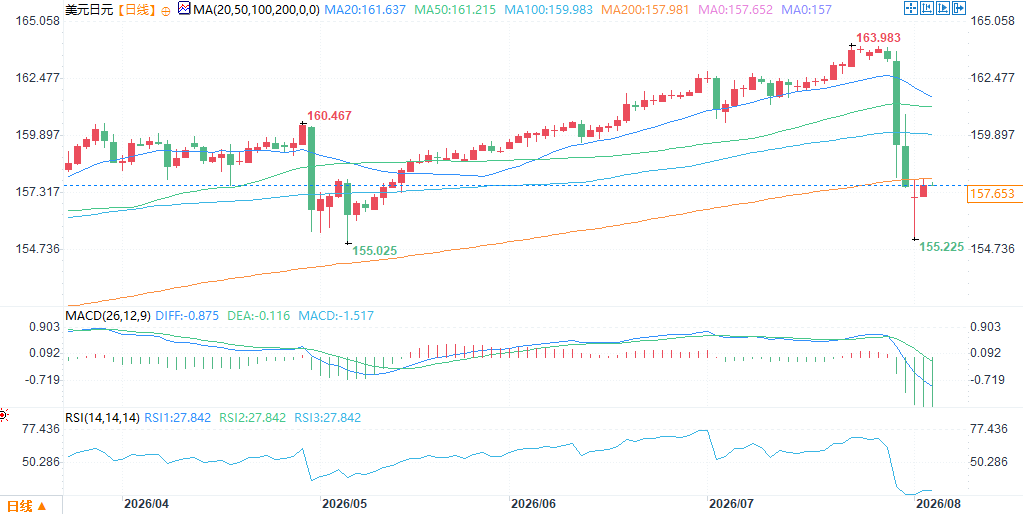 (USD/JPY daily chart, source: EasyForex) At 8:20 AM Beijing time on August 5, the USD/JPY exchange rate was 157.62/63.
Overall data: Real wages have seen positive growth for six consecutive months.
Data released by Japan's Ministry of Health, Labour and Welfare on Wednesday showed that nominal total cash income rose 3.4% year-on-year in June to approximately 531,700 yen (about US$3,374) per month, in line with market expectations and accelerating from the revised 3.2% in May. Adjusted for inflation, real wages rose 1.6% year-on-year in June, marking the sixth consecutive month of positive growth, unchanged from the revised 1.6% increase in May. Overtime pay rose 2.8% year-on-year in June, the same growth rate as in May, indicating that labor intensity remained stable.Salary Structure: Accelerated Rise in Base Wages Sends Key Signal
The most noteworthy highlight in this data is the change in salary structure. Basic wages (regular salaries) rose 3.4% year-on-year in June, a significant acceleration from May's 3.0%, marking the fastest growth in several months. During the same period, special payments (mainly one-time bonuses) rose 3.5% year-on-year, a substantial slowdown from the revised 7.4% in May. This stark contrast between the accelerating growth of basic wages and the slowing growth of bonuses suggests that June's salary growth relied more on improvements in regular income than on short-term boosts from one-time special payments. This structural change is crucial for the Bank of Japan. The central bank has repeatedly stated that when assessing whether inflation is demand-driven, sustained growth in basic wages is more valuable than short-term fluctuations in bonuses.Policy implications: The path to interest rate hikes is becoming clearer.
Real wages have grown for six consecutive months, coupled with structural improvements in basic wages, reinforcing the basis for the Bank of Japan to continue normalizing monetary policy: First, its sustainability has been validated. Six consecutive months of real wage growth indicates that a positive wage-inflation cycle is taking shape, rather than being a fleeting impulse. Second, its quality has improved. The acceleration of basic wage growth to 3.4% indicates that the foundation for wage growth is broadening, no longer relying on volatile factors such as bonuses. The Bank of Japan has repeatedly emphasized that only sustained growth in basic wages can confirm that inflation is demand-driven rather than cost-driven. Third, government expectations are aligned. In its latest economic forecast released last month, the Japanese government projected that nominal wages will grow at an average annual rate of 3.1% until fiscal year 2027, and real wages will continue to grow even with persistent inflation. This means that policymakers believe the current trend is sustainable, rather than a temporary phenomenon.Key variables of the Japanese yen and Japanese government bond yields
Following the data release, the key to market reaction lies in interpreting its correlation with the Japanese government's own forecasts. The government's prediction that real wages will continue to grow until fiscal year 2027 suggests that policymakers believe the current trend is sustainable. This will further strengthen market expectations for continued interest rate hikes by the Bank of Japan, thereby providing support for the yen.Summarize
Japan's real wages rose for the sixth consecutive month in June, with basic wages accelerating to 3.4%, indicating that wage improvements are shifting from being driven by one-off bonuses to structural, regular growth. This data combination provides strong support for further interest rate hikes by the Bank of Japan, especially given the government's forecast that real wages will continue to grow until fiscal year 2027. The market will closely watch the reaction of the yen and Japanese government bond yields, and the sustainability of wage trends will be a key variable determining the pace of the Bank of Japan's policy normalization. (USD/JPY daily chart, source: EasyForex) At 8:20 AM Beijing time on August 5, the USD/JPY exchange rate was 157.62/63.
- Risk Warning and Disclaimer
- The market involves risk, and trading may not be suitable for all investors. This article is for reference only and does not constitute personal investment advice, nor does it take into account certain users’ specific investment objectives, financial situation, or other needs. Any investment decisions made based on this information are at your own risk.