Is a global oil route about to be opened? Iran plans to allow European mine clearance, Brent crude falls below $80, and Bessant releases a significant signal.
2026-08-05 09:42:52
Global markets are closely watching the Strait of Hormuz, which has been blocked for over five months, putting continued pressure on energy supply chains and bringing shipping activity to a near standstill. On Tuesday (August 4), Iran softened its stance in private talks, considering allowing European countries to participate in mine clearance in the strait—a key concession signal. US Treasury Secretary Bessenter announced on Tuesday that an agreement might be finalized within the next two days (Tuesday and Wednesday), causing international benchmark Brent crude futures to plummet nearly 12% in two days, falling below $80 on Tuesday and reaching $78.43 per barrel in early Asian trading on Wednesday (August 5), a new low since July 13. However, risks such as internal divisions within the Revolutionary Guard and further attacks on cargo ships remain, leaving considerable uncertainty about whether an agreement will be finalized. Market sentiment is volatile, and investors remain vigilant. 
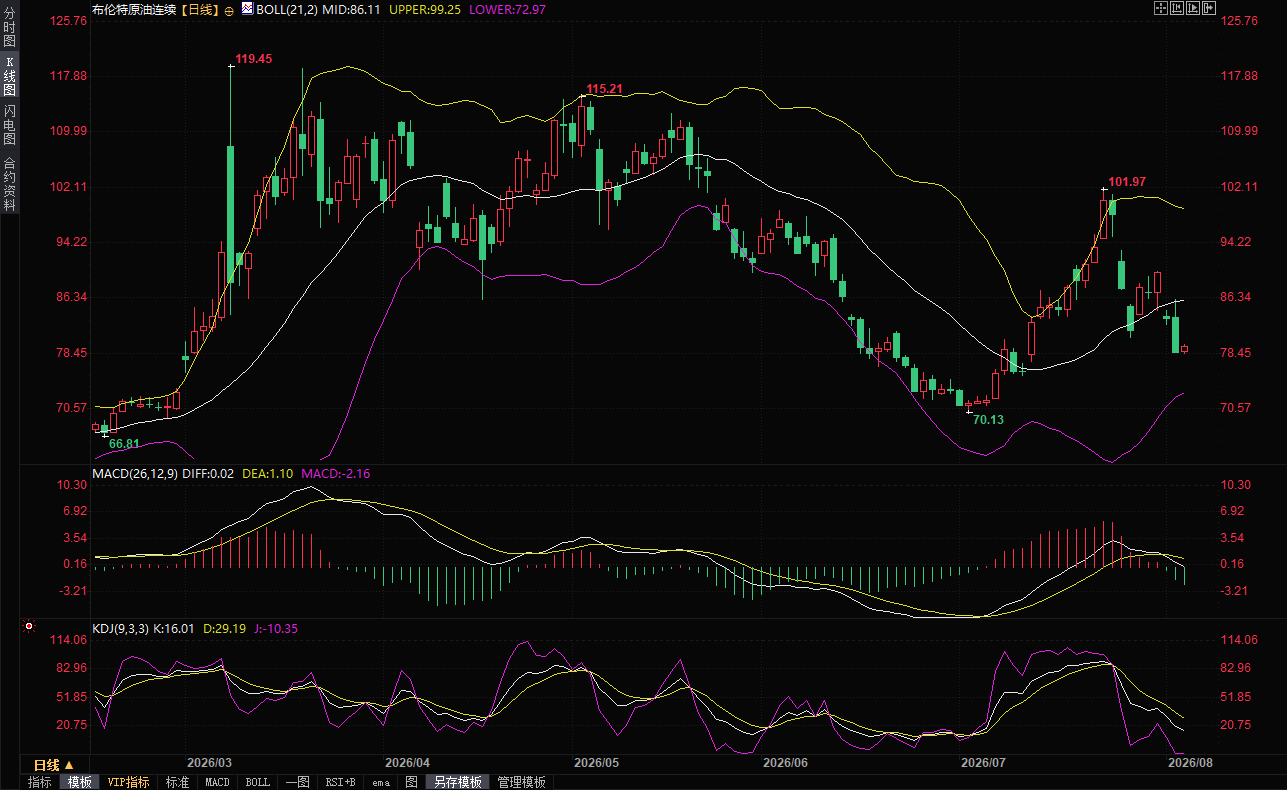 (Brent crude oil daily chart, source: FX678) It's worth noting that oil prices initially rose in early trading on Tuesday—October Brent futures briefly climbed to $86.33 per barrel—primarily driven by news of a bulk carrier being attacked by an unidentified projectile near the Strait of Hormuz on Monday evening. However, as senior U.S. officials released clear optimistic signals, market sentiment quickly reversed, and oil prices reversed course and fell sharply. Goldman Sachs assessed this price volatility, believing that Brent crude oil prices will remain within the $80 to $90 per barrel range until a new U.S.-Iran agreement is confirmed or regional conflicts escalate significantly. The bank estimates the fair value of Brent spot prices at approximately $80 per barrel, suggesting that the current market only incorporates a modest risk premium.
I. A Turning Point After a Stalemate in May: Iran Privately Softens Its Mine Clearance Stance
The stalemate in the Strait of Hormuz, which has lasted for over five months, is showing rare signs of a diplomatic breakthrough. According to several diplomats familiar with the matter, Iran has demonstrated a degree of policy flexibility in recent private meetings and is considering allowing European countries to participate in clearing mines from the Strait of Hormuz. This potential concession contrasts sharply with Tehran's public statements—Iran has repeatedly declared that it will not allow any foreign power to interfere in the mine-clearing operations of this crucial energy route. The Strait of Hormuz carries approximately one-fifth of the world's oil and liquefied natural gas shipments. Since the US-Israel attack on Iran on February 28, 2026, the waterway has been under continuous military standoff and blockade. On July 22, the Iranian Islamic Revolutionary Guard Corps officially announced that mines had been laid in the southern channel of the strait and warned shipping companies "not to be deceived by the United States." Since then, several ships attempting to cross the strait have been attacked or struck by mines. According to maritime data company Kpler, shipping activity in the strait has nearly come to a standstill. Sources say any European-led demining operation would require several preconditions: Iran must provide security guarantees for participating vessels, and the ceasefire agreement must remain in effect. Furthermore, the plan would need final approval from the Iranian Islamic Revolutionary Guard Corps—which has previously launched numerous attacks on maritime traffic through the Strait of Hormuz. According to informed sources, significant divisions remain within the Iranian leadership, with some Revolutionary Guard members insisting that Iran should bear the responsibility for demining itself.II. Oil Price Reaction: Brent Crude Falls Nearly 12% in Two Days
The signal of a diplomatic breakthrough quickly spread to the global energy market. On Tuesday (August 4), international oil prices fell sharply for the second consecutive trading day. Brent crude oil futures for October delivery fell $4.41, or 5.3%, to settle at $79.36 a barrel. The contract had fallen a cumulative 11.9% over the past two trading days. WTI crude oil futures for September delivery on the New York Mercantile Exchange also fell $4.57, settling at $75.77 a barrel, a drop of 5.69%. (Brent crude oil daily chart, source: FX678) It's worth noting that oil prices initially rose in early trading on Tuesday—October Brent futures briefly climbed to $86.33 per barrel—primarily driven by news of a bulk carrier being attacked by an unidentified projectile near the Strait of Hormuz on Monday evening. However, as senior U.S. officials released clear optimistic signals, market sentiment quickly reversed, and oil prices reversed course and fell sharply. Goldman Sachs assessed this price volatility, believing that Brent crude oil prices will remain within the $80 to $90 per barrel range until a new U.S.-Iran agreement is confirmed or regional conflicts escalate significantly. The bank estimates the fair value of Brent spot prices at approximately $80 per barrel, suggesting that the current market only incorporates a modest risk premium.III. The US releases a series of signals: Both Bessant and Rubio express optimism.
The United States is releasing optimistic signals with unprecedented frequency. Treasury Secretary Scott Bessant stated clearly in a television interview on Tuesday, "We are negotiating with Iran, and I think an agreement could be reached today or tomorrow to open the Strait." When asked whether ships passing through the strait would need to pay fees, Bessant responded that "it should be free passage." US Secretary of State Marco Rubio also told the media on the same day that negotiations with Iran on reopening the Strait of Hormuz "have made progress," but an agreement has not yet been finalized, and he hoped it could be reached "soon." Rubio pointed out that the most pressing and pressing issue is the Strait of Hormuz. The previous day, US President Donald Trump declared at the White House that the US and Iran were in dialogue, calling it Iran's "last chance" to reach an agreement. Trump stated that the negotiations would proceed in two phases: the first phase is opening the Strait of Hormuz, "which could be fully open as early as tomorrow"; the second phase is discussing Iran's "denuclearization." He also clearly stated that he would not allow Iran to charge fees for ships passing through the Strait of Hormuz. In response to Iran's denial that US-Iran negotiations had resumed, Trump refuted the claim on social media, insisting that negotiations had restarted and threatening Iran with "either a deal or total surrender."IV. Mediation efforts are progressing actively: Qatar says the draft has been distributed to all parties.
As a key mediator, Qatar is also sending positive signals. Qatari Foreign Ministry spokesman Majid Ansari stated that diplomatic contacts have entered a "very advanced stage." Mediators, including Qatar, Pakistan, and Oman, are coordinating closely to push for negotiations between Washington and Tehran and the exchange of draft proposals. The Qatari Emir's office stated that Trump and Qatari Emir Tamim bin Hamad Al Thani spoke by phone on Tuesday to discuss efforts to narrow the differences between Washington and Tehran. Qatar indicated that a draft proposal aimed at easing tensions is "circulating among the parties." However, Iranian official statements remain cautious. Iranian Foreign Ministry spokesman Esmail Bagheei stated that talks between Iran and Oman on the Strait of Hormuz are "positive" and ongoing, focusing on establishing a safe shipping lane. Bagheei emphasized that the route being discussed aims to ensure the sovereign rights and national security of both Iran and Oman. According to a senior Iranian source, Iran hopes to control inbound shipping through the Strait of Hormuz according to the proposed plan, while also monitoring outbound vessels and retaining the ability to intervene if necessary.V. Risks Remain: Cargo Ship Attacks and Pressure on US Missile Stockpiles
Despite the prospect of a diplomatic breakthrough boosting markets, the real risks in the Strait of Hormuz have not subsided. Earlier on Tuesday, the UK's Office for Maritime Trade Operations (UKMTO) reported that a cargo ship was attacked by an "unidentified projectile" in the Strait of Hormuz near the coast of Oman. Pioneer Technologies, a UK-based maritime security company, subsequently confirmed in a report that the attacked vessel was a bulk carrier; the crew had abandoned ship, and one sailor was missing. Public information about the ship indicates that the bulk carrier, named "Minos Pioneer," flies the Liberian flag and is operated by a Greek company. Meanwhile, the sustainability of the US's continued combat capability is raising growing concerns. Sources familiar with the data revealed that the US military has depleted most of its high-precision long-range missile inventory during the more than five months of the war. A report released last week by the Center for Strategic and International Studies (CSIS) estimated that between February and July 2026, the US military's Patriot system inventory would have been depleted by approximately 65%, and the THAAD system inventory would be at least 38% lower than before the war. Key surface-to-surface weapons, such as the Army Tactical Missile System (ATACMS) and Precision Strike Missile (PrSM), have depleted “almost all” of their stockpiles. Furthermore, U.S. Defense Secretary Peter Hegses has reportedly been urging Britain and France to organize an international conference on maritime traffic in the Strait of Hormuz, but the European side has rejected the request, fearing it would be interpreted as support for U.S. military action.Editor's Summary
The Strait of Hormuz blockade has lasted for over five months, posing a substantial challenge to the global energy supply chain. The current acceleration of the diplomatic process—centered on Iran's consideration of allowing European participation in mine clearance, a flurry of optimistic signals from senior US officials, and active efforts by mediators like Qatar to circulate the draft agreement—signals a potential turning point in the deadlock. Brent crude oil has plummeted nearly 12% in two trading days, falling below the $80 mark, reflecting that the market has already priced in a short-term agreement. However, the final implementation of the agreement still faces multiple uncertainties: the attitude of the Iranian Revolutionary Guard, the fundamental differences between the US and Iran on the issues of "control" and "passage fees," and the ongoing attacks on ships all constitute substantial obstacles. Goldman Sachs' assessment that Brent crude oil will fluctuate between $80 and $90 essentially reflects the market's probability-weighted assessment of two scenarios: "agreement reached" and "conflict escalation." The true quality of diplomatic progress will be tested in the coming days. As of 09:38 Beijing time, Brent crude oil is trading at $79.67 per barrel.- Risk Warning and Disclaimer
- The market involves risk, and trading may not be suitable for all investors. This article is for reference only and does not constitute personal investment advice, nor does it take into account certain users’ specific investment objectives, financial situation, or other needs. Any investment decisions made based on this information are at your own risk.