Joint US-Japan intervention failed to reverse the downward trend; the yen's brief rebound masks persistent medium- to long-term depreciation pressures.
2026-08-05 10:06:53
The US and Japan completed their first coordinated foreign exchange intervention in decades, triggering a temporary rebound in the yen and a rapid decline in the USD/JPY exchange rate from its multi-decade high. From a macroeconomic perspective, the core drivers of the yen's continued weakness have not been substantially addressed. Policy intervention can only create short-term price fluctuations and is unlikely to alter the medium- to long-term exchange rate trajectory; it's only a matter of time before the USD/JPY resumes its upward trend. Japan's loose monetary policy, heavy fiscal burden, and the structural forces of global carry trade will continue to exert downward pressure on the yen, and the underlying motivation for US intervention is not entirely about maintaining the stability of its allies' currencies.
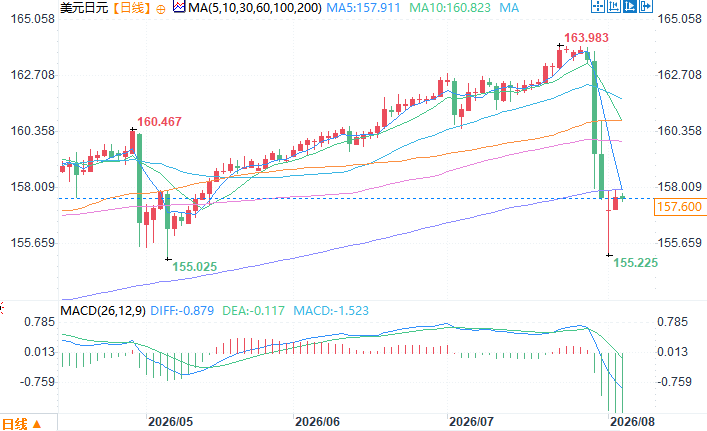 USD/JPY Daily Chart Source: FX678 At 10:04 AM Beijing Time on August 5th, the USD/JPY exchange rate was 157.64/65.
Multiple structural problems limit the yen's room for recovery.
Japan maintains the most accommodative monetary environment among developed economies, with domestic real interest rates remaining negative. The market had widely expected the Bank of Japan to use the current currency crisis to send a clear signal of accelerated policy normalization, but the Bank of Japan's statements have remained vague and cautious. Even though the derivatives market has priced in a possible interest rate hike before the end of the year, there has been no substantial tightening action at the policy level. Years of inflation exceeding the target and a persistently weak yen have not forced a rapid shift in monetary policy. Fiscal risks are also present. Japan's government debt remains high, making its economic resilience weak in the face of external shocks. Investors are therefore demanding higher yields on Japanese government bonds before they are willing to enter the market. Recent auction results for 10-year Japanese government bonds fell short of expectations, with declining bid-to-cover ratios and a significantly widening auction margin, reflecting market concerns about Japanese debt. Meanwhile, global risk appetite remains high, providing fertile ground for carry trades using low-cost yen. This structural factor will continue to suppress the yen's performance.The Realistic Considerations Behind US Intervention
U.S. Treasury Secretary Scott Bessent stated that the coordinated intervention was intended to maintain financial stability in Asia, preserve space for Japanese overseas investment, and that he believed the Bank of Japan would implement policies suited to its domestic economy. However, from a market perspective, this explanation does not fully account for the U.S.'s motivation for intervening. He failed to mention a key risk: if Japan were to prop up the yen alone, it could be forced to massively sell off dollar assets to raise funds for intervention, directly impacting the U.S. Treasury market. The U.S. values the tangible benefits of continued Japanese investment in the U.S., and maintaining related capital flows is no less important than stabilizing the yen's exchange rate itself. Behind the so-called ally cooperation lies a real exchange of interests.Traditional indicators are losing their correlation, and technical indicators are releasing key signals.
It's worth noting that traditional macroeconomic factors such as interest rate differentials and Fed policy expectations are now significantly less correlated with the USD/JPY exchange rate. Relying solely on the strength of European and American economic data to predict exchange rate movements has become far less reliable. The future trend of the US dollar will depend more on a series of economic data, including US employment and services PMI. For Japan, wage data is a necessary condition for the Bank of Japan to normalize its policy, but wage data alone is unlikely to directly drive a reversal in the exchange rate. From a technical perspective, the USD/JPY pair rebounded quickly after finding support around 155.30, mirroring the pattern following interventions in April and May of this year. After the concentrated clearing of speculative positions following the intervention, the bearish momentum has clearly weakened, with the 200-day moving average and the 157.92 level forming a significant resistance zone. If the exchange rate holds above this level, it signifies the end of this round of intervention, and the price will likely retest the 160 level, or even the previous high of 160.73. In summary , policy intervention is an external force that can only temporarily change the market's pace and cannot eradicate the underlying contradictions causing the yen's depreciation. Going forward, investors should continue to monitor changes in the monetary policies of the US and Japan, pay attention to the trends in the US Treasury market and carry trade, and rationally view the short-term market movements brought about by intervention. USD/JPY Daily Chart Source: FX678 At 10:04 AM Beijing Time on August 5th, the USD/JPY exchange rate was 157.64/65.
- Risk Warning and Disclaimer
- The market involves risk, and trading may not be suitable for all investors. This article is for reference only and does not constitute personal investment advice, nor does it take into account certain users’ specific investment objectives, financial situation, or other needs. Any investment decisions made based on this information are at your own risk.