With wage data providing support and the minutes confirming a hawkish stance, can Friday's non-farm payrolls report provide new momentum for the yen's rebound?
2026-08-05 10:52:58
The USD/JPY pair edged lower in Asian trading on Wednesday (August 6), currently trading around 157.40. The yen is supported by multiple positive factors: Japanese real wages saw positive growth for the sixth consecutive month, the Bank of Japan's meeting minutes released hawkish signals, and expectations of US-Iran negotiations weakened safe-haven buying of the dollar. However, uncertainty surrounding Japan's fiscal expansion and persistent interest rate differential pressures limited further yen appreciation. 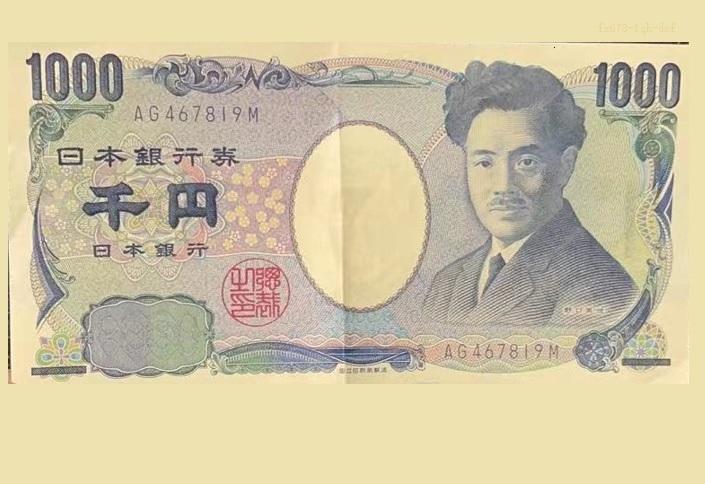
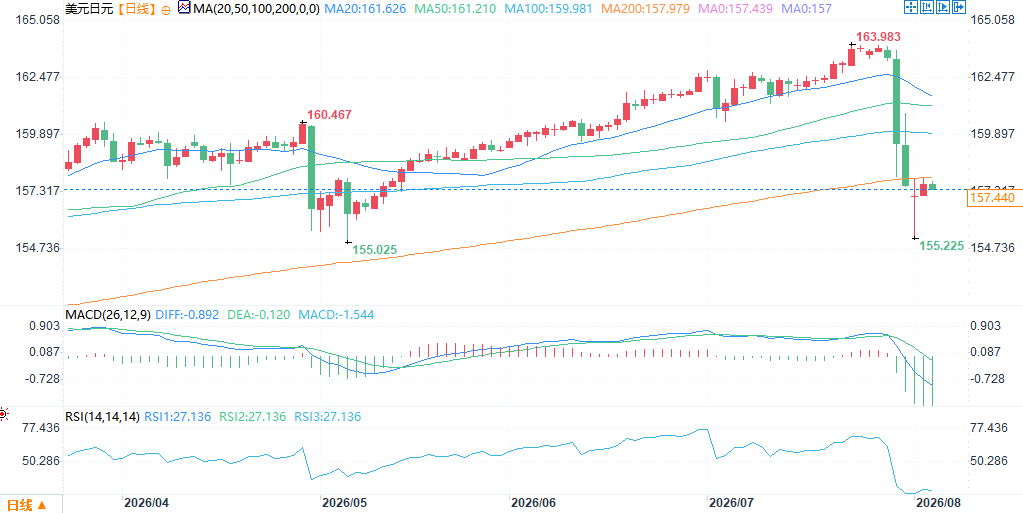 (USD/JPY daily chart, source: EasyForex) At 10:50 Beijing time on August 5, the USD/JPY exchange rate was 157.35/36.
Strong wage data provides support for the Bank of Japan to raise interest rates.
Data released by Japan's Ministry of Health, Labour and Welfare on Wednesday showed that real wages rose 1.6% year-on-year in June, marking the sixth consecutive month of positive growth and matching the revised increase in May. Nominal total cash income increased by 3.4% year-on-year, with basic wage growth accelerating to 3.4%, the fastest pace in several months. The accelerated rise in basic wages was the core highlight of this data. Compared to the more volatile one-time bonuses, the sustained growth of basic wages better reflects the stability of the wage-inflation positive cycle. The Bank of Japan has repeatedly emphasized that only sustained growth in basic wages can confirm that inflation is demand-driven rather than cost-driven. Six consecutive months of real wage growth, coupled with structural improvements in basic wages, further strengthened market expectations that the Bank of Japan will continue to normalize monetary policy.The Bank of Japan's meeting minutes confirmed its hawkish stance.
The minutes of the Bank of Japan's June 15-16 meeting, released on the same day, showed that the Policy Board voted 7-1 to raise the policy rate by 25 basis points to approximately 1.0%, the highest level since 1995. The minutes noted that upside risks to inflation were the main consideration supporting the rate hike. This vote was largely in line with market expectations, but the policy resolve revealed in the minutes is noteworthy. Against the backdrop of the Japanese government's upward revision of its economic outlook and continued improvement in real wages, the consensus within the central bank regarding further rate hikes is strengthening. Combined with the recent joint intervention by the US and Japan, the Bank of Japan's confidence in normalizing monetary policy is increasing.Rising expectations of US-Iran negotiations weaken safe-haven buying of the US dollar.
Regarding the US dollar, positive signals from the US-Iran negotiations are eroding safe-haven demand for the currency. US Treasury Secretary Bessant stated that the US and Iran are close to reaching an agreement, and that a deal to reopen the Strait of Hormuz is "imminent." This statement pushed oil prices to a near four-week low, easing market concerns about inflation and thus weakening market expectations for further interest rate hikes by the Federal Reserve. As a safe-haven currency, the US dollar is under pressure due to both easing geopolitical risks and declining expectations of interest rate hikes. This has provided some upward momentum for the Japanese yen against the US dollar. However, the actual progress of the US-Iran negotiations remains to be seen—Iran denies direct contact with the US, and reports of attacks on ships near the Strait continue to emerge, leaving the prospects for a diplomatic solution uncertain.Japan's fiscal concerns continue to weigh on the yen.
Despite multiple positive factors supporting the yen, market concerns about Japan's fiscal situation are limiting its further appreciation. Japan's ruling Liberal Democratic Party has formally approved a proposal to significantly reduce the food consumption tax rate from 8% to 1% starting in April 2027, for a period of two years. In addition, the government has proposed distributing approximately 600 billion yen in cash subsidies annually to low- and middle-income households. The problem with this fiscal expansion plan is the uncertainty surrounding the source of funding. With Japan's government debt ratio already exceeding 260%, any large-scale fiscal spending without a clear source of funding will further weaken market confidence in the yen's medium- to long-term value. This fiscal uncertainty, coupled with the still significant interest rate differential between the US and Japan, continues to provide fertile ground for yen carry trades, limiting the downside potential of the USD/JPY exchange rate.Market Outlook: Focus on US Employment Data
Looking ahead, market focus has shifted to the US ADP private sector employment report and ISM services PMI later today, as well as the US July non-farm payrolls report to be released on Friday. These data will provide clearer guidance for the Federal Reserve's subsequent policy path. If the US employment data weakens, it will further reduce expectations of a Fed rate hike, putting downward pressure on the USD/JPY pair; if the data remains strong, it could push the dollar to rebound, testing the resistance zone of 158.00-159.00. Meanwhile, substantial progress in US-Iran negotiations, the funding sources for Japan's fiscal package, and the pace of further interest rate hikes by the Bank of Japan will continue to intertwine and influence the short-term direction of the USD/JPY pair. (USD/JPY daily chart, source: EasyForex) At 10:50 Beijing time on August 5, the USD/JPY exchange rate was 157.35/36.
- Risk Warning and Disclaimer
- The market involves risk, and trading may not be suitable for all investors. This article is for reference only and does not constitute personal investment advice, nor does it take into account certain users’ specific investment objectives, financial situation, or other needs. Any investment decisions made based on this information are at your own risk.