The Bank of England may put the brakes on quantitative tightening in September, putting the pound at a critical test at the 1.35 level.
2026-08-05 15:46:55
On Wednesday, August 5, the pound sterling returned above 1.3450 against the dollar, with market pricing influenced by the Bank of England's interest rate path, the pace of balance sheet contraction, and changes in external energy prices. 
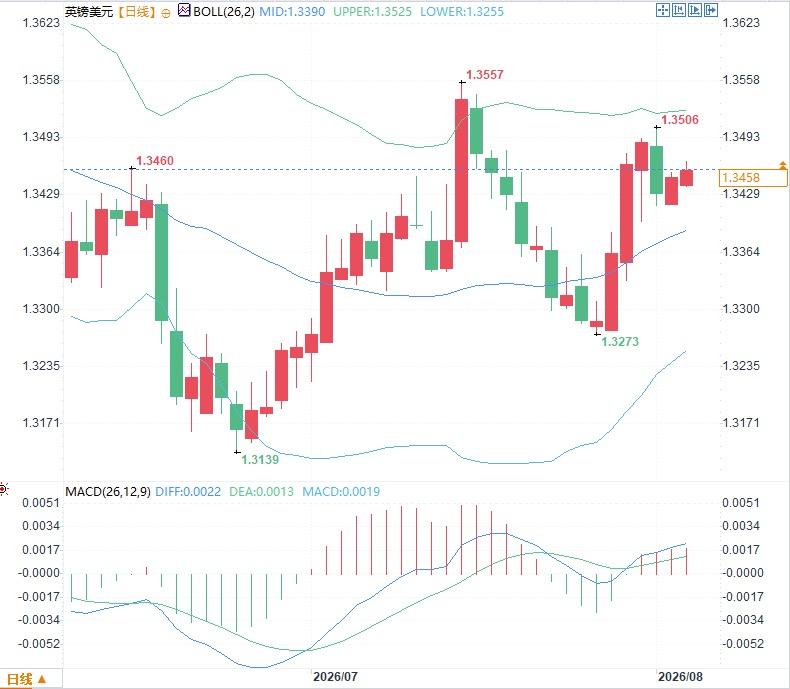 The recent rebound high is at 1.3506, while 1.3557 corresponds to the previous high, forming a dense resistance zone. If the exchange rate remains below 1.3500 for an extended period, the market can still be interpreted as a consolidation within the range, rather than a complete reversal of the trend. Fundamentals and technicals currently present similar signals. Lower-than-expected UK inflation is exerting some constraint on the pound, but the Bank of England's maintenance of a 3.75% interest rate limits the rapid narrowing of interest rate spreads. Meanwhile, if the scale of active quantitative tightening is reduced in September, the upward pressure on UK long-term bond yields from additional supply may decrease. The pound's reaction will depend on whether the market interprets this change as an adjustment to the operational framework or a general shift towards easing.
The Bank of England's policy focus is shifting from interest rates to its balance sheet.
The Bank of England kept its interest rate at 3.75% on July 30. Policy divergence widened, with some members favoring a rate hike, but most believing it remained to be seen whether the energy price shock would lead to a second wave of transmission through wages and service prices. Governor Andrew Bailey stated that current policy signals did not indicate the Bank of England was paving the way for a near-term rate hike, reflecting the policymakers' continued attempt to balance inflation risks and economic slowdown. Compared to interest rates, the September balance sheet annual review is likely to be a more significant variable for the pound and UK government bond markets. In September 2025, the Bank of England decided to reduce its holdings of UK government bonds in its asset purchase program by £70 billion between October 2025 and September 2026, targeting a balance of £488 billion. Five active sales totaling £3.375 billion are still planned for the third quarter of 2026, with no further sales of long-term bonds, significantly reducing direct supply pressure on the long-term market. Whether active sales will continue in the next fiscal year will be announced after the policy meeting on September 17. This arrangement indicates that quantitative tightening has not stopped, but the implementation method has begun to shift towards term structure management. The Bank of England previously emphasized that proactive selling would help restore future balance sheet expansion space; however, as the balance sheet gradually approaches a stable range, the marginal benefit of continuing to sell is declining, while the impact on the term premium of government bonds, fiscal cash flow, and market liquidity is becoming more prominent.The necessity of proactively selling is diminishing.
As of the end of March 2026, the Bank of England held £527.9 billion in UK government bonds for monetary policy purposes. Bond maturities in the first quarter reduced holdings by £19.8 billion, while active sales reduced them by only £5.5 billion. This data suggests that the main driver of quantitative tightening has shifted from active sales to natural maturity. From March 2025 to February 2026, holdings of related government bonds decreased from £645.7 billion to £529.1 billion, a cumulative decrease of £116.6 billion. As the scale of maturing bonds continues to expand, even if active sales cease, the balance sheet will still naturally shrink. Therefore, the core issue discussed in September was not whether to completely exit quantitative tightening, but whether the Bank of England still needs to further reduce its holdings through auctions. Active sales also prematurely convert book valuation losses into fiscal spending. When bond market prices fall below the initial purchase price, sales immediately recognize losses, while holding to maturity spreads gains and losses over a longer period. More importantly, the simultaneous release of government bond supply to the market by the central bank and the Treasury may increase term premiums. If the Bank of England switches to a passive maturity mechanism, monetary conditions will not suddenly ease, but the additional supply pressure on long-term government bonds may decrease.The decline in inflation has not completely lifted policy constraints.
The UK Consumer Price Index (CPI) rose 2.6% year-on-year in June, down from 2.8% in May; the core CPI rose 2.6% year-on-year, while the increase in service prices slowed to 3.6% from 3.7%. Transport, food, and non-alcoholic beverages were the main contributors to the decline in inflation. The data indicates that inflationary pressures on goods continue to ease, but service prices remain above the 2% policy target, and the Bank of England lacks the conditions for a rapid shift to easing. Energy prices remain a key disturbance to the policy path. Supply risks from external conflicts could push up fuel and utility costs again, but recent declines in energy prices have reduced the necessity for immediate policy tightening. The real problem facing the Bank of England is that it needs to prevent energy costs from being passed on to wages and service pricing, while avoiding the excessive constraints on demand and financial conditions caused by the combination of high interest rates and active quantitative tightening. Therefore, stopping or reducing active selling is not equivalent to cutting interest rates. Interest rates can still play a major role in inflation regulation, while bond holdings can be gradually reduced through maturity. This policy division helps reduce the signaling confusion caused by tightening different tools simultaneously.The pound's technical structure has entered a zone of heavy resistance above.
Observing the daily chart, the British pound rebounded rapidly after forming a low of 1.3273 against the US dollar, and is currently between the middle Bollinger Band at 1.3390 and the upper Bollinger Band at 1.3525. The MACD fast line is above the slow line, and the histogram remains positive, indicating that the short-term momentum is still biased towards recovery, but the incremental momentum has not expanded significantly. The recent rebound high is at 1.3506, while 1.3557 corresponds to the previous high, forming a dense resistance zone. If the exchange rate remains below 1.3500 for an extended period, the market can still be interpreted as a consolidation within the range, rather than a complete reversal of the trend. Fundamentals and technicals currently present similar signals. Lower-than-expected UK inflation is exerting some constraint on the pound, but the Bank of England's maintenance of a 3.75% interest rate limits the rapid narrowing of interest rate spreads. Meanwhile, if the scale of active quantitative tightening is reduced in September, the upward pressure on UK long-term bond yields from additional supply may decrease. The pound's reaction will depend on whether the market interprets this change as an adjustment to the operational framework or a general shift towards easing.
- Risk Warning and Disclaimer
- The market involves risk, and trading may not be suitable for all investors. This article is for reference only and does not constitute personal investment advice, nor does it take into account certain users’ specific investment objectives, financial situation, or other needs. Any investment decisions made based on this information are at your own risk.