The joint intervention by the US and Japan set a record in decades, but the three major obstacles of interest rate differentials, fiscal policy, and energy remain. How long can the yen hold out?
2026-08-05 16:00:53
On Wednesday (August 5th) during the European session, the USD/JPY pair traded in a narrow range, currently hovering around 157.70. The deterrent effect of the coordinated intervention remains, but fundamental pressures cannot be ignored. On Monday (August 3rd), the US and Japan implemented a coordinated intervention by buying yen and jointly warned that if necessary, the two countries would not hesitate to intervene again to defend the yen's value. This move marked one of the most notable interventions in the global foreign exchange market in decades, signifying a major shift in US exchange rate policy. However, the yen's weakness is rooted in structural factors such as wide interest rate differentials, fiscal concerns, and energy dependence. Whether the coordinated intervention can truly reverse the yen's decline remains to be seen. 
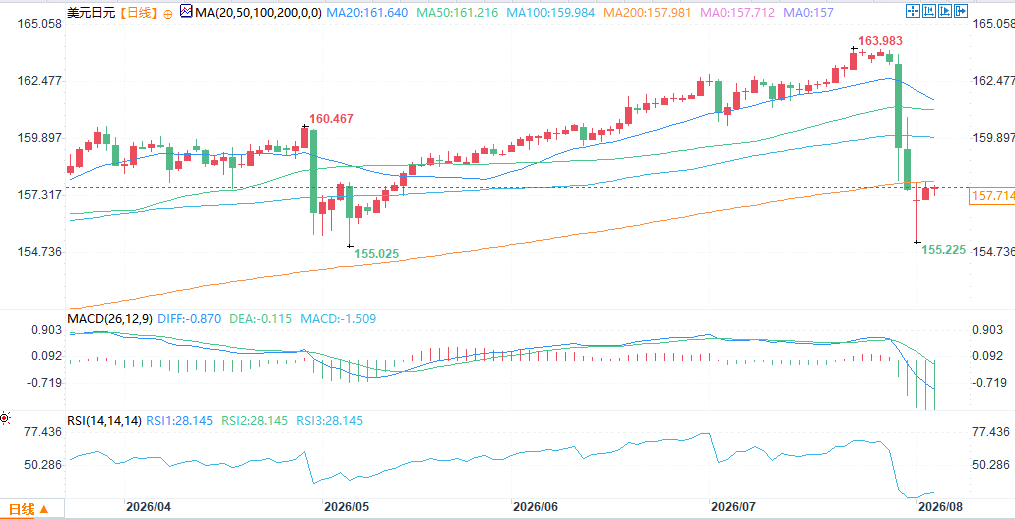 (USD/JPY daily chart, source: FX678) At 15:59 Beijing time on August 5, the USD/JPY exchange rate was 157.70/71.
Joint Intervention: The Background of a Historic Action
The depreciation of the yen has become an increasingly serious challenge for Japanese policymakers. Its pressure to push up import prices and household living costs has not only caused concern within Japan but has also attracted the attention of the United States. In late April of this year, Japanese authorities intervened in the foreign exchange market with nearly $74 billion over two months to support the yen, but the rebound failed to hold. By July 23, the yen had further slipped to its weakest level against the dollar since 1986, ultimately triggering this joint intervention. Both the US and Japan explicitly warned during the intervention that they would not hesitate to act again if necessary, a statement that strengthened the credibility of the intervention. Unlike previous interventions that were solely unilateral by Japan, the direct involvement of the United States significantly increased the psychological impact of the operation.The Three Roots of the Yen's Weakness
First, the significant interest rate differential. The vast gap between Japan's ultra-low interest rates and those of the US and other major economies continues to encourage investors to borrow cheap yen and invest in high-yield overseas assets. This resulting capital outflow exerts sustained downward pressure on the yen. Although the Bank of Japan raised its benchmark interest rate to its highest level in 31 years in June, this level remains low by international standards and is far from sufficient to reverse the structural attractiveness of carry trades. Second, fiscal concerns. Investors' worries about Japan's fiscal prospects have further exacerbated the downward pressure on the yen. Japan's government debt-to-GDP ratio exceeds 200%, the highest among major economies, and persistent budget deficits have fueled market concerns about the Japanese government's inability to make ends meet. This fiscal situation weakens market confidence in Japanese assets and the yen. Third, energy dependence. The conflict between the US and Israel and Iran has also added additional pressure to the yen. Japan is almost entirely dependent on energy imports, with most of its crude oil coming from the Middle East, making it highly exposed to the risk of regional supply disruptions. Rising oil prices mean Japan must pay more US dollars for energy imports—directly increasing demand for foreign currency at the expense of the yen. The global inflation triggered by the Middle East conflict has also changed market expectations for the path of US interest rates—shifting from rate cuts to rate hikes, making dollar-denominated assets more attractive and further weakening the yen.Limitations and prospects of intervention
The goal of joint intervention is to curb the expectation of unilateral depreciation of the yen, rather than to reverse its long-term trend. Historically, the joint purchase of yen by the US and Japan during the 1998 Asian financial crisis and the G7's joint intervention to weaken the yen in 2011 demonstrate that joint actions do indeed have a more significant psychological impact in the short term. However, the limitations of intervention are equally apparent. As long as the three structural factors—excessive interest rate differentials, fiscal deficits, and energy dependence—do not fundamentally change, the yen's weak foundation will be difficult to shake. The US's provision of liquidity support to Japan through the FIMA repurchase facility has indeed enhanced the sustainability of the intervention, but no large-scale foreign exchange intervention can replace fundamental adjustments. Joint intervention is more about buying time and creating a window for the Japanese authorities to advance structural reforms and normalize monetary policy.Summarize
The joint intervention by the US and Japan to buy yen marks a shift in US exchange rate policy from passive observation to active intervention. The yen's weakness is rooted in structural factors such as wide interest rate differentials, fiscal concerns, and energy dependence; intervention alone cannot fundamentally solve these problems. While the joint intervention effectively curbed expectations of a one-way yen depreciation in the short term, the yen's long-term trajectory still depends on the Bank of Japan's pace of interest rate hikes, improvements in government fiscal discipline, and the evolution of global energy prices and the US-Japan interest rate differential. Until a substantial change in fundamentals occurs, every rebound in the yen is likely to face renewed selling pressure. (USD/JPY daily chart, source: FX678) At 15:59 Beijing time on August 5, the USD/JPY exchange rate was 157.70/71.- Risk Warning and Disclaimer
- The market involves risk, and trading may not be suitable for all investors. This article is for reference only and does not constitute personal investment advice, nor does it take into account certain users’ specific investment objectives, financial situation, or other needs. Any investment decisions made based on this information are at your own risk.