The misalignment between expectations of a US-Iran agreement and shipping realities makes it difficult for oil prices to find a clear direction in the short term.
2026-08-05 15:36:53
On Wednesday (August 6), WTI crude oil futures traded in a volatile range during the European session, currently hovering around $76 per barrel. Overnight downward pressure due to positive signals in US-Iran negotiations eased, leading to a slight rebound in oil prices. The market is closely watching the progress of the interim US-Iran agreement and the EIA crude oil inventory report to be released later today. 
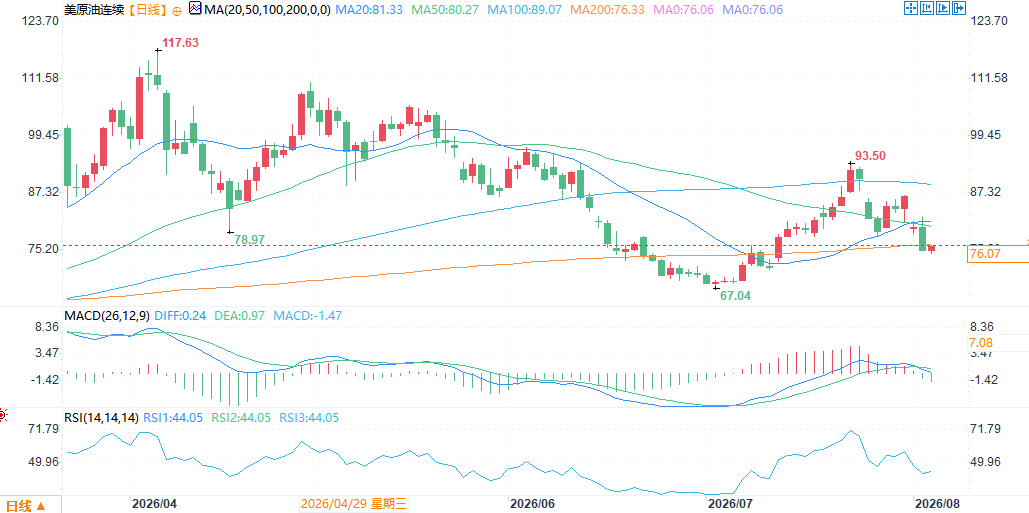 (US crude oil futures daily chart, source: FX678) At 15:32 Beijing time on August 5, US crude oil futures were trading at $76.10 per barrel.
Geopolitical signals: Negotiations are progressing well, but uncertainty remains.
The latest developments in US-Iran negotiations continue to influence oil prices. US President Trump stated on Wednesday that negotiations with Iran were "very productive." Axios reported that the US, Iran, and Oman are close to reaching a provisional agreement to reopen the Strait of Hormuz, with Washington aiming for a formal announcement on Wednesday. Iranian state television Press TV also reported that discussions with Oman have entered a "new phase," aiming to establish a "middle corridor" through this crucial waterway. However, uncertainty remains. According to data from Kpler, shipping traffic in the Strait of Hormuz and the Bab el-Mandeb Strait remained largely unchanged on Tuesday compared to the previous day. This indicates that even with positive diplomatic signals, actual navigation conditions have not seen substantial improvement. For oil prices, positive signals from US-Iran negotiations mean further pressure to clear geopolitical risk premiums; however, the lack of significant changes in shipping traffic and Iran's denial of direct negotiations provide some floor support for oil prices. The market is currently caught in a tug-of-war between "diplomatic optimism" and "realistic risks."Institutional View: The market is trying to "see through" the risks of conflict.
Analysts at Mitsubishi UFJ Financial Group, a well-known institution, pointed out that despite the ongoing geopolitical tensions, "the market is making every effort to see through the risk of a renewed conflict, pointing directly to the ultimate destination—and perhaps that's correct." They believe this forward-looking stance helps explain why oil prices have remained relatively restrained despite persistent geopolitical risks. This assessment accurately captures the core sentiment in the current market. After months of back-and-forth trading, traders have grown fatigued with the cycle of "Trump's rhetoric - Iran's denial," and the market is learning to price more rationally between verbal signals and actual supply disruptions. However, this does not mean that geopolitical risks have disappeared—any substantial escalation of conflict could still trigger a sharp reaction in oil prices.Summarize
Positive signals from US-Iran negotiations continued to clear geopolitical risk premiums, while the lack of substantial improvement in shipping volumes provided some floor support for oil prices. Mitsubishi UFJ Financial Group pointed out that the market is trying to "see through" the conflict risks, and this forward-looking stance explains the relative restraint of oil prices amid geopolitical turmoil. In the short term, oil prices are expected to maintain a weak and volatile pattern, with the market focusing on the actual progress of the interim US-Iran agreement and the guidance of EIA inventory data on supply and demand fundamentals. Before the agreement is confirmed or the situation escalates significantly, oil prices lack a catalyst for a trend-breaking directional move. (US crude oil futures daily chart, source: FX678) At 15:32 Beijing time on August 5, US crude oil futures were trading at $76.10 per barrel.
- Risk Warning and Disclaimer
- The market involves risk, and trading may not be suitable for all investors. This article is for reference only and does not constitute personal investment advice, nor does it take into account certain users’ specific investment objectives, financial situation, or other needs. Any investment decisions made based on this information are at your own risk.