Joint intervention is merely a symptom; the real weakness of the policy lies in long-term US Treasury bonds.
2026-08-05 17:22:52
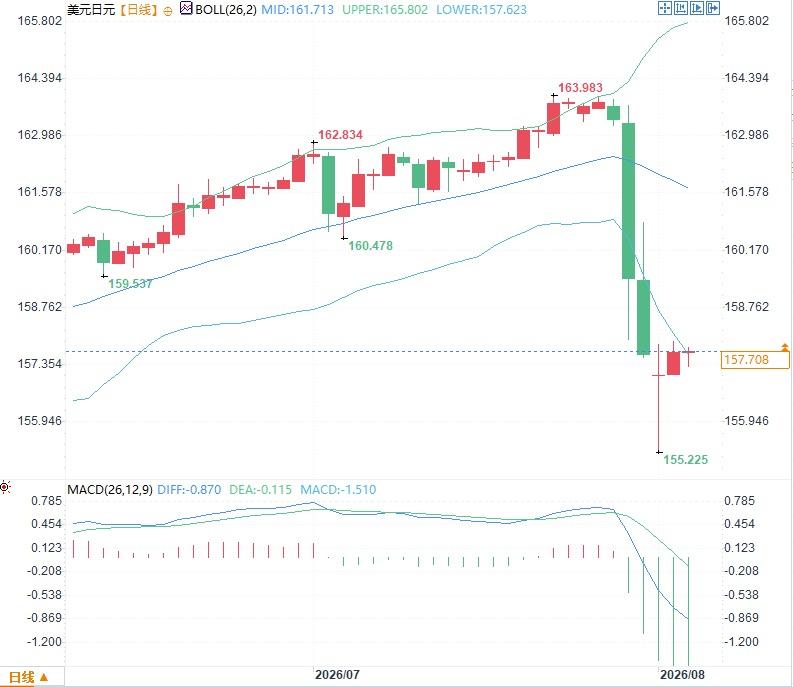
On Wednesday, August 5th, the USD/JPY pair was trading around 157.7, a significant drop from the pre-intervention high of 164, but still in its high range for decades. Previously, Japan and the US had unusually coordinated yen purchases, with Japan's intervention estimated at approximately 14 trillion yen over two days, while the US used euros for some yen purchases. Meanwhile, the yield on 10-year US Treasury bonds was around 4.60%, and the yield on 30-year bonds was around 5.15%, indicating that long-term financing costs remained high. This unprecedentedly close interplay between foreign exchange intervention, government bond liquidity, and reserve management raises the market's focus beyond just whether the yen can rebound; it also reveals why official funds are deliberately reducing their reliance on the sale of US Treasury bonds. The direct effect of the foreign exchange intervention is to force yen short covering, increase the cost for speculative short selling, and compress carry trade volume through increased volatility. This explains why the USD/JPY pair quickly fell from around 164 to the 157-158 range. However, approximately 14 trillion yen in the global foreign exchange market is insufficient to sustainably reshape trends. As long as the interest rate differential between Japan and the United States, the pressure of energy imports, and the real interest rate in Japan do not change fundamentally, the demand for yen created by intervention may still be offset by new asset allocation funds.  The Bank of Japan is currently maintaining its policy rate at around 1.0%. Its July outlook acknowledged that underlying inflation is approaching 2% and stated that it will continue to raise the policy rate if the economic and price paths follow expectations. However, pressure on Japanese household consumption and a high level of government debt mean that the pace of interest rate hikes is significantly constrained. The market thus faces a policy misalignment: the fiscal authorities want to quickly stabilize the exchange rate, while the monetary authorities need to control the impact of rising interest rates on consumption, fiscal policy, and the bond market. As long as this misalignment does not converge, intervention is more likely to alter the pace of exchange rate movements than to completely reverse their direction. The most noteworthy aspect of this action is not the coordinated intervention itself, but rather that the US did not primarily buy yen by selling dollar assets, but instead utilized its euro position in the Foreign Exchange Stabilization Account. This arrangement may include inventory facilities, but it also reduces the need for additional sales of US Treasury bonds during the intervention. When the yields on 10-year and 30-year US Treasury bonds are at approximately 4.60% and 5.15%, respectively, any large-scale selling from official reserve accounts could amplify term premiums and liquidity discounts. Especially given the simultaneous pressures on long-term supply, fiscal financing needs, and uncertainties in monetary policy communication, official authorities clearly do not want exchange rate stabilization efforts to translate into a new round of pressure on the government bond market. Japan has also indicated it may use the Federal Reserve's FIMA repurchase facility for foreign official institutions. This mechanism allows eligible official accounts to obtain short-term dollar liquidity by using their holdings of U.S. Treasury bonds as collateral, without having to sell bonds directly in the secondary market. Its essence is not selling reserves, but rather temporarily converting government bonds into cash.
  This arrangement serves a dual purpose. For Japan, it provides the liquidity needed for intervention, mitigating the price shock caused by concentrated sales of US Treasury bonds. For the US, it acts as a liquidity buffer for foreign official holders, preventing foreign exchange pressure from being transmitted to Treasury yields and financing conditions. However, from a trader's perspective, the willingness to use the tool itself is informative. Collateralized financing channels only become important when the market is concerned about the potential for significant shocks from spot bond sales. The FIMA tool is not evidence of a loss of liquidity in US Treasury bonds, but it does indicate that official institutions have begun to distinguish between "book saleable" and "sellable without disrupting prices." More significant changes occur at the marginal level. If official investors gradually believe that large-scale use of dollar reserves could push up long-term US yields, or that they need to rely on repurchase agreements to avoid price shocks during periods of market tension, then their new reserve allocations may become more diversified. This adjustment may first manifest as shortening duration and increasing the proportion of cash and highly liquid non-dollar assets, rather than concentrated sales of existing US Treasury bonds. This means that in the future, we need to observe not only the dollar index, but also the US Treasury term premium, the structure of overseas official holdings, the usage of the FIMA tool, and the Bank of Japan's interest rate hike path. What this intervention may truly change is not the exchange rate on a particular day, but rather the way the market measures the "usability" of official reserves.
The Bank of Japan is currently maintaining its policy rate at around 1.0%. Its July outlook acknowledged that underlying inflation is approaching 2% and stated that it will continue to raise the policy rate if the economic and price paths follow expectations. However, pressure on Japanese household consumption and a high level of government debt mean that the pace of interest rate hikes is significantly constrained. The market thus faces a policy misalignment: the fiscal authorities want to quickly stabilize the exchange rate, while the monetary authorities need to control the impact of rising interest rates on consumption, fiscal policy, and the bond market. As long as this misalignment does not converge, intervention is more likely to alter the pace of exchange rate movements than to completely reverse their direction. The most noteworthy aspect of this action is not the coordinated intervention itself, but rather that the US did not primarily buy yen by selling dollar assets, but instead utilized its euro position in the Foreign Exchange Stabilization Account. This arrangement may include inventory facilities, but it also reduces the need for additional sales of US Treasury bonds during the intervention. When the yields on 10-year and 30-year US Treasury bonds are at approximately 4.60% and 5.15%, respectively, any large-scale selling from official reserve accounts could amplify term premiums and liquidity discounts. Especially given the simultaneous pressures on long-term supply, fiscal financing needs, and uncertainties in monetary policy communication, official authorities clearly do not want exchange rate stabilization efforts to translate into a new round of pressure on the government bond market. Japan has also indicated it may use the Federal Reserve's FIMA repurchase facility for foreign official institutions. This mechanism allows eligible official accounts to obtain short-term dollar liquidity by using their holdings of U.S. Treasury bonds as collateral, without having to sell bonds directly in the secondary market. Its essence is not selling reserves, but rather temporarily converting government bonds into cash. This arrangement serves a dual purpose. For Japan, it provides the liquidity needed for intervention, mitigating the price shock caused by concentrated sales of US Treasury bonds. For the US, it acts as a liquidity buffer for foreign official holders, preventing foreign exchange pressure from being transmitted to Treasury yields and financing conditions. However, from a trader's perspective, the willingness to use the tool itself is informative. Collateralized financing channels only become important when the market is concerned about the potential for significant shocks from spot bond sales. The FIMA tool is not evidence of a loss of liquidity in US Treasury bonds, but it does indicate that official institutions have begun to distinguish between "book saleable" and "sellable without disrupting prices." More significant changes occur at the marginal level. If official investors gradually believe that large-scale use of dollar reserves could push up long-term US yields, or that they need to rely on repurchase agreements to avoid price shocks during periods of market tension, then their new reserve allocations may become more diversified. This adjustment may first manifest as shortening duration and increasing the proportion of cash and highly liquid non-dollar assets, rather than concentrated sales of existing US Treasury bonds. This means that in the future, we need to observe not only the dollar index, but also the US Treasury term premium, the structure of overseas official holdings, the usage of the FIMA tool, and the Bank of Japan's interest rate hike path. What this intervention may truly change is not the exchange rate on a particular day, but rather the way the market measures the "usability" of official reserves.
- Risk Warning and Disclaimer
- The market involves risk, and trading may not be suitable for all investors. This article is for reference only and does not constitute personal investment advice, nor does it take into account certain users’ specific investment objectives, financial situation, or other needs. Any investment decisions made based on this information are at your own risk.