Crude oil fell 14% this week, reaching a critical turning point! The 48-hour negotiation window holds hidden uncertainties for market movements.
2026-08-05 16:36:55
On Wednesday (August 5th) during the Asian and European sessions, international oil prices rebounded slightly, but still fell sharply by more than 14% this week. WTI crude oil is currently trading at 76.06, up 76.04. Boosted by optimistic expectations of a breakthrough in US-Iran negotiations and the imminent reopening of the Strait of Hormuz, the risk premium for international crude oil has fallen rapidly recently. Global markets are basking in the optimism surrounding US-Iran peace talks, and global capital markets have rebounded sharply in recent trading days. Although the market has further bet on optimism in terms of price, the news environment still presents both risks and crises. 
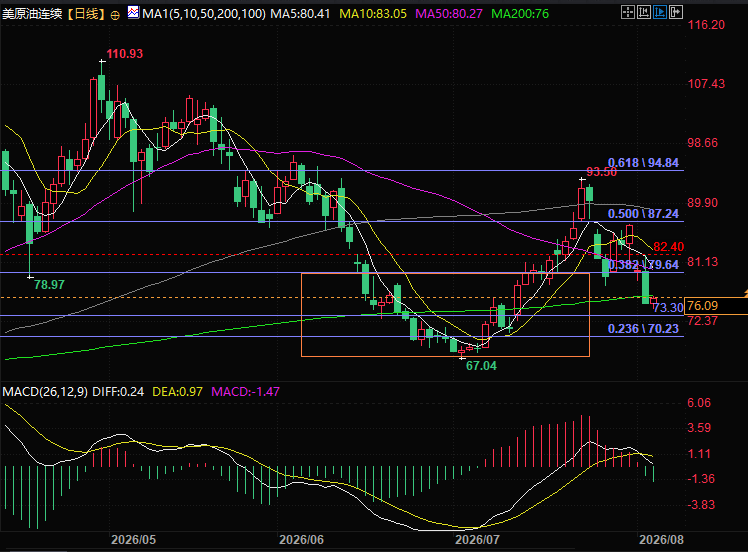 (WTI crude oil futures daily chart, source: EasyTrade) At 16:34 Beijing time, WTI crude oil futures contract is currently trading at $76.16 per ounce.
Major Turning Point in US-Iran Relations: Trump Grants 48-Hour Window, Using Both Hard and Soft Approaches to Push for Reopening of Straits Relations
The persistently tense geopolitical situation has seen a breakthrough in diplomatic relations, with market bets on the reopening of the Strait of Hormuz rising, directly driving down oil prices. Last night, Trump publicly stated repeatedly that the agreement to reopen the Strait of Hormuz could be finalized as early as Wednesday or Thursday, reaffirming substantial progress in the negotiations. In an interview with reporters in Los Angeles, he further released key signals, clarifying that the US-Iran negotiations are "progressing very well," and believing that Iran would make a very wise choice if it successfully reaches an agreement. He also officially announced that more key information about the negotiations would be released within the next 48 hours, drawing significant market attention. Trump fully disclosed the core background of this round of negotiations and the US's tough stance: the US had originally prepared for the largest military strike since World War II, but ultimately postponed the action after Iran proactively requested negotiations. He stated bluntly that it was the high-intensity military pressure from the US that forced Iran to sit down and engage in consultations. At the same time, Trump established a clear bottom line, emphasizing that Iran will never possess nuclear weapons, and this core demand will be written into the final agreement and formally confirmed in an official manner. On the issue of navigation in the Strait of Hormuz, Trump took a tough stance and made his position clear, stating that the Strait of Hormuz "will reopen soon." He added that if Iran refuses to cooperate, the US will launch a "very strong strike," forcibly opening the waterway by military means. He also warned Iran that if it subsequently reneges on its agreements and violates the consensus reached in negotiations, it will suffer a "severe blow" from the US, a consequence Iran is well aware of. Trump revealed that the US has already inflicted significant damage on Iran, but the real final blow has not yet been delivered, and the US still hopes to resolve the dispute through diplomatic means to avoid military escalation.The Middle East shipping crisis continues to escalate: US blockade and pressure, frequent safety incidents in the Strait of Hormuz and Red Sea shipping lanes.
As a vital global energy chokepoint, the Strait of Hormuz carries approximately one-fifth of the world's oil and gas exports. Since the joint US-Israeli attack on Iran on February 28, this waterway has been continuously disrupted, with shipping traffic nearly halted, continuously pushing up the geopolitical risk premium for international crude oil. The latest report from the US Central Command on August 4 stated that the US is still strictly enforcing its maritime blockade policy against Iran. As of that day, it had forced 45 merchant ships to change their routes, causing two ships to completely lose their navigation capabilities, and completed boarding inspections on two other vessels. Currently, the situation remains tense along several key shipping routes in the Middle East, with security risks surging. On Tuesday, two serious shipping incidents occurred in quick succession: an Indian-flagged merchant ship was attacked and sunk by an explosive speedboat in the Red Sea near Yemen; fortunately, the Yemeni Coast Guard successfully rescued 13 Indian crew members and 1 Yemeni crew member. Simultaneously, a cargo ship in the Strait of Hormuz was attacked by an unidentified projectile, sustaining damage. In addition, the Houthi rebels in Yemen, supported by Iran, have continued to escalate their interference in shipping, having previously announced the closure of the Bab el-Mandeb Strait to Saudi-affiliated vessels in retaliation for Saudi blockade and airstrikes, further exacerbating the instability of the Middle East shipping system.Ioman proposed a joint management plan for the waterways: separate navigation and toll-based operation and maintenance, which was strongly rejected by the United States.
The core draft of this round of negotiations, negotiated and formulated by Iran and Oman, established a clear waterway control system: all ships entering the Persian Gulf will use the Iranian-controlled waterway, while ships leaving the Persian Gulf will use the Oman-controlled waterway. A special service fee will be set aside for waterway security and maintenance, route support, and marine ecological protection. This plan aims to clarify the rights and responsibilities of the two countries regarding the waterways and quickly restore navigation order. However, this joint management plan has been strongly opposed and completely rejected by the United States. The Trump administration has consistently maintained its bottom line, refusing to accept any agreement that would grant Iran control of the Strait of Hormuz, fearing it would set a dangerous international precedent. Trump himself has publicly rejected a toll collection mechanism for the strait, stating firmly that if either side attempts to collect tolls, the US will take reciprocal measures in response. Several regional officials revealed that the negotiations are still in a deep game, the final agreement text is subject to significant changes, and all agreements are rigidly tied to the precondition of "the US lifting the blockade of Iranian ports."There are clear differences in the statements made by the US and Iran: the US has officially announced negotiations, while Iran denies direct contact.
Despite numerous positive signals from the US, significant contradictions remain between the public statements of the two sides, and the negotiation situation harbors inherent uncertainty. US Secretary of State Rubio confirmed progress in the consultations but emphasized that no final consensus has been reached, and the situation remains unresolved. He also reiterated his warning that transferring control of the Strait of Hormuz to Iran would create significant risks to the global geopolitical landscape. US Treasury Secretary Bessenter optimistically predicted that a Straits opening agreement is highly likely to be reached within the next two days, gradually normalizing the Middle East conflict. Trump further outlined the negotiation phases, clarifying that this round of consultations is divided into two main phases: the first phase's core objective is to open the Strait of Hormuz and restore normal navigation; the second phase focuses on advancing the Iranian denuclearization issue, completely resolving the nuclear dispute, and stated that this is Iran's "last window of opportunity" to avoid a new round of large-scale US military escalation. In contrast, Iranian officials have consistently denied conducting direct negotiations with the US, emphasizing that all consultations were conducted through Oman and without direct contact with the US. The Iranian Foreign Ministry stated that the core of this round of negotiations is to establish a two-way safe shipping route that balances the sovereign rights and national security of both countries, and the final result will be officially announced after the consultations are fully completed.Iran's internal stance is showing signs of softening and divergence: European involvement in mine clearance may be allowed, but the Revolutionary Guard opposes this.
During the diplomatic negotiations, Iran's unusually softened stance has become a potential key positive factor in pushing the agreement to fruition. Multiple diplomatic sources revealed that Iran is considering allowing European countries to participate in mine-clearing operations in the Strait of Hormuz. This matter is expected to be included in the final negotiated agreement, helping to quickly clear obstacles to the waterway, restore shipping traffic, and create favorable conditions for a reconciliation between the US and Iran. Previously, Iran's public stance was extremely hardline, consistently rejecting any foreign involvement in the Strait's mine-clearing operations. However, in recent weeks of closed-door consultations, Tehran's attitude has gradually softened. It is understood that the implementation of the European mine-clearing plan has two major prerequisites: first, Iran must provide security guarantees for the European naval vessels participating in the operation; second, the US and Iran must maintain a ceasefire and stability. At the same time, the plan must be approved by the Islamic Revolutionary Guard Corps (IRGC), the powerful armed force in Iran that has led attacks on merchant ships in the Strait, making its implementation extremely difficult. However, the approach of mine-clearing vessels signifies a significant compromise by the IRGC. Some factions within the IRGC firmly oppose foreign intervention, insisting that the Strait's mine-clearing work must be entirely carried out independently by Iran. This disagreement has become a significant internal obstacle to the agreement's implementation, and the European mine-clearing plan currently lacks absolute guarantee of its success. This is also a key point for future observation: whether European forces will intervene in mine clearance. This also indicates that there are indeed significant differences in the positions of two factions within Iran; the Revolutionary Guard demands civilian involvement in negotiations but is unwilling to compromise itself.The core motivation for the US negotiations: domestic pressures compounded by the costs of war, making it urgent to end the conflict and stabilize oil prices.
The Trump administration's active promotion of diplomatic reconciliation and abandonment of military strikes stems from multiple real-world pressures. The current Middle East war has resulted in low public opinion and support in the United States, while the ongoing conflict continues to drive up international gasoline and crude oil prices, exacerbating domestic inflationary pressures. Simultaneously, the approaching US midterm elections add to the pressure on public opinion, livelihoods, and the election, and the protracted conflict is depleting US ammunition reserves, which is detrimental to the US strategic plan. Therefore, Trump's recent stance has been fluctuating, simultaneously releasing military deterrent signals and threatening heavy strikes while embracing diplomatic negotiations and efforts to de-escalate the situation. Meanwhile, Qatar has actively mediated, with its Emir engaging in in-depth discussions with Trump, actively bridging the differences between the US and Iran, and helping to promote a sustainable diplomatic solution to this Middle East crisis.Summary and Technical Analysis: Expectations drove oil prices down, but uncertainty remains.
From a long-term market perspective, the current decline in oil prices is entirely driven by expectations surrounding the negotiations. Actual navigation in the Strait of Hormuz has not yet truly resumed, and the situation remains highly uncertain. The core variable for future oil price movements depends on the progress of the agreement's implementation: key points to watch include whether negotiations are successfully concluded within the 48-hour window, the official reopening of the strait, and whether a European fleet participates in minesweeping in the Strait of Hormuz. These details will determine whether oil prices can remain low. If negotiations break down, Iran reneges, or tensions between the US and Iran escalate again, leading to a military conflict in the Middle East, the geopolitical risk premium for oil will rebound rapidly, and oil prices will resume their upward trend. Overall, this round of negotiations involves multiple interests, with intertwined variables such as domestic demands in the US, internal divisions within Iran, disputes over strait control, and the constraints of denuclearization clauses. The implementation of the agreement faces significant obstacles, and the Middle East energy landscape and oil prices will likely remain highly volatile. Technical Analysis: WTI oil prices have currently fallen below the 200-day moving average, with support at 73.3 and below that at 70.26. The market has recently slowed down as it bets on the prospects of US-Iran peace talks, and the current expectation is that the talks will proceed more slowly. Any outcome of the talks falling short of expectations would likely lead to a rebound in oil prices, with the current resistance level around 77.5. (WTI crude oil futures daily chart, source: EasyTrade) At 16:34 Beijing time, WTI crude oil futures contract is currently trading at $76.16 per ounce.
- Risk Warning and Disclaimer
- The market involves risk, and trading may not be suitable for all investors. This article is for reference only and does not constitute personal investment advice, nor does it take into account certain users’ specific investment objectives, financial situation, or other needs. Any investment decisions made based on this information are at your own risk.