Employment data deteriorates marginally: Fed hawks remain on the sidelines
2026-08-05 20:58:52
On Wednesday (August 5th) during the European and American trading sessions, the US dollar index reversed its gains and fell sharply by 15 points to trade around 99.68 following the release of the ADP (non-farm payrolls) data. The latest US July ADP employment report presented an extremely complex "two-sided characteristic": on one hand, a sharp slowdown in hiring momentum, and on the other hand, an unexpected rebound in wages for job-hoppers. Against the backdrop of slightly cooling inflation, this data not only shows signs of economic cooling but also sows the seeds of sticky inflation in the service sector. Combined with the latest hawkish statements from Federal Reserve officials (such as Kashkari), the market's speculation on the future path of Federal Reserve interest rates is entering a highly sensitive "fine-tuning period." 
 The slowdown in total employment (44,000) will initially boost market expectations for interest rate cuts and lower US Treasury yields; however, the "7% increase in job-hopping wages," which the market subsequently analyzes, will quickly narrow this optimism, leading to sharp two-way fluctuations in asset prices. The ultimate battle will be the non-farm payrolls report: the industry divergence in ADP (such as the decline in leisure and dining and the rise in the financial sector) suggests that the cooling of the US economy is uneven. The market will next focus all its attention on the upcoming official non-farm payrolls (NFP) report. If the non-farm payrolls report also confirms "firm hourly wages + slowing growth," the Fed's hawkish wait-and-see approach of "higher for longer" or "cautious small-step testing" will be difficult to break.
 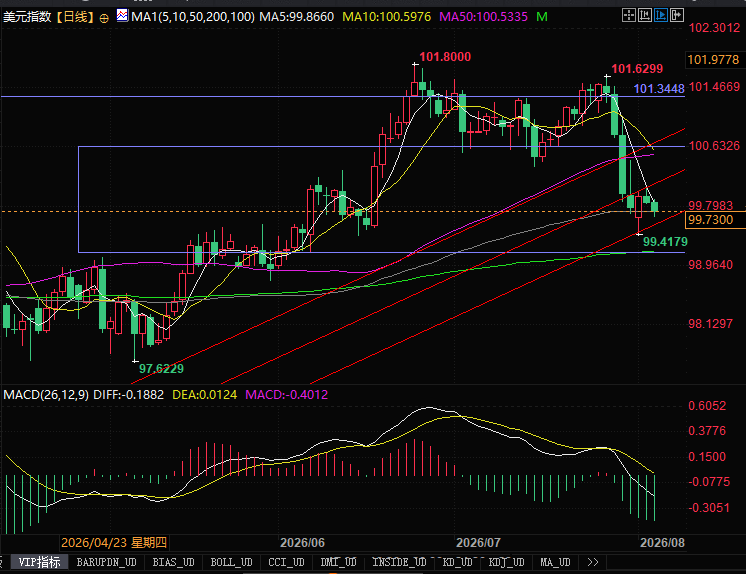 (US Dollar Index Daily Chart, Source: FX678) At 20:54 Beijing time, the US Dollar Index is currently at 99.73.
A comprehensive data analysis: Toutiao's cooling down and its internal structure exhibiting a "triple divergence."
The core characteristics of the July ADP data can be summarized as: overall slowdown, industry divergence, and resilient wages. Overall hiring momentum has slowed significantly, with growth highly concentrated in the service sector. The private sector added only 44,000 jobs in July, a sharp drop from the revised 95,000 in June, indicating a significant contraction in hiring intentions across the US. Sectoral divergence is evident: goods-producing sectors lost 3,000 jobs (manufacturing added only 2,000, and construction a slight increase of 1,000), while the service sector alone contributed 47,000 new jobs. Within the service sector, there is uneven performance. While financial services (+10,000) and professional/business services (+9,000) showed some recovery, leisure and hospitality saw a sharp drop of 11,000, and trade/transportation/utilities lost 8,000. The loss of personnel in experiential services, a crucial vehicle for consumption, signals that high interest rates are eroding end-user demand. Wage growth unexpectedly accelerated, and the "tail effect" of labor shortages persists. Compared to the decrease in quantity, the resilience of prices (wages) is the biggest variable in this report: Job Stayers: Annualized salary growth remained at 4.4%, indicating that basic salaries within companies remain highly rigid. Job Switchers: Year-on-year salary growth accelerated to 7.0%, marking the fastest growth rate since August 2025. By industry: The median annualized salary growth rate in core industries such as manufacturing (5.0%) and financial services (5.2%) both saw slight increases compared to June (professional/business services remained flat at 4.1%). This means that although companies are hiring less (quantity reduction), they still have to offer premiums as high as 7% (price increase) to attract experienced core talent. This implies that the structural shortage in the labor market has not been completely resolved, and the risk of "wage-price stickiness" continues to prevent inflation from rapidly returning to zero.Profound impact on Federal Reserve policy and interest rate hike expectations
Combining the latest statements from Federal Reserve hawk Neel Kashkari—"preferring small steps now rather than waiting," "not calling for large rate hikes, but remaining open to them," and "clear response mechanisms"—we can glean the Fed's current policy mindset: First, shrinking employment data suppresses the possibility of a large rate hike, but wage growth remaining high at 4.4% locks in the door to rapid rate cuts, while the threshold for rate hikes has also increased. The ADP employment report, showing a decrease from 95,000 new jobs to 44,000, confirms that high borrowing costs are indeed curbing economic expansion. Fed officials cannot ignore the risk of a slowdown in the labor market, which corresponds to Kashkari's explicit statement that he "does not call for large rate hikes." However, the 7% wage growth for job-hoppers and the rise in wages in manufacturing and finance have made the Fed extremely concerned that service sector inflation might "resurface." As long as wage growth does not completely fall back to the historical anchor range of 3.5%-4.0%, the Fed will find it difficult to confidently launch a large-scale rate cut. Policy Direction Analysis: From "Big Cuts" to "Small Steps" Kashkari's mention of "preferring small steps" and "not believing in a fixed number of meetings" reflects the Fed's current refined operational approach: Policy Bias: The Fed's current ideal is to maintain high interest rates while using very small policy adjustments (such as a single 25 basis point trial move or extending the observation period) to guide the market, rather than slamming on the brakes or accelerating sharply. Data-Driven Response Mechanism: The contradiction of "weak employment, strong wages" presented by the ADP report will force the Fed to rely more heavily on subsequent official non-farm payroll (NFP) and CPI data. The Fed needs to confirm whether this wage rebound is merely temporary noise or a structural inflection point.Summary and Market Outlook
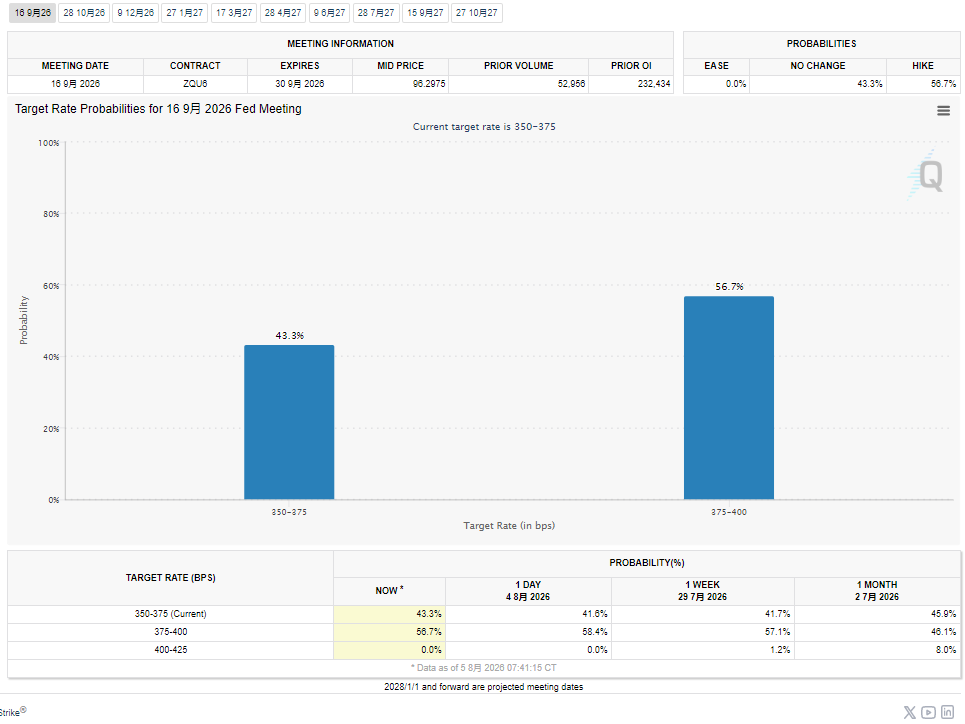
In summary, the July ADP report presents a picture of a declining economy and lingering tail risks to inflation. Previously, the Federal Reserve focused on when to raise interest rates because of a robust labor market, requiring only consideration of inflation. However, the current slowdown in job growth indicates a loosening of the overarching premise of a robust labor market that fueled the focus on rate hikes. This gradual easing will eventually lead to a turning point, at least shifting from expectations of rate hikes to maintaining current interest rates. Consequently, the dollar index fell, while gold rose by over 3%. Currently, CME interest rate futures indicate a new recent low in the probability of a September rate hike, dropping from nearly 80% to 56%. The slowdown in total employment (44,000) will initially boost market expectations for interest rate cuts and lower US Treasury yields; however, the "7% increase in job-hopping wages," which the market subsequently analyzes, will quickly narrow this optimism, leading to sharp two-way fluctuations in asset prices. The ultimate battle will be the non-farm payrolls report: the industry divergence in ADP (such as the decline in leisure and dining and the rise in the financial sector) suggests that the cooling of the US economy is uneven. The market will next focus all its attention on the upcoming official non-farm payrolls (NFP) report. If the non-farm payrolls report also confirms "firm hourly wages + slowing growth," the Fed's hawkish wait-and-see approach of "higher for longer" or "cautious small-step testing" will be difficult to break. (US Dollar Index Daily Chart, Source: FX678) At 20:54 Beijing time, the US Dollar Index is currently at 99.73.
- Risk Warning and Disclaimer
- The market involves risk, and trading may not be suitable for all investors. This article is for reference only and does not constitute personal investment advice, nor does it take into account certain users’ specific investment objectives, financial situation, or other needs. Any investment decisions made based on this information are at your own risk.