Why is the market still hesitant to bet on a policy shift despite Kashkari's sudden downgrade?
2026-08-05 21:00:52
On Wednesday, August 5th, the US dollar index was fluctuating around 99.70, with a daily decline of approximately 0.13%. The latest private employment data significantly missed market expectations, but wage structure did not cool down accordingly. Coupled with Federal Reserve officials downplaying aggressive rate hike statements, the interest rate market is not facing a single easing signal, but rather a complex combination of weakening employment, persistent wage stickiness, and supply shocks pushing up inflation. 
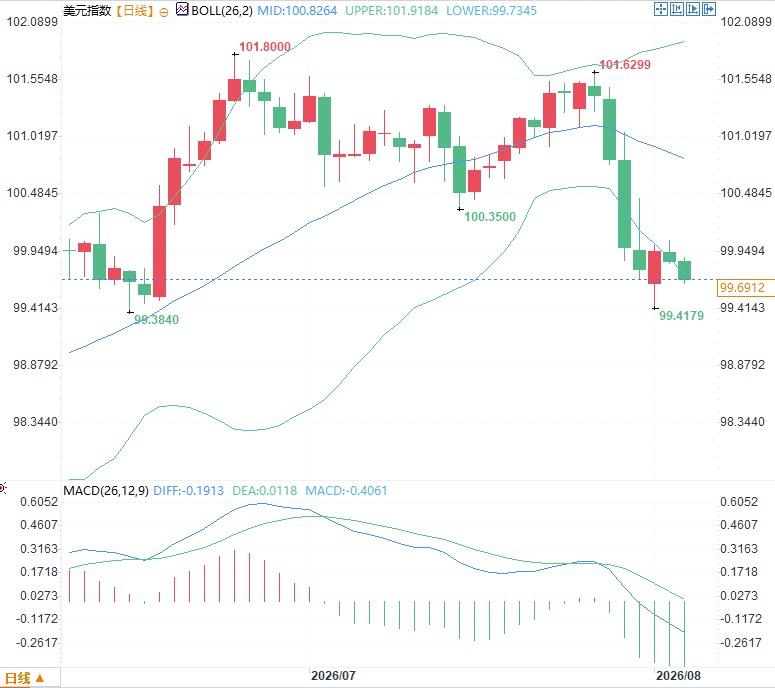 In the MACD indicator, the fast line is below the slow line, and the histogram is in negative territory, indicating that the momentum generated by the previous pullback from the high has not yet fully converged. However, once the price deviates from the lower Bollinger Band, the indicator is easily affected by short-term fluctuations, data releases, and changes in liquidity.
Employment growth has plummeted, and the labor market has entered a period of low mobility.
U.S. private sector added 44,000 jobs in July, lower than the market expectation of 70,000 and significantly slower than the revised 95,000 in June, marking the weakest increase in nearly six months. This follows job gains of 122,000 in May and 98,000 in June, indicating a weakening willingness among businesses to expand hiring. The industry structure is more noteworthy than the total number of jobs added. Education and healthcare added 36,000, financial services added 10,000, and construction added only 1,000; trade, transportation, and utilities lost 8,000, and leisure and hospitality lost 11,000. New jobs were highly concentrated in sectors with strong demand and close ties to public spending, while cyclical service industries and the distribution of goods contracted. This suggests that the job market is not experiencing a complete slowdown, but rather that job creation capacity is becoming more concentrated, and businesses are more cautious about discretionary consumption and business expansion. This situation can be summarized as low hiring and low layoffs. While companies have not yet engaged in large-scale layoffs, their incentive to fill positions and expand teams has decreased. For financial markets, low hiring will weaken the increase in household income, but it will not immediately change the unemployment rate like rapid layoffs. Therefore, the transmission of employment data to interest rate expectations may be slower and more dependent on subsequent official employment, working hours and unemployment claims data for confirmation.Wage disparity reveals inflation stickiness; weak employment does not equate to weak prices.
Wage growth for retained employees remained at 4.4% year-on-year, while wage growth for those changing jobs rose from 6.6% to 7.0%. The simultaneous decline in employment and accelerated wage growth during job changes is the most policy-significant combination in this data. Job-change wages are typically more sensitive to immediate labor supply and demand. The fact that companies are reducing hiring overall, yet still paying higher premiums for some in-demand positions, indicates a clear stratification within the labor market. Healthcare, professional and technical, and specific service positions may still face skills mismatches, while low-value-added service industries are reducing employment. Nera Richardson, chief economist at a relevant institution, stated that job-change workers are highly sensitive to the real-time economic environment, and their rapid wage growth reflects continued supply constraints in parts of the labor market. This also explains why weak job growth cannot be directly equated with the disappearance of inflationary pressures. If wage growth consistently exceeds productivity improvements, companies may absorb costs through prices, profit margins, or staffing. Current data more closely resembles a cooling of labor demand, but supply constraints have not been completely eliminated, rather than a typical rapid contraction in demand.Kashkari softens radical rhetoric, shifting policy focus to reaction functions.
Minneapolis Federal Reserve President Neal Kashkari recently stated that the Fed's goal is not to suppress economic activity, but to reduce inflation, and explicitly stated that he is not advocating for a significant increase in interest rates. He believes that recent inflation is mainly due to supply shocks, coupled with some demand pressures, and remains open to the number of meetings and communication methods. The key point of this statement is not a shift towards a dovish stance, but a rejection of a mechanical policy path. The Fed's current target range for the federal funds rate remains at 3.50% to 3.75%, and the official report also points out that inflation remains above the 2% target, with some price pressures stemming from supply shocks in sectors such as energy. Supply-side inflation presents a policy dilemma. Raising interest rates cannot directly increase the supply of energy, transportation, or labor, but may suppress other demands, thereby indirectly balancing price pressures. Therefore, policy communication is beginning to emphasize the reaction function, that is, how policymakers weigh the duration of inflation, wage diffusion, the degree of employment slowdown, and inflation expectations, rather than making pre-promised fixed numbers of rate hikes.Technical indicators suggest a shift in the volatility structure, with momentum still in the release phase.
Observing the daily chart, the US dollar index has fallen below the Bollinger Band middle line after retreating from around 101.80, and is currently trading near the lower line. The Bollinger Band middle line is approximately 100.83, and the lower line is approximately 99.73. The price briefly fell below the lower line during the session, reflecting a significant expansion in short-term volatility. In the MACD indicator, the fast line is below the slow line, and the histogram is in negative territory, indicating that the momentum generated by the previous pullback from the high has not yet fully converged. However, once the price deviates from the lower Bollinger Band, the indicator is easily affected by short-term fluctuations, data releases, and changes in liquidity.
- Risk Warning and Disclaimer
- The market involves risk, and trading may not be suitable for all investors. This article is for reference only and does not constitute personal investment advice, nor does it take into account certain users’ specific investment objectives, financial situation, or other needs. Any investment decisions made based on this information are at your own risk.