The yen traded in a consolidation phase as traders weighed weak U.S. data against market sentiment.
2026-08-06 01:18:53
On Wednesday (August 5), the USD/JPY pair traded around 157.748 during the US session. Despite a general weakening of the US dollar, the pair was essentially flat for the day. US private sector employment data fell short of expectations, and service sector activity cooled slightly.  The market continues to focus on the progress of US-Iran negotiations, while the yen is supported by expectations of the Bank of Japan's policy. The USD/JPY pair traded around 157.748, with limited intraday volatility. The dollar faces downward pressure, but investor caution regarding the yen offsets the impact of a weaker dollar. The dollar continued to be pressured after a series of weaker-than-expected US economic data releases. The ADP report showed that the US private sector added 44,000 jobs in July, lower than the market expectation of 70,000, and compared to 98,000 in June. Meanwhile, the Institute for Supply Management (ISM) released its July services purchasing managers' index (PMI) at 54.1, slightly below the expected 54.5. Although the services sector remained in expansion territory, the employment sub-index fell to 47.4 from 51.2, reflecting a weakening hiring environment. Other reports indicated that the US Treasury lifted some sanctions against Iran, removing restrictions on two aircraft and three airlines, a move seen as a signal of progress in US-Iran negotiations. Other reports indicate that Oman and Iran have finalized a draft agreement, awaiting Tehran's approval, which has improved overall market risk sentiment. In Japan, investors are still studying the minutes of the Bank of Japan's June monetary policy meeting. Although these minutes predate the latest monetary policy moves, they show that policymakers were already discussing whether further interest rate hikes were necessary to address inflation risks. Bank of Japan Governor Kazuo Ueda has repeatedly stated that the central bank will continue to normalize monetary policy if economic conditions permit, providing underlying support for the yen. Meanwhile, surveys show that the vast majority of foreign exchange strategists believe that further intervention by the Japanese authorities alone is unlikely to provide sustained support for the yen. This further confirms the view that the yen's long-term trend depends primarily on the Bank of Japan's monetary policy outlook and the interest rate differential between Japan and the US. The probability of a Bank of Japan (BOJ) rate hike has increased, and US intervention has set an upside ceiling for the USD/JPY pair, providing support for the yen. Brown Brothers Harriman (BBH) strategists noted, "USD/JPY is currently hovering below its 200-day moving average (158.04)." Strong Japanese wage data has fueled market expectations for further tightening by the BOJ. The bank stated, "Accelerated wage growth in Japan has increased market bets on a BOJ rate hike." Nominal total wages in Japan rose 3.4% year-on-year in June, in line with market expectations, compared to 3.2% in May; while the less volatile fixed wages for full-time employees accelerated to 2.9% year-on-year, a four-month high, exceeding the market expectation of 2.7%, compared to 2.5% in May. Regarding interest rate pricing, Brown Brothers Harriman noted, "Before the wage data release, the market's implied probability of a 25 basis point rate hike to 1.25% by the BOJ at its September 18th policy meeting had fallen as low as nearly 40%, but has now climbed to 60%."
 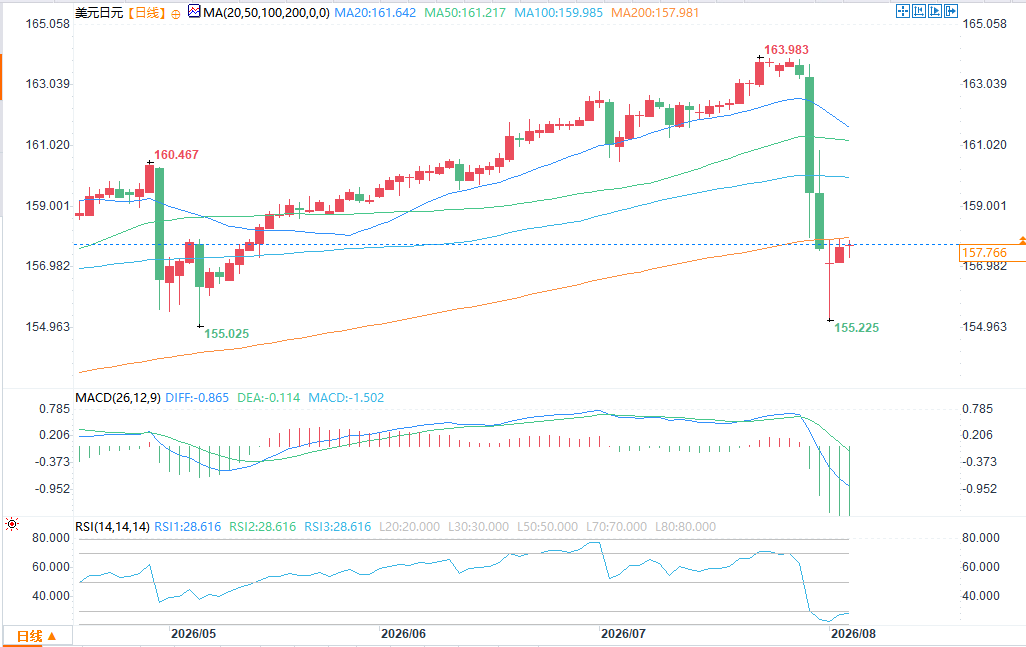 (USD/JPY Daily Chart Source: EasyTrade) The bank acknowledged that "Japan's core inflation remains moderate," but also believes that "there is a risk of further repricing in the market, leaning towards a hawkish stance from the Bank of Japan, which is beneficial to the yen." Their reasoning is: "Japan's policy rate is near the lower end of the central bank's neutral rate range (1.10%-2.50%), while the Japanese economy is already operating above its potential output level." On the policy front, Brown Brothers Harriman also interpreted recent official signals. The report stated: "US Treasury Secretary Scott Bessant indirectly confirmed yesterday that in last Friday's joint US-Japan intervention, the US bought yen with euros, not by selling dollars." Bessant stated that he assured Europe that the intervention was merely a restructuring of US foreign exchange reserves; he also said, "In my view, the euro price is very close to equilibrium." Brown Brothers Harriman also admitted, "The daily turnover of the yen foreign exchange market is as high as $1.61 trillion, and the scale of the aforementioned foreign exchange reserve operations is limited and insufficient to completely reverse the yen's trend." However, the bank emphasized, "The policy signal released by this intervention is of great significance." In the bank's view, this policy stance "significantly raises the transaction cost of shorting a stronger yen, establishing a more solid upward ceiling for the USD/JPY exchange rate."
The market continues to focus on the progress of US-Iran negotiations, while the yen is supported by expectations of the Bank of Japan's policy. The USD/JPY pair traded around 157.748, with limited intraday volatility. The dollar faces downward pressure, but investor caution regarding the yen offsets the impact of a weaker dollar. The dollar continued to be pressured after a series of weaker-than-expected US economic data releases. The ADP report showed that the US private sector added 44,000 jobs in July, lower than the market expectation of 70,000, and compared to 98,000 in June. Meanwhile, the Institute for Supply Management (ISM) released its July services purchasing managers' index (PMI) at 54.1, slightly below the expected 54.5. Although the services sector remained in expansion territory, the employment sub-index fell to 47.4 from 51.2, reflecting a weakening hiring environment. Other reports indicated that the US Treasury lifted some sanctions against Iran, removing restrictions on two aircraft and three airlines, a move seen as a signal of progress in US-Iran negotiations. Other reports indicate that Oman and Iran have finalized a draft agreement, awaiting Tehran's approval, which has improved overall market risk sentiment. In Japan, investors are still studying the minutes of the Bank of Japan's June monetary policy meeting. Although these minutes predate the latest monetary policy moves, they show that policymakers were already discussing whether further interest rate hikes were necessary to address inflation risks. Bank of Japan Governor Kazuo Ueda has repeatedly stated that the central bank will continue to normalize monetary policy if economic conditions permit, providing underlying support for the yen. Meanwhile, surveys show that the vast majority of foreign exchange strategists believe that further intervention by the Japanese authorities alone is unlikely to provide sustained support for the yen. This further confirms the view that the yen's long-term trend depends primarily on the Bank of Japan's monetary policy outlook and the interest rate differential between Japan and the US. The probability of a Bank of Japan (BOJ) rate hike has increased, and US intervention has set an upside ceiling for the USD/JPY pair, providing support for the yen. Brown Brothers Harriman (BBH) strategists noted, "USD/JPY is currently hovering below its 200-day moving average (158.04)." Strong Japanese wage data has fueled market expectations for further tightening by the BOJ. The bank stated, "Accelerated wage growth in Japan has increased market bets on a BOJ rate hike." Nominal total wages in Japan rose 3.4% year-on-year in June, in line with market expectations, compared to 3.2% in May; while the less volatile fixed wages for full-time employees accelerated to 2.9% year-on-year, a four-month high, exceeding the market expectation of 2.7%, compared to 2.5% in May. Regarding interest rate pricing, Brown Brothers Harriman noted, "Before the wage data release, the market's implied probability of a 25 basis point rate hike to 1.25% by the BOJ at its September 18th policy meeting had fallen as low as nearly 40%, but has now climbed to 60%." (USD/JPY Daily Chart Source: EasyTrade) The bank acknowledged that "Japan's core inflation remains moderate," but also believes that "there is a risk of further repricing in the market, leaning towards a hawkish stance from the Bank of Japan, which is beneficial to the yen." Their reasoning is: "Japan's policy rate is near the lower end of the central bank's neutral rate range (1.10%-2.50%), while the Japanese economy is already operating above its potential output level." On the policy front, Brown Brothers Harriman also interpreted recent official signals. The report stated: "US Treasury Secretary Scott Bessant indirectly confirmed yesterday that in last Friday's joint US-Japan intervention, the US bought yen with euros, not by selling dollars." Bessant stated that he assured Europe that the intervention was merely a restructuring of US foreign exchange reserves; he also said, "In my view, the euro price is very close to equilibrium." Brown Brothers Harriman also admitted, "The daily turnover of the yen foreign exchange market is as high as $1.61 trillion, and the scale of the aforementioned foreign exchange reserve operations is limited and insufficient to completely reverse the yen's trend." However, the bank emphasized, "The policy signal released by this intervention is of great significance." In the bank's view, this policy stance "significantly raises the transaction cost of shorting a stronger yen, establishing a more solid upward ceiling for the USD/JPY exchange rate."
- Risk Warning and Disclaimer
- The market involves risk, and trading may not be suitable for all investors. This article is for reference only and does not constitute personal investment advice, nor does it take into account certain users’ specific investment objectives, financial situation, or other needs. Any investment decisions made based on this information are at your own risk.