A rebounding US dollar put pressure on gold prices, which were capped at the $4,300 level as the Fed's hawkish rhetoric and geopolitical shifts combined, awaiting guidance from the non-farm payrolls report.
2026-08-06 14:30:53
The international gold market has recently experienced a volatile price movement. Gold prices climbed to $4303.90 per ounce earlier in the Asian session on Thursday (August 6th), the highest level since June 18th of this year, demonstrating strong upward resilience. However, the bulls failed to consolidate this breakthrough into a sustained offensive, and gold prices subsequently retreated moderately from their seven-week high, currently fluctuating fiercely around the $4260 per ounce level. The core factor hindering this round of gold price increases is that the US dollar index, after a period of weakness, found some buying support during the day, resulting in a slight rebound. Since gold is a non-interest-bearing asset denominated in US dollars, a stronger dollar usually has a direct suppressive effect on gold prices, as it increases the opportunity cost for non-dollar currency holders to purchase gold and weakens its short-term appeal as a safe-haven asset. 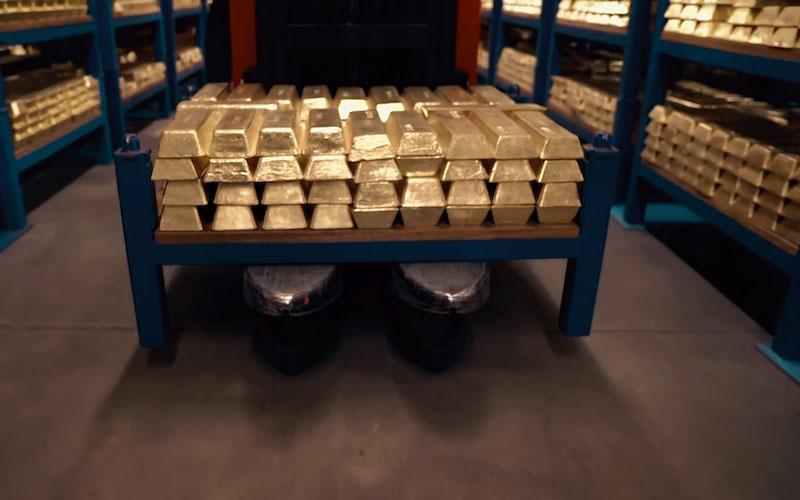
 (Spot gold daily chart, source: FX678)
Policy battleground: Fed officials speak out in quick succession, inflation concerns keep interest rate hike expectations high.
A deeper analysis from a policy perspective reveals that several high-ranking Federal Reserve officials have recently delivered public speeches, all pointing to a common theme: the persistent risk of inflation in the United States should not be underestimated. The resilience of the labor market and potential disruptions to the supply chain could cause prices to fall more slowly than previously expected. This series of cautious, even hawkish, remarks has reignited market concerns that the Fed may be forced to further tighten monetary policy, thus providing additional upward momentum for the dollar and significantly limiting the upside potential of gold, a non-interest-bearing asset. Specifically, in a recent public speech, Federal Reserve Governor Lisa Cook explicitly stated that although overall inflation has declined from its peak, current inflation readings remain too high and are significantly far from the Fed's long-term target of 2%. She emphasized that if the decline in inflation stalls or even reverses in the coming months, she personally would not hesitate to support further increases in benchmark interest rates. Cook also warned that central banks cannot remain inactive indefinitely, waiting for inflation to subside on its own, until price pressures show a clear and sustainable path to easing. Such a passive stance could significantly increase subsequent governance costs. Meanwhile, San Francisco Fed President Mary Daly expressed a similar view around the same time , but she emphasized the data needed for decision-making. Daly pointed out that the current US economy is in a complex macroeconomic environment, and officials need to review more fresh data covering employment, consumer spending, and prices to make a more accurate judgment at the September policy meeting—whether the current inflation is due to a combination of temporary factors or has evolved into a more persistent structural inflation. This uncertainty itself is enough to make investors cautious about the future of gold. Furthermore, from a market pricing perspective, traders still believe that the probability of the Fed raising interest rates at least once more before the end of this year remains at around 80%. One of the key supporting factors for this expectation is the potential risk of imported inflation caused by supply chain disruptions in the Red Sea region. The disruption to shipping routes has not only driven up global transportation costs for energy and commodities, but has also put new upward pressure on prices of consumer goods, thereby reinforcing the necessity for central banks to maintain a tight stance.Geopolitical variables: Red Sea conflict and diplomatic glimmer coexist; oil price fluctuations indirectly affect the gold market.
At the geopolitical level, the evolving situation in the Middle East has also injected complex variables into the gold market. The Iranian-backed Houthi rebels in Yemen recently claimed responsibility for launching missiles at an oil tanker near the Saudi port of Yanbu and another merchant ship in the Gulf of Aden, undoubtedly escalating tensions in Red Sea shipping security . However, quite subtly, despite these recurring attacks, investors remain optimistic about the possibility of a peace agreement between the US and Iran and the reopening of the Strait of Hormuz. This optimism has largely curbed further increases in international oil prices, keeping them near their recent lows. More importantly, Iran revealed on Wednesday that it is in the final stages of finalizing a draft agreement with Oman regarding the Strait of Hormuz. This news was immediately interpreted by the market as a positive signal of resolving the five-month-long regional conflict through diplomatic channels. Once normal passage through the strait is restored, the stability of global energy supply will significantly improve, which will alleviate inflationary anxieties to some extent, thus limiting the substantial appreciation of the US dollar due to safe-haven demand. From this perspective, the easing of geopolitical risks may actually provide some indirect support for gold, as an overly strong dollar is always a heavy burden on gold prices.Economic data guidance: Weak US employment and services data cool the probability of a September rate hike.
On the macroeconomic data front, the latest report released by ADP on Wednesday showed that the U.S. private sector added only 40,000 jobs in July. This figure was not only far lower than the revised 95,000 in the previous month, but also significantly lower than the higher levels generally expected by market analysts. This sharp slowdown in job growth has once again raised concerns about whether the resilience of the U.S. labor market is waning. Meanwhile, the Institute for Supply Management (ISM) released its July services Purchasing Managers' Index (PMI), which came in at 54.1, a slight increase from the previous 54.0, but failing to reach the market expectation of 54.5. The slower-than-expected expansion of the service sector, a major component of the U.S. economy, undoubtedly casts a shadow over the economic outlook. Following the release of these somewhat weak data, the implied probability of a Federal Reserve rate hike at its September meeting in the interest rate futures market quickly dropped from about 67% to about 55%. The cooling of interest rate hike expectations is undoubtedly a bucket of cold water for dollar bulls, which explains why the dollar's upward momentum appears relatively limited after a brief rebound, thus preserving a glimmer of hope for gold bulls.Market Focus Preview: Non-Farm Payrolls Report Becomes Key Variable, Short-Term Trading Opportunities Emerge
Faced with the current complex and mixed market conditions, most traders are adopting a wait-and-see approach, awaiting Friday's release of the US monthly non-farm payrolls report. This crucial data will provide the market with an updated overview of the health of the US job market and directly impact the Federal Reserve's assessment of future policy paths. Prior to this, Thursday's US economic agenda also includes the weekly initial jobless claims data and public speeches from several influential Federal Open Market Committee (FOMC) members . These events and data points will collectively drive short-term fluctuations in the US dollar exchange rate, thereby creating ample short-term trading opportunities in the gold market. Furthermore, any significant new developments in the Middle East crisis could trigger volatility in risk sentiment across global financial markets, requiring traders to remain highly vigilant.Technical Analysis: A bullish structure is beginning to take shape; key retracement levels will determine future upside potential.
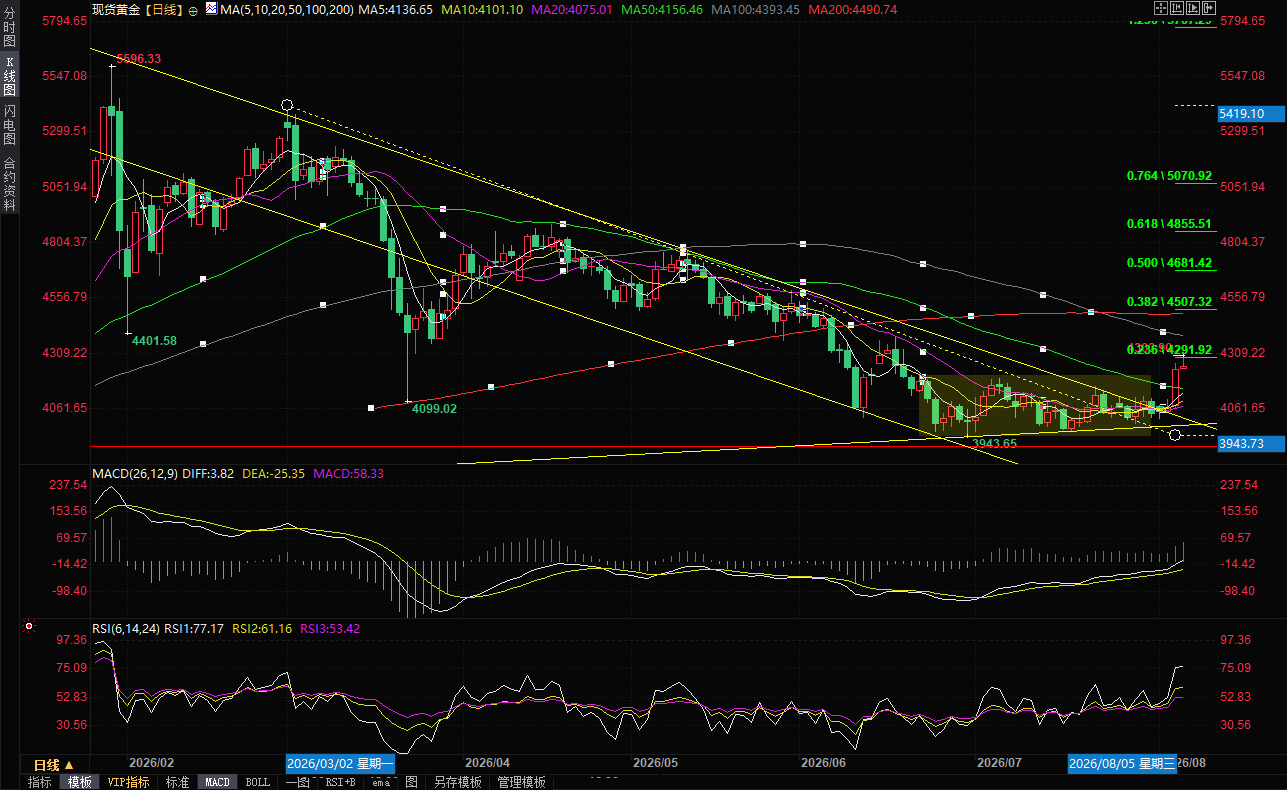
From a technical analysis perspective, gold prices achieved a strong breakout above the 50-day simple moving average (currently around 4156) in overnight trading, marking the first time it has effectively closed above this moving average since March 17th of this year. Many technical analysts view this breakout as a new trigger signal for activated bullish momentum. Meanwhile, the commonly used momentum indicator—the Moving Average Convergence Divergence (MACD)—has now risen into positive territory, while the Relative Strength Index (RSI) is around 61.10. Although not yet in overbought territory, it clearly shows that bullish momentum is gradually accumulating and improving. Nevertheless, before asserting the start of a new upward trend, cautious traders tend to wait for gold prices to effectively and sustainably hold above the 23.6% Fibonacci retracement level of the March-June decline (approximately 4292). Only after successfully overcoming this resistance can further upward movement be opened up. Once conditions are met, gold bulls are expected to target the $4,500 level, which coincides with the intersection of the 200-day simple moving average and the 38.2% Fibonacci retracement level, making it technically significant. Further up, the 50.0%, 61.8%, and 78.6% Fibonacci retracement levels are located at $4,681, $4,855, and $5,070 respectively. If gold prices can continue to break out of the current range, these levels will become the subsequent bullish targets. On the downside, initial support is provided by the recently broken 50-day moving average, specifically around $4,156. A deeper pullback could test the $3,944 area near the Fibonacci cycle low, considered a crucial support level for a medium-term structural bottom. (Spot gold daily chart, source: FX678)Summarize
In conclusion, the gold market is currently at a crossroads where bullish and bearish forces are in a delicate balance. On one hand, hawkish comments from Federal Reserve officials and persistent inflation risks are supporting the US dollar and putting downward pressure on gold prices. On the other hand, sluggish economic data, geopolitical uncertainties, and the upcoming non-farm payroll report are making short sellers hesitant to act. Technically, while gold has shown initial signs of bullishness, only a successful breakthrough of the key Fibonacci resistance (around 4292) will truly pave the way for further upward movement. Before the release of major data releases, the market may maintain a range-bound trading pattern, and investors need to closely monitor every catalyst and respond flexibly.Frequently Asked Questions
Question 1: Why do speeches by Federal Reserve officials have such a significant impact on gold prices? Answer: Gold is an asset that does not generate interest, and its price is highly negatively correlated with real interest rate movements. The comments of Federal Reserve officials directly reflect the central bank's inclination towards future monetary policy. When officials express concerns about inflation and hint at possible further interest rate hikes, the market anticipates higher and longer-lasting interest rates, which pushes up the dollar exchange rate and US Treasury yields, significantly reducing the attractiveness of holding gold. Therefore, every public statement by a major official can trigger significant fluctuations in the gold market. Question 2: Why do ADP employment data and the ISM services index influence the probability of interest rate hikes? Answer: ADP data, often referred to as the "mini-nonfarm payrolls," is an important leading indicator of the official nonfarm payrolls report, while the ISM services index covers approximately 90% of service sector activity in the US economy. A simultaneous weakening of both data points suggests that economic growth momentum may be slowing, and the labor market is no longer as tight as before. In this context, the necessity for the Federal Reserve to continue raising interest rates decreases, as tightening policies may excessively harm the economy. The market then reassesses the probability of interest rate hikes, thereby affecting the pricing of the dollar and gold. Question 3: How are the Red Sea conflict and the Strait of Hormuz agreement related to gold? Answer: The Red Sea and the Strait of Hormuz are crucial chokepoints for global energy transport. Escalating conflict can push up oil prices, exacerbate global inflation, and force central banks to maintain tight monetary policy, which is detrimental to gold. Conversely, a peace agreement alleviates supply concerns, oil prices fall, inflation expectations cool, and the urgency to raise interest rates may decrease, which is relatively favorable for gold. At the same time, geopolitical risks themselves can also stimulate gold's safe-haven properties, but this effect is often overshadowed by inflation and interest rate logic, requiring a comprehensive assessment. Question 4: Why are Fibonacci retracement levels and moving averages so crucial in technical analysis? Answer: Fibonacci retracement levels are potential support and resistance zones calculated based on the amplitude of previous trends. Many institutional traders and algorithmic programs set pending orders and stop-loss orders at these levels, thus possessing a self-fulfilling effect. The 50-day and 200-day moving averages are the "lifeline" of medium- to long-term trends; crossing or breaking below these moving averages is often seen as an important signal of trend reversal. The "resonance zone" formed at the intersection of these two factors usually has stronger technical significance, and price performance near this area often determines the subsequent trend. Question 5: How should ordinary investors respond before the release of the non-farm payroll report? Answer: Market sentiment is usually cautious before the release of major data, and prices are prone to narrow-range fluctuations or random volatility. Ordinary investors should not over-bet on one-sided directions, but should control their positions and set reasonable stop-loss orders. They can pay attention to the immediate reaction after the data release—if the non-farm payroll is significantly better than expected, gold may come under pressure and fall; if the data is significantly worse than expected, gold is expected to gain upward momentum. It is recommended to combine technical levels (such as the breakout of $4300) for flexible operations and avoid chasing highs and lows before the data release. As of 14:26 Beijing time, spot gold is currently trading at $4257.28 per ounce.- Risk Warning and Disclaimer
- The market involves risk, and trading may not be suitable for all investors. This article is for reference only and does not constitute personal investment advice, nor does it take into account certain users’ specific investment objectives, financial situation, or other needs. Any investment decisions made based on this information are at your own risk.