The euro broke out of its range against the dollar, with focus shifting to non-farm payrolls and the peace agreement.
2026-08-06 18:48:56
On Thursday (August 6), the euro rose against the US dollar in the early morning but then fluctuated downwards, with the price gradually falling and further declining in the later period, showing an overall weak and downward trend.  For most of this year, the euro has been pressured by a downward trend against the dollar, but has finally broken through. Whether this rally is short-lived or a confirmed trend will likely depend on subsequent US economic data and developments in the Gulf region. Multiple positive factors are converging for now . One of the key changes in the past week was the outlook for US interest rates. Although the latest US economic data still generally demonstrates economic resilience, traders have become more conservative in their assessment of how much the Federal Reserve needs to tighten monetary policy to combat inflation. Both the US ISM manufacturing and services PMIs exceeded market expectations, with the new orders sub-index of both surveys strengthening, indicating that the US economy will continue to operate in the second half of this year. Even with the strong economic data, the market has lowered its expectation for a rate hike before the Fed's June 2027 meeting to about 42 basis points. Correlation analysis shows that the euro/dollar exchange rate has been highly correlated with the movement of short-term US interest rates in the past week, which can partially explain the current upward trend of the euro/dollar. Another major positive factor for the euro is the market's optimism about the possibility of a lasting peace agreement in the Middle East. While there is still significant uncertainty about whether a peace agreement will be reached, this expectation has led to a further decline in energy prices. This is significant for the Eurozone, a major net energy importer. The US, as the world's largest energy producer, enjoys a significant advantage in energy security; in comparison, the decline in oil and natural gas prices has a much stronger effect on boosting the Eurozone economy. The easing of energy pressures has weakened a major headwind that has weighed on the euro in recent months. At the same time, inflationary pressures from supply shocks have eased, and the European Central Bank no longer needs to take aggressive interest rate hikes, avoiding further amplifying the risk of economic downturn. The Japanese market intervention also indirectly benefits the euro. It is extremely rare for the US Treasury to support another country's currency unless against the backdrop of a financial crisis or disorderly market turmoil. The true motives behind the US intervention are still unclear: whether it's due to the yen exchange rate, overseas demand for US Treasury bonds, US foreign trade competitiveness, or other considerations, the outside world has no way of knowing. However, it is certain that this event has hit dollar bulls, providing short-term upward momentum for the euro against the dollar. But it must be noted that most of the above-mentioned positive factors supporting the euro's strength are short-term drivers, and their sustainability is highly uncertain. The future direction of the euro largely depends on the situation in the Gulf and the US non-farm payroll report to be released on Friday. Non-farm payroll data directly alters market pricing in the Federal Reserve's interest rate path, making it a crucial factor at present. The euro/dollar exchange rate has broken through resistance, opening up further upside potential.
 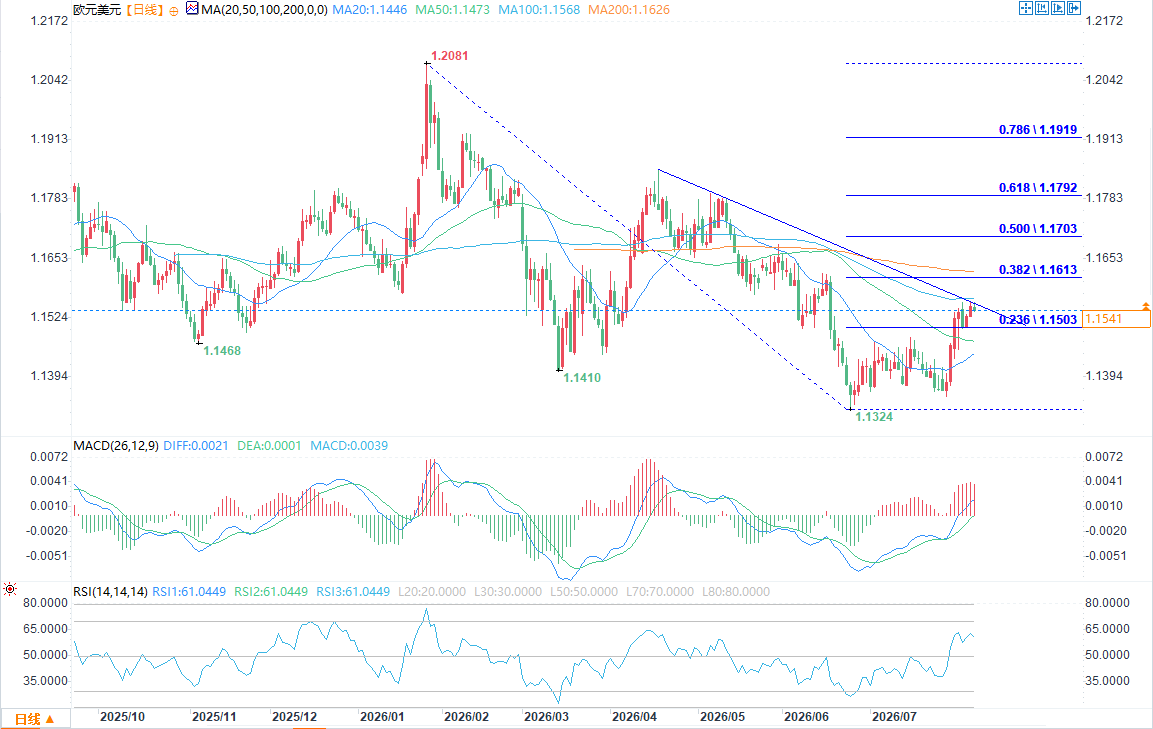 (EUR/USD Daily Chart Source: FX678) From a technical perspective, the short-term downtrend that formed after the Fed meeting in mid-July has been broken upwards. The exchange rate subsequently continued its upward momentum, rising above the 1.1480 resistance level and the 50-day moving average, and began testing the long-term downtrend line that started at the end of January. A false breakout occurred on Monday, with the exchange rate falling back to the 23.6% Fibonacci retracement level of the January-June decline; now, the price has rebounded again, closing above this downtrend line, suggesting further upward potential. 1.1550 is a key short-term level and the point where the price encountered resistance on Monday. If this level can be held, the exchange rate is expected to test the 100-day moving average. Compared to the 50-day and 200-day moving averages, the 100-day moving average has a weaker binding effect on the market; however, if it successfully rises above the 100-day moving average, the next target is the 38.2% Fibonacci retracement level of the January-June decline, and more importantly, the 200-day moving average. Historically, a successful breakout above the 200-day moving average is a significant technical signal, potentially initiating a larger bullish trend. Conversely, if the breakout fails and the price falls back below the trendline, bears will regain control. The price will likely retest the 23.6% Fibonacci retracement level of the January-June decline, while the support zone coinciding with the 1.1480 (previous resistance) and the 50-day moving average will also be tested. A breach of this support zone would lead to a deep correction, heading towards the July lows. Oscillator signals favor a continuation of the breakout. The 14-period Relative Strength Index (RSI) is rising, moving away from the 50 neutral line, but has not yet entered overbought territory. The MACD indicator has also turned positive, with the difference between it and the signal line widening, indicating accumulating upward momentum. This does not constitute a strong buy signal, but short-term trading strategies are more suited to buying on dips and following the breakout, rather than shorting against the trend. At 18:41 Beijing time, the euro/dollar exchange rate was 1.1540/41, down 0.10%.
For most of this year, the euro has been pressured by a downward trend against the dollar, but has finally broken through. Whether this rally is short-lived or a confirmed trend will likely depend on subsequent US economic data and developments in the Gulf region. Multiple positive factors are converging for now . One of the key changes in the past week was the outlook for US interest rates. Although the latest US economic data still generally demonstrates economic resilience, traders have become more conservative in their assessment of how much the Federal Reserve needs to tighten monetary policy to combat inflation. Both the US ISM manufacturing and services PMIs exceeded market expectations, with the new orders sub-index of both surveys strengthening, indicating that the US economy will continue to operate in the second half of this year. Even with the strong economic data, the market has lowered its expectation for a rate hike before the Fed's June 2027 meeting to about 42 basis points. Correlation analysis shows that the euro/dollar exchange rate has been highly correlated with the movement of short-term US interest rates in the past week, which can partially explain the current upward trend of the euro/dollar. Another major positive factor for the euro is the market's optimism about the possibility of a lasting peace agreement in the Middle East. While there is still significant uncertainty about whether a peace agreement will be reached, this expectation has led to a further decline in energy prices. This is significant for the Eurozone, a major net energy importer. The US, as the world's largest energy producer, enjoys a significant advantage in energy security; in comparison, the decline in oil and natural gas prices has a much stronger effect on boosting the Eurozone economy. The easing of energy pressures has weakened a major headwind that has weighed on the euro in recent months. At the same time, inflationary pressures from supply shocks have eased, and the European Central Bank no longer needs to take aggressive interest rate hikes, avoiding further amplifying the risk of economic downturn. The Japanese market intervention also indirectly benefits the euro. It is extremely rare for the US Treasury to support another country's currency unless against the backdrop of a financial crisis or disorderly market turmoil. The true motives behind the US intervention are still unclear: whether it's due to the yen exchange rate, overseas demand for US Treasury bonds, US foreign trade competitiveness, or other considerations, the outside world has no way of knowing. However, it is certain that this event has hit dollar bulls, providing short-term upward momentum for the euro against the dollar. But it must be noted that most of the above-mentioned positive factors supporting the euro's strength are short-term drivers, and their sustainability is highly uncertain. The future direction of the euro largely depends on the situation in the Gulf and the US non-farm payroll report to be released on Friday. Non-farm payroll data directly alters market pricing in the Federal Reserve's interest rate path, making it a crucial factor at present. The euro/dollar exchange rate has broken through resistance, opening up further upside potential. (EUR/USD Daily Chart Source: FX678) From a technical perspective, the short-term downtrend that formed after the Fed meeting in mid-July has been broken upwards. The exchange rate subsequently continued its upward momentum, rising above the 1.1480 resistance level and the 50-day moving average, and began testing the long-term downtrend line that started at the end of January. A false breakout occurred on Monday, with the exchange rate falling back to the 23.6% Fibonacci retracement level of the January-June decline; now, the price has rebounded again, closing above this downtrend line, suggesting further upward potential. 1.1550 is a key short-term level and the point where the price encountered resistance on Monday. If this level can be held, the exchange rate is expected to test the 100-day moving average. Compared to the 50-day and 200-day moving averages, the 100-day moving average has a weaker binding effect on the market; however, if it successfully rises above the 100-day moving average, the next target is the 38.2% Fibonacci retracement level of the January-June decline, and more importantly, the 200-day moving average. Historically, a successful breakout above the 200-day moving average is a significant technical signal, potentially initiating a larger bullish trend. Conversely, if the breakout fails and the price falls back below the trendline, bears will regain control. The price will likely retest the 23.6% Fibonacci retracement level of the January-June decline, while the support zone coinciding with the 1.1480 (previous resistance) and the 50-day moving average will also be tested. A breach of this support zone would lead to a deep correction, heading towards the July lows. Oscillator signals favor a continuation of the breakout. The 14-period Relative Strength Index (RSI) is rising, moving away from the 50 neutral line, but has not yet entered overbought territory. The MACD indicator has also turned positive, with the difference between it and the signal line widening, indicating accumulating upward momentum. This does not constitute a strong buy signal, but short-term trading strategies are more suited to buying on dips and following the breakout, rather than shorting against the trend. At 18:41 Beijing time, the euro/dollar exchange rate was 1.1540/41, down 0.10%.
- Risk Warning and Disclaimer
- The market involves risk, and trading may not be suitable for all investors. This article is for reference only and does not constitute personal investment advice, nor does it take into account certain users’ specific investment objectives, financial situation, or other needs. Any investment decisions made based on this information are at your own risk.