The agreement hasn't even been finalized yet, but crude oil prices have already been drastically priced in. What will the market really need to test next?
2026-08-07 19:28:52
On Friday, August 7th, Brent crude oil was trading around $81.90 per barrel, down about 1.9% on the day. The previous trading day saw a cumulative increase of nearly 5%, and the market's pricing focus has shifted from simply betting on the reopening of the Strait of Hormuz to assessing whether the agreement can truly translate into stable, continuous, and insurable energy transportation. Reports indicate that consultations between Iran and Oman regarding the management arrangements for the Strait of Hormuz are still progressing, but the draft involves issues such as ship access, channel management, fee arrangements, and restrictions on specific related vessels. Meanwhile, there are still reports of new military friction near the strait's entrance. In other words, the current oil market is no longer facing a simple binary question of "open or closed," but rather the extent to which the channel will be open, under what rules, and whether commercial shipping can truly resume. 
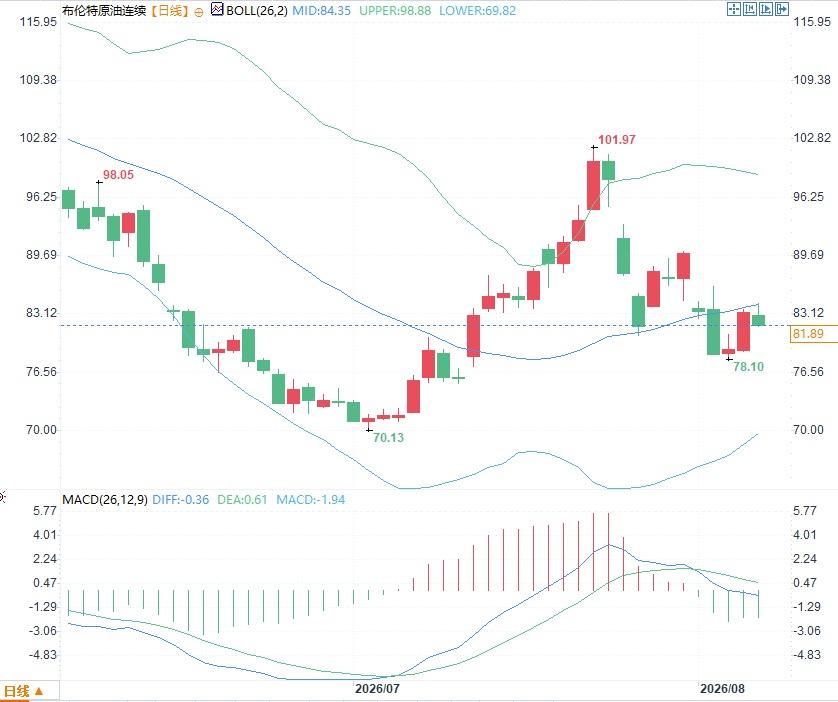 The MACD indicator currently shows a DIFF of approximately -0.36, a DEA of approximately 0.61, and a histogram of approximately -1.94, reflecting a significant weakening of the short-term momentum generated by the previous rapid rebound. What's more noteworthy here is not the direction the indicator points to, but rather the shift in market structure from one-sided risk premium expansion to news-driven high-frequency repricing. At 19:24 Beijing time, Brent crude oil was trading at $81.86 per barrel.
The risk premium for crude oil did not disappear as negotiations progressed.
The significant fluctuations in Brent crude oil prices over the past few days essentially reflect the market's repeated reassessment of the risk premium associated with the Strait of Hormuz. On August 3, after the US suspended new military operations and signaled its willingness to negotiate, Brent crude oil prices fell by about 7% in a single day, indicating that a substantial supply disruption premium was already priced in. However, the rebound in oil prices in the latter half of this week suggests that negotiations alone are insufficient to eliminate the risk premium. Iran's proposal involves not only the restoration of the waterway but also more complex commercial conditions such as ship access rights, shipping management rights, insurance, and environmental service fees. If future navigation changes from the relatively standardized rules of the past to a new system with ship identification, management review, and additional service costs, then even if actual crude oil exports begin to recover, shipping costs may remain higher than previous levels for a long time. Therefore, for the market, the truly important variable has shifted from "whether there is an agreement" to "whether the agreement is enforceable."The real core issue is not oil well production capacity, but whether maritime logistics can be restored.
The Strait of Hormuz's importance to the global energy market stems from transportation rather than simply production. Under normal circumstances, approximately one-fifth of global oil transportation is linked to this waterway. Therefore, even if oil production facilities themselves do not decrease simultaneously, the effective supply available to the market will still decline as long as tankers cannot enter, load, and leave normally. In June, the market rapidly compressed oil price risk premiums due to expectations of reopening, but industry institutions had already pointed out at that time that even if political arrangements were implemented, the return of shipping to normal could take weeks or even longer. There is an easily overlooked difference here: "the waterway is open to traffic" does not equate to "immediate resumption of commercial transportation." Shipowners need to reassess safety risks, insurance institutions need to renegotiate underwriting terms, the charter market needs to establish new freight rates, stranded vessels need to be reordered, and refinery procurement, tanker scheduling, and port loading and unloading plans must all be re-coordinated. This means that even if a formal agreement emerges in the future, the crude oil market will likely prioritize the speed of logistical recovery rather than simply calculating new supply based on nominal production capacity.The so-called central channel plan may change the way the market assesses risks.
One key arrangement currently under discussion is the establishment of a so-called "central channel," while gradually phasing out two other currently limited shipping routes. If the final plan approaches this framework, the risk structure of the Strait of Hormuz could change significantly. Previously, the market focused more on the possibility of a complete disruption to the strait; under the new framework, the risk may shift to traffic efficiency, vessel review, channel capacity, and operational stability. Centralized transport can improve management efficiency, but it also means that major transport flows are concentrated in limited channels. If a brief security incident, shipping congestion, or operational dispute occurs in this channel, the disruption to the immediate supply chain could be more direct. Furthermore, vessel ownership structure is a potential variable. Modern large oil tankers often involve multiple entities, including the place of registration, actual controller, shipowner, operator, financing institution, and insurance institution. Therefore, if the restrictions expand from flags to ownership or investment relationships, the actual impact could significantly exceed the apparent number of specific vessels. This is why the market cannot simply estimate the impact based on the assumption that "the number of restricted vessels is very small."Technical indicators suggest the market is re-establishing a trading range.
Looking at the daily chart for Brent crude oil, the price previously rebounded rapidly from around 70.13 to around 101.97, before pulling back significantly and currently trading around the $80 mark. The Bollinger Bands' middle band is around 84.35, the upper band around 98.88, and the lower band around 69.82, indicating that the wide fluctuations following the previous sharp rise have not yet fully subsided. The MACD indicator currently shows a DIFF of approximately -0.36, a DEA of approximately 0.61, and a histogram of approximately -1.94, reflecting a significant weakening of the short-term momentum generated by the previous rapid rebound. What's more noteworthy here is not the direction the indicator points to, but rather the shift in market structure from one-sided risk premium expansion to news-driven high-frequency repricing. At 19:24 Beijing time, Brent crude oil was trading at $81.86 per barrel.
- Risk Warning and Disclaimer
- The market involves risk, and trading may not be suitable for all investors. This article is for reference only and does not constitute personal investment advice, nor does it take into account certain users’ specific investment objectives, financial situation, or other needs. Any investment decisions made based on this information are at your own risk.