From technical consolidation to fundamental reassessment, the next key focus for USD/CAD is emerging.
2026-08-07 20:03:00
On Friday, August 7th, the pricing logic surrounding the USD/CAD exchange rate in the foreign exchange market is shifting. The current exchange rate remains within its recent trading range, hovering around 1.4015. The impact of evolving Middle East tensions on energy transport security continues to unfold, while volatility in the oil market affects the Canadian dollar's performance through trade revenue channels. Meanwhile, uncertainty surrounding the Federal Reserve's monetary policy path continues to impact the attractiveness of dollar-denominated assets. 
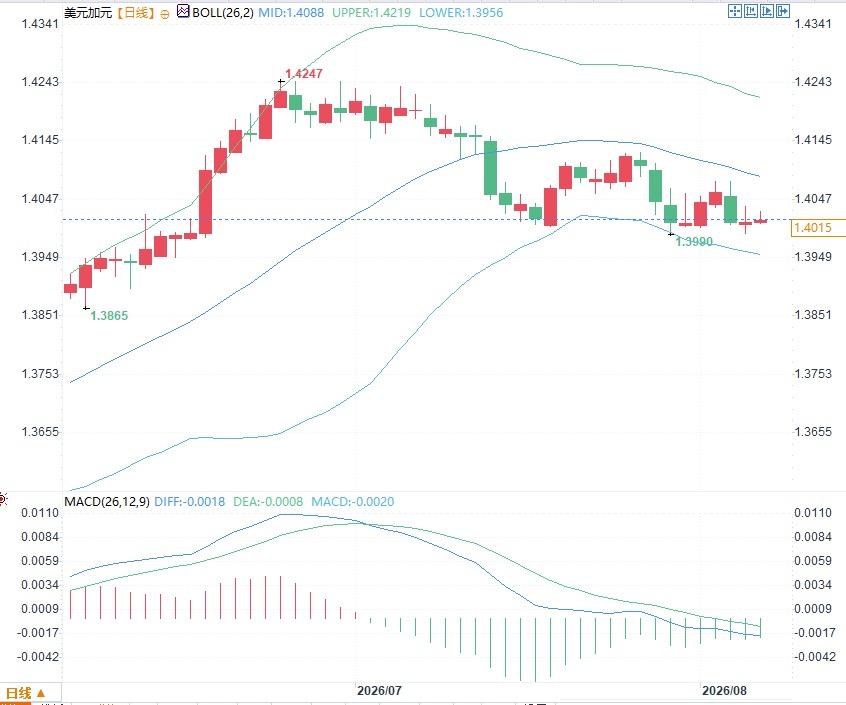 In the MACD indicator, the fast and slow lines are still running near the weak zone, and the changes in the histogram reflect weakening short-term momentum. At the same time, the distance between the price and the moving average is narrowing, indicating that the market is reducing directional bets and is more inclined to wait for new fundamental information to confirm the trend. At 19:58 Beijing time, the USD/CAD exchange rate was 1.4012.
Employment data has become a key variable in the short-term market reassessment of policy expectations.
One of the biggest focuses in the USD/CAD market recently has been the simultaneous release of US and Canadian employment data. As a crucial indicator of economic resilience, changes in the job market not only affect market assessments of economic growth but also alter investor expectations regarding the central bank's interest rate policy path. The market anticipates that the US economy may add 80,000 jobs in July, higher than previous levels, with the unemployment rate expected to remain around 4.2% and wage growth projected to stay near 3.5%. More than a single data point, the market is focused on whether the job market continues its cooling trend and whether wage pressures have eased further. A significant discrepancy between the employment data and market expectations could lead to a readjustment of the Federal Reserve's future policy pace in the interest rate market. Currently, the market is still assessing whether inflationary pressures have entered a stable decline phase; therefore, changes in the job market are a crucial reference for observing policy space. In Canada, the job market has recently shown relative improvement. The market expects Canada to add approximately 15,000 jobs in July, following an increase of 182,000 in June, with the unemployment rate expected to remain around 6.5%. Some institutions believe that the momentum of Canadian job growth may continue, particularly with improved demand for service sector jobs, providing support for the overall labor market. However, the recovery of the Canadian job market still needs to be assessed in conjunction with wage growth, consumer demand, and employer hiring intentions. Single-month data changes are insufficient to alter long-term trends; the market is more focused on consistent performance.The dollar's support stems from the combined effects of safe-haven demand and interest rate expectations.
The recent performance of the US dollar has been influenced by a variety of factors, with safe-haven demand remaining a significant supporting factor. Global market attention has intensified regarding developments in the Middle East, particularly the uncertainty surrounding key energy transportation routes, prompting investors to reassess supply chain risks. Energy transportation risks not only affect crude oil prices but may also influence the policy decisions of major central banks globally through inflation expectations. If energy prices continue to be driven by risk premiums, the market may reconsider whether the process of inflation decline faces obstacles. Meanwhile, US Treasury yields remain relatively high, reflecting the market's continued assessment of the likelihood of the Federal Reserve maintaining restrictive policies. Recent speeches by some Fed officials have been generally cautious, emphasizing that inflation risks have not completely subsided and that interest rate policy needs further confirmation based on economic data. For the US dollar, interest rate advantage and safe-haven attributes remain important factors influencing market capital flows. However, as the market continues to digest policy expectations, the dollar's trajectory will depend more on whether economic data continues to support the current interest rate environment.The crude oil market provided support for the Canadian dollar, but the impact was limited in its path.
As the currency of a resource-based economy, the Canadian dollar is typically influenced by fluctuations in international crude oil prices. When crude oil prices rise, Canadian energy export revenues improve, potentially supporting terms of trade and increasing demand for Canadian dollar assets. However, from a market perspective, rising crude oil prices do not necessarily drive a sustained strengthening of the Canadian dollar. Exchange rates are the result of multiple factors, including interest rate differentials, economic growth expectations, risk appetite, and capital flows. If the US dollar is driven by safe-haven flows, and Canadian economic data fails to generate stronger policy expectations, the supporting effect of energy factors on the Canadian dollar may be limited. Therefore, the market is currently seeking a new balance among these variables.Technical indicators suggest the market has entered a waiting phase, with macroeconomic factors dominating short-term fluctuations.
From a daily chart perspective, the USD/CAD pair has gradually retreated after its previous surge, and is currently consolidating around the moving average system. The Bollinger Bands are narrowing, indicating decreased market volatility, with trading funds awaiting new catalysts. In the MACD indicator, the fast and slow lines are still running near the weak zone, and the changes in the histogram reflect weakening short-term momentum. At the same time, the distance between the price and the moving average is narrowing, indicating that the market is reducing directional bets and is more inclined to wait for new fundamental information to confirm the trend. At 19:58 Beijing time, the USD/CAD exchange rate was 1.4012.
- Risk Warning and Disclaimer
- The market involves risk, and trading may not be suitable for all investors. This article is for reference only and does not constitute personal investment advice, nor does it take into account certain users’ specific investment objectives, financial situation, or other needs. Any investment decisions made based on this information are at your own risk.