Institutions: Gold is expected to reach a turning point once real interest rates peak.
2026-08-10 10:20:54
The gold market in 2026 has been characterized by a paradoxical phenomenon: geopolitical risks and fiscal pressures should have provided strong safe-haven support for gold, but the opportunity cost of persistently rising real interest rates has continued to suppress gold prices. Market focus has shifted from the high level of real interest rates to whether they will continue to rise. Many institutions believe that the upside potential for interest rates is limited, and the biggest negative factor for gold may gradually subside.
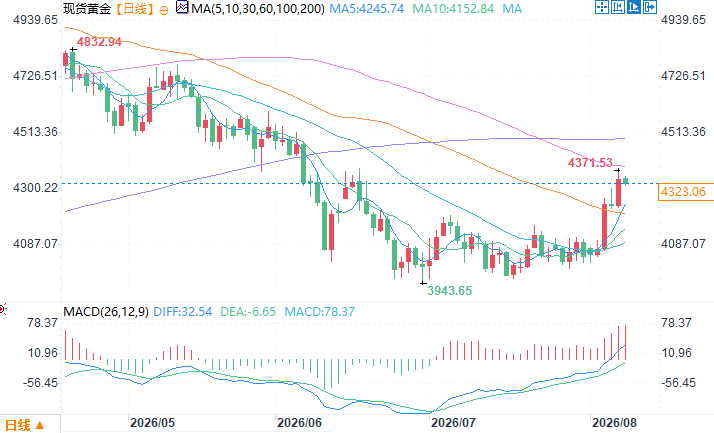 Spot gold daily chart source: FX678. At 10:18 AM Beijing time on August 10th, spot gold was trading at $4324.06 per ounce.
Gold prices are under significant pressure due to a reversal in interest rate expectations.
This year has seen a dramatic reversal in market expectations regarding monetary policy. At the beginning of the year, the market widely bet on one or two rate cuts by the Federal Reserve. However, with fluctuating inflation data, the market has begun trading in the possibility of rate hikes. Jefferies estimates that the yield on 10-year Treasury Inflation-Protected Securities (TIPS) will rise from 1.94% in early 2026 to 2.41%. This rapid shift in expectations has caused gold prices to fall by about 25% from their recent highs. Even in the face of such strong negative factors, gold has stubbornly held onto the key psychological level of $4,000 per ounce. Data from the World Gold Council shows that gold prices remained relatively stable around $4,027 in July. Even with the real yield on German government bonds hitting a 15-year high, European gold ETFs still saw inflows, demonstrating strong buying support at the bottom of the market. Gold has already absorbed most of the negative impact from opportunity costs.Institutional View: No need for interest rate cuts; a halt in the price increase is a positive sign.
In its latest report, BCA Research stated that the most difficult phase of real interest rate pressure on gold has likely ended. Roukaya Ibrahim, the firm's chief commodities strategist, said that a new round of gold price increases does not require a rate cut by the Federal Reserve Chairman; a halt to the sustained upward trend of real interest rates and the US dollar would be sufficient to drive a gold price recovery. Jefferies further corroborated this logic by reviewing historical market data, suggesting that after being impacted by real interest rate shocks, gold's subsequent performance is not entirely dependent on the absolute value of interest rates, but rather on whether the upward momentum of interest rates can subside. The market has largely priced in the repricing of monetary policy; once the upward pressure on real interest rates eases, gold and gold mining stocks will have a foundation for recovery.The structural bullish foundation remains unshaken.
While headwinds suppressing gold prices are expected to ease, the underlying logic supporting gold remains solid. Central banks worldwide continue to increase their gold reserves, and de-dollarization, fiscal uncertainties in various countries, and global geopolitical uncertainties remain the long-term main themes of the market . BCA Research stated that although central bank gold purchases are unlikely to drive a surge in gold prices, official demand can still solidify the bottom for gold prices. The impact of inflation on gold prices also needs to be viewed dialectically. The World Gold Council stated that higher inflation is not necessarily beneficial for gold; only when inflation exceeds 4%, accompanied by a decline in real interest rates, a weakening dollar, or an increased risk of economic recession, will the boosting effect of inflation be fully realized. In summary , a bullish outlook for gold does not require extreme scenarios such as a significant economic recession or emergency monetary easing. As long as the negative factors suppressing gold prices do not continue to worsen, the market will see a turnaround. After a sharp opportunity cost shock, gold may have reached a critical turning point. If real interest rates are confirmed to have peaked, the biggest negative factor in the past will transform into the core driving force for rising gold prices. Spot gold daily chart source: FX678. At 10:18 AM Beijing time on August 10th, spot gold was trading at $4324.06 per ounce.
- Risk Warning and Disclaimer
- The market involves risk, and trading may not be suitable for all investors. This article is for reference only and does not constitute personal investment advice, nor does it take into account certain users’ specific investment objectives, financial situation, or other needs. Any investment decisions made based on this information are at your own risk.