Weak US jobs data boosted gold prices, and it may return to bullish territory in the short term.
2026-08-10 15:22:54
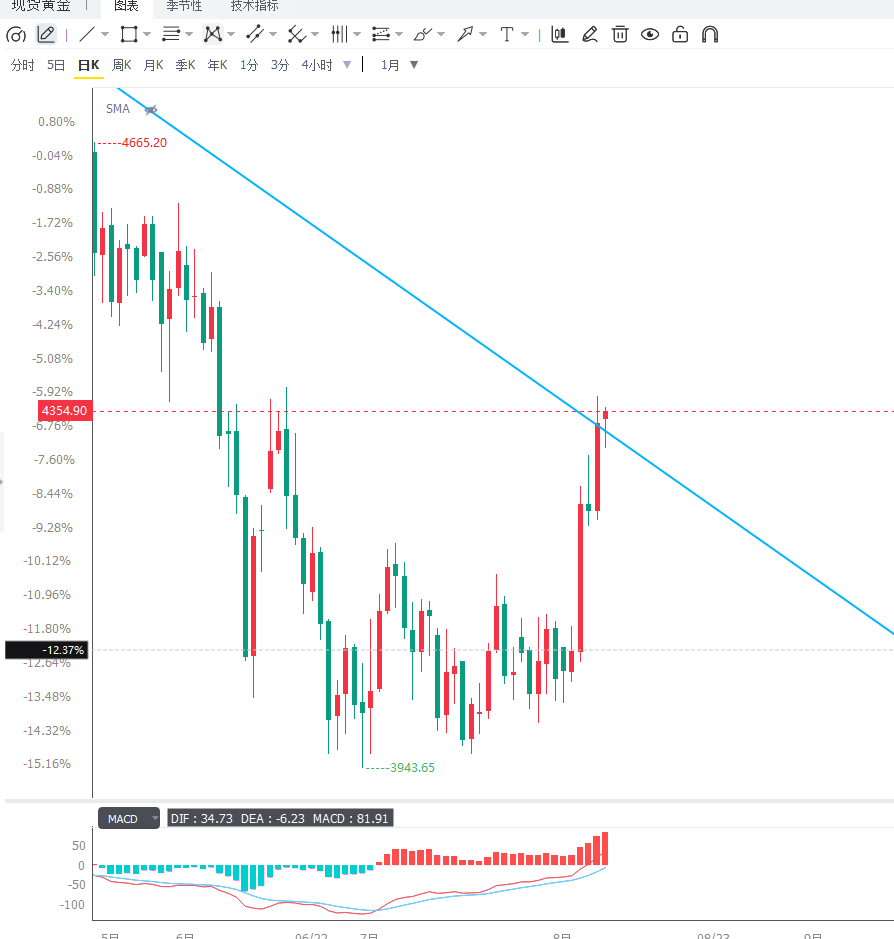
Spot gold (XAU/USD) fluctuated higher in early Asian and European trading on Monday, recovering to near its intraday high, approaching the $4,350 level. Gold prices had previously surged on Friday due to weak US non-farm payroll data, reaching their highest level since June 17, but gains were subsequently limited by a rebounding US dollar.  The cooling US job market is a significant factor driving gold's rise. Data shows that US non-farm payrolls unexpectedly fell by 23,000 in July, while June's employment data was revised down to an increase of 20,000, significantly lower than the previously reported 57,000. This marked slowdown in US job growth weakened the Federal Reserve's policy basis for further interest rate hikes and pushed the dollar weaker, providing upward momentum for gold. As gold is a non-interest-bearing asset, its price is highly sensitive to changes in interest rate expectations. Following the release of the employment data, the market lowered its expectations for short-term tightening by the Federal Reserve, and US Treasury yields fell, driving funds back into the gold market. However, the dollar did not continue to weaken, limiting further gains in gold. The recent situation in the Middle East remains a crucial factor influencing the precious metals market. Significant uncertainty remains regarding the reopening of the Strait of Hormuz, with Iran stating that a full resumption of navigation requires conditions including the lifting of the maritime blockade, the removal of sanctions, and related compensation demands. Meanwhile, Iran has temporarily ruled out direct negotiations, keeping the market at a risk premium. Geopolitical risks support safe-haven demand for gold on one hand, but on the other hand, they also push the dollar stronger, putting some downward pressure on gold prices. The coexistence of safe-haven demand for the US dollar and the safe-haven attribute of gold has resulted in a short-term tug-of-war between bulls and bears for gold. Meanwhile, rising oil prices have also become a key focus for the market. The situation between the US and Iran could affect energy supply expectations; if oil prices continue to rise, global inflationary pressures may resurface, prompting major central banks to maintain a tighter policy stance. Market interest rate tools indicate that investors still believe there is a certain probability of a Fed rate hike before the end of the year, keeping US Treasury yields relatively high and limiting the upside potential for gold. TD Securities believes that whether the Fed will adjust its policy in the future still depends on inflation data. The institution predicts that the US core CPI and overall CPI monthly rates may reach approximately 0.20% and 0.15%, respectively. If inflation meets expectations or further cools, the market may continue to reduce its bets on rate hikes, pushing US interest rates down and providing new upward momentum for gold. Currently, investors are awaiting the US inflation data to be released this week for clues about the Fed's policy path. If the CPI continues to show easing inflation, the dollar may come under pressure, and gold is expected to extend its gains; however, if rising energy prices lead to a rebound in inflation, US Treasury yields and the dollar may strengthen again, putting pressure on gold. From a daily chart perspective, gold has recently reclaimed the 38.2% Fibonacci retracement level of the April-June correction, around $4303, which currently acts as a key support level. Technically, the MACD remains positive, and the RSI is around 64, indicating a bullish market, though not yet clearly overbought. However, gold is currently facing resistance from the 100-day moving average around $4390 and the 200-day moving average around $4496, requiring a break above these key resistance levels for further gains. On the daily chart, the first resistance level to watch is the 100-day moving average around $4390, followed by the 50% Fibonacci retracement level around $4414. A decisive break above these areas could lead to further testing of the $4496-$4525 range; further upside targets are $4683 and the previous high around $4884. On the downside, support is seen at $4303; a break below this level could lead to a pullback to around $4166, and in extreme cases, a retest of the $3944 area. From a 4-hour chart perspective, gold maintains its short-term rebound structure, with prices continuing to advance towards $4350 after breaking through $4300. Short-term moving averages are trending strongly, but the upward movement still faces pressure from a rebounding US dollar and yield curves. If gold prices hold above $4300, there is still a chance to challenge the $4390 resistance level in the short term; if they fall below $4300, they may enter a technical correction phase, with targets at $4250 and $4166.
  Editor's Summary: Gold is currently in a favorable environment of weakening interest rate expectations and increased safe-haven demand. Weak US employment data has reduced pressure on the Federal Reserve to raise interest rates in the short term, supporting gold price increases. However, safe-haven demand for the US dollar, inflation risks from rising energy prices, and high US Treasury yields still limit further upside potential for gold. In the short term, the $4300 support level and the $4390 resistance level will be key areas to watch. If US inflation continues to cool, the medium-term upward trend in gold may continue; if inflation rebounds, the risk of a pullback due to a dollar rebound should be noted.
The cooling US job market is a significant factor driving gold's rise. Data shows that US non-farm payrolls unexpectedly fell by 23,000 in July, while June's employment data was revised down to an increase of 20,000, significantly lower than the previously reported 57,000. This marked slowdown in US job growth weakened the Federal Reserve's policy basis for further interest rate hikes and pushed the dollar weaker, providing upward momentum for gold. As gold is a non-interest-bearing asset, its price is highly sensitive to changes in interest rate expectations. Following the release of the employment data, the market lowered its expectations for short-term tightening by the Federal Reserve, and US Treasury yields fell, driving funds back into the gold market. However, the dollar did not continue to weaken, limiting further gains in gold. The recent situation in the Middle East remains a crucial factor influencing the precious metals market. Significant uncertainty remains regarding the reopening of the Strait of Hormuz, with Iran stating that a full resumption of navigation requires conditions including the lifting of the maritime blockade, the removal of sanctions, and related compensation demands. Meanwhile, Iran has temporarily ruled out direct negotiations, keeping the market at a risk premium. Geopolitical risks support safe-haven demand for gold on one hand, but on the other hand, they also push the dollar stronger, putting some downward pressure on gold prices. The coexistence of safe-haven demand for the US dollar and the safe-haven attribute of gold has resulted in a short-term tug-of-war between bulls and bears for gold. Meanwhile, rising oil prices have also become a key focus for the market. The situation between the US and Iran could affect energy supply expectations; if oil prices continue to rise, global inflationary pressures may resurface, prompting major central banks to maintain a tighter policy stance. Market interest rate tools indicate that investors still believe there is a certain probability of a Fed rate hike before the end of the year, keeping US Treasury yields relatively high and limiting the upside potential for gold. TD Securities believes that whether the Fed will adjust its policy in the future still depends on inflation data. The institution predicts that the US core CPI and overall CPI monthly rates may reach approximately 0.20% and 0.15%, respectively. If inflation meets expectations or further cools, the market may continue to reduce its bets on rate hikes, pushing US interest rates down and providing new upward momentum for gold. Currently, investors are awaiting the US inflation data to be released this week for clues about the Fed's policy path. If the CPI continues to show easing inflation, the dollar may come under pressure, and gold is expected to extend its gains; however, if rising energy prices lead to a rebound in inflation, US Treasury yields and the dollar may strengthen again, putting pressure on gold. From a daily chart perspective, gold has recently reclaimed the 38.2% Fibonacci retracement level of the April-June correction, around $4303, which currently acts as a key support level. Technically, the MACD remains positive, and the RSI is around 64, indicating a bullish market, though not yet clearly overbought. However, gold is currently facing resistance from the 100-day moving average around $4390 and the 200-day moving average around $4496, requiring a break above these key resistance levels for further gains. On the daily chart, the first resistance level to watch is the 100-day moving average around $4390, followed by the 50% Fibonacci retracement level around $4414. A decisive break above these areas could lead to further testing of the $4496-$4525 range; further upside targets are $4683 and the previous high around $4884. On the downside, support is seen at $4303; a break below this level could lead to a pullback to around $4166, and in extreme cases, a retest of the $3944 area. From a 4-hour chart perspective, gold maintains its short-term rebound structure, with prices continuing to advance towards $4350 after breaking through $4300. Short-term moving averages are trending strongly, but the upward movement still faces pressure from a rebounding US dollar and yield curves. If gold prices hold above $4300, there is still a chance to challenge the $4390 resistance level in the short term; if they fall below $4300, they may enter a technical correction phase, with targets at $4250 and $4166. Editor's Summary: Gold is currently in a favorable environment of weakening interest rate expectations and increased safe-haven demand. Weak US employment data has reduced pressure on the Federal Reserve to raise interest rates in the short term, supporting gold price increases. However, safe-haven demand for the US dollar, inflation risks from rising energy prices, and high US Treasury yields still limit further upside potential for gold. In the short term, the $4300 support level and the $4390 resistance level will be key areas to watch. If US inflation continues to cool, the medium-term upward trend in gold may continue; if inflation rebounds, the risk of a pullback due to a dollar rebound should be noted.
- Risk Warning and Disclaimer
- The market involves risk, and trading may not be suitable for all investors. This article is for reference only and does not constitute personal investment advice, nor does it take into account certain users’ specific investment objectives, financial situation, or other needs. Any investment decisions made based on this information are at your own risk.