High-level US-Iran rivalry becomes the latest main driver of oil price pricing.
2026-08-10 16:06:54
On Monday (August 10), international oil prices saw a slight rise followed by a decline during the Asian and European sessions, continuing their recent rebound. Multiple risks, including the stalemate in negotiations for navigation in the Strait of Hormuz and the escalating armed attacks in Yemen, along with declining global demand, continue to disrupt the global energy supply chain. However, recent developments in US-Iran negotiations, including mutual threats such as the US Treasury Secretary's repeated statements about economic sanctions and Iran's hardline stance and the appointment of a more hawkish core leadership team, have become key variables influencing the fluctuations in international crude oil prices. 
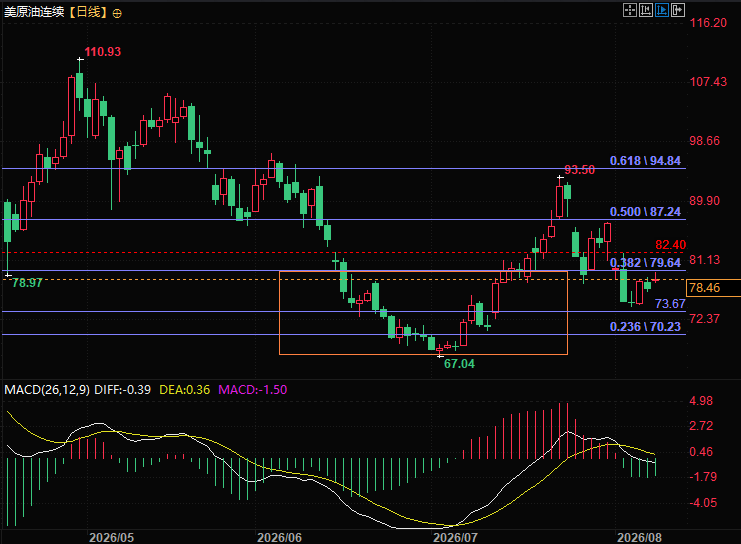 (WTI crude oil futures contract daily chart, source: EasyTrade) At 16:02 Beijing time, the WTI crude oil futures contract is currently trading at $78.07 per barrel.
Iran and Oman reach a temporary agreement on cross-strait navigation, leading to adjustments in strait shipping rules.
Negotiations on navigation in the Strait of Hormuz, led by Iran and Oman, have entered the final stage. The two sides intend to finalize a temporary navigation management agreement, completely reshaping the existing shipping rules of the strait. According to sources, the proposed temporary agreement introduces a new navigation mechanism, implementing a one-way passage model of "Iranian entry, Omani exit," and allowing all passing vessels to pass free of charge during the transition period. This plan has been approved by all members of the Gulf Cooperation Council and is expected to be jointly announced by Iran, Oman, the United States, and the International Maritime Organization of the United Nations. However, the terms of the agreement are still subject to temporary adjustments, and its final implementation remains uncertain, leading to a wait-and-see attitude in the market.Iran sets multiple red lines for air travel, stalling substantive negotiations between the US and Iran.
Despite the negotiations nearing their conclusion, Iran has made it clear that the Strait of Hormuz is not yet ready for a full reopening and will not unconditionally restore full navigation. The Iranian government has outlined several non-negotiable preconditions, demanding a complete overhaul of the US policy towards Iran. Core demands include a permanent end to all military conflicts against Iran and its allies, lifting the naval blockade of Iranian ports, withdrawing all US troops from the Middle East, full compensation for war losses, lifting all sanctions against Iran, and unconditionally unfreezing Iranian assets overseas. Iranian Foreign Minister Araqchi further clarified the current state of the US-Iran standoff, emphasizing that the two sides are currently only exchanging information through third parties and have not engaged in any substantive negotiations. Bilateral negotiations cannot resume until the US rectifys its previous violations of the interim agreement. Meanwhile, the Iranian Parliament's National Security Committee has approved the overall framework for the Strait's management plan, introducing stringent new navigation regulations that explicitly prohibit vessels from "hostile countries" from passing through. Vessels from all countries that have caused damage to Iran must complete compensation before being allowed passage, significantly tightening the entry barriers for shipping through the Strait. In order to adapt to the new round of geopolitical competition with the United States and to coordinate the Taiwan Strait negotiations with national security strategy, Iran recently completed a reshuffle of its core security leadership, with former Revolutionary Guard commander and Supreme Leader's military advisor Mohsen Rezaei taking over as chairman of the Supreme National Security Council, further strengthening the stability and execution of the core decision-making system.The United States has abandoned military strikes and is instead pressuring Iran through economic sanctions.
Faced with Iran's hardline stance and the complex situation in the Middle East, the Trump administration has clearly adjusted its strategy towards Iran, abandoning plans for a new round of military strikes and instead focusing on economic pressure and long-term attrition to force Iran to make concessions. In other words, it leans towards exerting economic pressure on Iran rather than launching new military action. In media interviews, Trump admitted that the US is only maintaining limited, exploratory contact with Iran, in a "semi-negotiating" wait-and-see state, continuing to rely on the maritime blockade and comprehensive sanctions implemented since April of this year to precisely cripple the Iranian economy. Currently, Iran is mired in economic difficulties due to high inflation and difficulties in raising military funds, and the economic pressure continues to intensify. The US intends to force Iran to compromise and back down in the Strait of Hormuz and regional geopolitical games through long-term economic pressure. This strategic adjustment has effectively stabilized domestic energy consumption pressure in the US and significantly alleviated the cost of oil for American consumers. However, market risks have not been completely eliminated. As a global energy chokepoint, continued restrictions on navigation through the Strait of Hormuz will directly cut off the core lifeline of global energy supply. In the short term, oil prices will continue to fluctuate widely depending on the progress of negotiations and the situation.The escalating conflict in Yemen exacerbates the risks to energy shipping in the Red Sea.
Beyond the Strait of Hormuz standoff, escalating conflicts in the Middle East are further exacerbating uncertainty in the crude oil market. The Houthi rebels in Yemen, backed by Iran, continued their military operations, launching an attack on the government-controlled Red Sea port of Moha on Sunday night—the second strike against this strategic port in 24 hours. This attack precisely targeted the port's weapons depots and Saudi military outposts, causing casualties among civilians and military personnel, severely damaging port buildings and dock facilities, disrupting the supply of commercial goods and food, and disrupting Red Sea shipping and logistics. Simultaneously, Houthi drones attacked the Saudi Aramco refinery in the Jizan region, causing a fire. While no casualties were reported, this directly impacted Saudi Arabia's core energy processing system. The escalating conflict in Yemen has brought the 2022 ceasefire agreement to the brink of collapse, significantly increasing the risk of renewed conflict in the Middle East. These multiple geopolitical risks continue to support the resilience of the crude oil market at its bottom.The economies of the US and Europe weakened simultaneously: US ADP, non-farm payrolls, and PCE data all showed a cooling trend.
While the European economy continues to stagnate, core US economic data is weakening simultaneously, creating a triple cooling effect across employment, inflation, and demand. Both the US and European economies are under pressure, and the global recovery momentum continues to weaken. On the employment front, US ADP private sector employment increased by only 44,000 in July, nearly halved from the previous month, indicating a significant contraction in demand for labor in the real economy. Meanwhile, non-farm payroll data significantly missed expectations, with job growth turning negative. Combined with downward revisions to previous data and slower wage growth, this signifies a complete cooling of the previously tight US labor market. On the inflation front, the US core PCE price index continued to decline in June and July, with inflationary pressures steadily easing. Coupled with weak employment suppressing household income and consumption, domestic demand expansion momentum is clearly insufficient. The current weak downward trend in the US economy echoes the stagnant low growth and weak recovery in Europe. The simultaneous weakening of the US and European economies continues to suppress global aggregate demand, fueling expectations of easing by central banks in the US and Europe, and significantly increasing the volatility risks in commodities and cross-border trade.Institutional Viewpoint:
On the one hand, large investment banks and event-driven funds such as Goldman Sachs and UBS focus on the vulnerability of the supply side and the risk of double-inflation. They believe that the geopolitical risks of key Middle Eastern shipping chokepoints (such as the Strait of Hormuz) and refining facilities are unlikely to be eliminated in the short term. Once a physical supply disruption occurs, it could easily trigger a chain reaction of "soaring oil prices → increased production and transportation costs → a second rebound in core inflation." Therefore, the geopolitical risk premium provides strong support for the bottom of oil prices. On the other hand, macro institutions with a more baseline focus, such as Morgan Stanley, Citigroup, and the EIA, pay more attention to the risk of recession on the demand side. They point out that the labor market and consumption momentum in the US and Europe continue to slow down, the European economy is stagnant, and global real oil consumption is declining. As long as geopolitical conflicts do not cause a sustained, large-scale, and complete supply disruption, the weakening demand fundamentals will firmly seal off the upside potential of oil prices. In summary, mainstream institutions generally believe that "supply disruption and double-inflation anxiety" determine the lower limit of oil prices, while "US and European demand recession" locks in the upper limit. The interplay of bullish and bearish factors on the fundamental level is driving oil prices to maintain a wide range of fluctuations at high levels.Oil Price Outlook: Geopolitical Games Dominate, Volatile Pattern to Continue
Overall, the core contradiction in the current international crude oil market still revolves around the geopolitical standoff between the US and Iran and the resulting navigational dispute over the Strait of Hormuz. The market is concerned about a potential second wave of supply shocks, and the simultaneous decline in both global supply and demand amid the US-Iran conflict has lowered the ceiling for oil price increases due to reduced demand. However, recent key marginal variables have begun to revolve around the leadership's intentions in both the US and Iran. For example, Iranian hardliners are unwilling to relinquish their core interest in controlling the Strait of Hormuz and are opting for more hawkish officials, while the US needs to maintain its image of controlling the US-Iran conflict before the midterm elections. Ultimately, the US's overall economic blockade of Iran and its active efforts to advance negotiations, coupled with the pressure of the midterm elections, have significantly compressed the potential for recent oil price increases. Technically, WTI oil prices have shown strong rebound momentum. Although they encountered resistance at the 0.382 Fibonacci retracement level, they are still likely to continue rebounding. Current support is around 77.50; if this level holds, oil prices have the potential for further gains. (WTI crude oil futures contract daily chart, source: EasyTrade) At 16:02 Beijing time, the WTI crude oil futures contract is currently trading at $78.07 per barrel.
- Risk Warning and Disclaimer
- The market involves risk, and trading may not be suitable for all investors. This article is for reference only and does not constitute personal investment advice, nor does it take into account certain users’ specific investment objectives, financial situation, or other needs. Any investment decisions made based on this information are at your own risk.