Why is USD/JPY even more difficult to analyze after the unexpected negative non-farm payrolls data?
2026-08-10 15:58:54
On Monday, August 10th, the USD/JPY pair saw a significant shift in market pricing logic following a rare instance of coordinated official action. The current exchange rate is trading around 158.50, having previously approached 164 before quickly retreating with a noticeably long lower shadow, indicating significantly increased short-term volatility. Meanwhile, the US dollar index is around 99.7, and the market is awaiting this week's US inflation and retail sales data. The latest US employment data, however, was significantly weaker than expected, making interest rate expectations a key variable in foreign exchange pricing once again. 
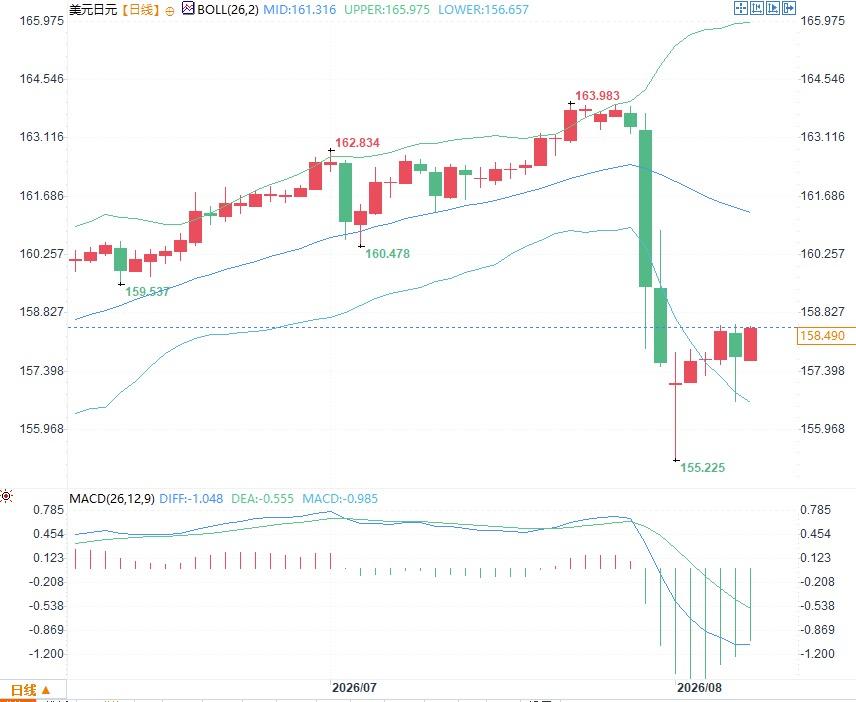 From a daily chart perspective, the Bollinger Band middle line is around 161.316, and the lower line is around 156.657, with the price currently trading below the middle line. The MACD DIFF is around -1.048, and the DEA is around -0.555, with the histogram still below the zero line. This reflects that the momentum indicators are still in negative territory after the previous rapid correction and do not constitute a judgment on future direction. More importantly, the consecutive large-bodied candlesticks and unusually long shadows indicate that the volatility structure has changed. After official intervention, conventional technical indicators are easily distorted by extreme single-day fluctuations; therefore, the interpretative value of these indicators needs to be reassessed in conjunction with policy events.
The core issue surrounding the USD/JPY exchange rate has shifted from simple interest rate differentials to policy credibility.
The main factors driving the USD/JPY exchange rate higher in the past were not complex. The Bank of Japan currently maintains its unsecured overnight call rate at around 1.0%, while the Federal Reserve's target range for the federal funds rate remains at 3.50% to 3.75%, maintaining a significant interest rate differential. On July 29, the Federal Reserve kept its policy rate unchanged and noted that inflation remained above its 2% target, meaning the cost of funds difference between the dollar and the yen has not yet disappeared. However, the market now needs to reassess not only the interest rate differential itself, but also the policymakers' tolerance for sharp exchange rate fluctuations. Previously, after the USD/JPY approached 164, the US and Japan took rare coordinated action, followed by a sharp adjustment in the exchange rate. This means that when market volatility is officially deemed excessive or disorderly, exchange rate pricing models based solely on interest rate differentials may be subject to interference from exogenous policy forces. The official framework itself also clearly states that foreign exchange intervention is mainly used to address excessive volatility and disorderly trends, rather than as a long-term substitute for monetary policy. Therefore, the variables in the market have now changed from one to three: the USD/JPY interest rate differential, the pace of the Bank of Japan's policy, and the official tolerance for the speed of exchange rate fluctuations.The new signals released by the Bank of Japan are more noteworthy than a single currency intervention.
The summary of the Bank of Japan's July meeting, released on August 10, revealed noteworthy changes. Most opinions still held that the impact of previous interest rate hikes on the economy and prices had a transmission lag of approximately one to one and a half years, thus maintaining the 1.0% interest rate in July was reasonable. However, several members explicitly mentioned that potential inflation was approaching 2%, financial conditions remained loose, and the degree of monetary easing should be further adjusted. More importantly, some opinions suggested that if economic, price, and financial conditions changed, the pace of interest rate hikes might be faster than previously expected by the market. This differs from the slow normalization logic the market was familiar with in the past. The meeting even saw a proposal to raise the policy rate to 1.25%, although it ultimately did not receive majority support, indicating that there are now voices within the Bank of Japan more actively tightening policy. The Bank of Japan also pointed out that the depreciation of the yen would put upward pressure on prices, and high oil prices, import prices, and domestic distribution costs could still affect consumer goods prices. The meeting concluded that price risks are currently clearly skewed to the upside. This shows that the exchange rate issue is no longer just a financial market issue, but is entering the monetary policy response function through import costs and inflation transmission.The slowdown in the US job market has altered interest rate expectations, but has not eliminated inflationary constraints.
The variables on the other end have also changed. The latest US non-farm payrolls decreased by 23,000, significantly lower than the market expectation of approximately 80,000, with an average increase of only about 20,000 jobs over the past three months. However, the unemployment rate actually fell to 4.1%, indicating that the job market is showing a coexistence of weakening new job creation and relatively stable existing indicators. This data has lowered market pricing for another Fed rate hike in September, with the probability now significantly reduced to about 45%. However, the Fed's official statement at the end of July still emphasized that inflation was above the 2% target, and three members at that meeting advocated for a 25 basis point rate hike. This shows that the US interest rate path remains highly dependent on inflation data, rather than being determined solely by a single month's employment data. Therefore, the USD/JPY exchange rate faces a rare combination: on one hand, US employment data is cooling; on the other hand, the Bank of Japan is becoming more sensitive to the upside risks of inflation, and the exchange rate market has added the additional variable of official coordinated action. The traditional single carry trade framework therefore needs to incorporate policy reaction functions and volatility factors. From a daily chart perspective, the Bollinger Band middle line is around 161.316, and the lower line is around 156.657, with the price currently trading below the middle line. The MACD DIFF is around -1.048, and the DEA is around -0.555, with the histogram still below the zero line. This reflects that the momentum indicators are still in negative territory after the previous rapid correction and do not constitute a judgment on future direction. More importantly, the consecutive large-bodied candlesticks and unusually long shadows indicate that the volatility structure has changed. After official intervention, conventional technical indicators are easily distorted by extreme single-day fluctuations; therefore, the interpretative value of these indicators needs to be reassessed in conjunction with policy events.
- Risk Warning and Disclaimer
- The market involves risk, and trading may not be suitable for all investors. This article is for reference only and does not constitute personal investment advice, nor does it take into account certain users’ specific investment objectives, financial situation, or other needs. Any investment decisions made based on this information are at your own risk.