Trump suddenly demands reparations from Iran! This adds further uncertainty to the Hormuz negotiations, causing oil prices to surge over 6% to a one-week high.
2026-08-11 08:02:57
In August 2026, the standoff between the US and Iran over the reopening of the Strait of Hormuz escalated again. US President Trump suddenly demanded substantial compensation from Iran, directly responding to Tehran's previous demands for compensation and the lifting of sanctions. This statement not only cast a shadow over the near-reached agreement on navigation through the strait but also instantly pushed international oil prices to a one-week high, causing renewed turbulence in the global energy market. 
Trump makes explicit demands for compensation for the first time
On Monday (August 10), Trump responded to Iran's demand for compensation for losses suffered in the past five months of military conflict in a post on the social media platform Truth Social. He wrote, "That's an interesting idea because now I'm also demanding compensation from Iran." Trump emphasized that the United States will seek compensation for those killed and wounded in the conflict and demand that Iran pay compensation to the families of hundreds of thousands of protesters allegedly killed by Iran. He further broadened the scope, stating that Iran should be held responsible for the injuries and deaths suffered by people in Lebanon, Syria, Yemen, and Gaza, while also mentioning that the families of the 17 U.S. sailors killed in the October 2000 attack on the Yemeni destroyer USS Cole should receive compensation. This demand had never been publicly made by Trump before. It directly responds to Tehran's demands for compensation and the lifting of sanctions, which are largely consistent with the preliminary peace agreement signed by both sides in June of this year but later collapsed. Since the U.S. and Israel launched airstrikes against Iran in February of this year, triggering a war, Trump's statements have oscillated between escalating the threat of conflict and claiming that a peace agreement is imminent. Now, his sudden demand for reciprocal compensation has further polarized the positions of both sides. Analysts point out that given neither side is likely to accept the other's demands, it remains unclear how any substantive agreement can be reached. Trump reiterated this position to the media at the White House, claiming that the United States effectively controls the Strait of Hormuz and has cleared Iranian mines from the strategic oil route. This statement further reinforces the US's hardline stance on the Strait issue.The prospects for reopening the Strait of Hormuz are once again uncertain.
The Strait of Hormuz, a crucial global energy corridor, handled approximately one-fifth of the world's oil and liquefied natural gas (LNG) shipments before the conflict. Since the start of the war in February, the strait has been effectively blocked, directly driving up oil prices and inflationary pressures. Iran previously stated it was close to reaching a final agreement with Oman to demarcate a new shipping route through the strait, but reiterated that the US must meet conditions such as compensation, lifting sanctions, and ceasing military threats before reopening this vital waterway. Iranian Foreign Ministry spokesman Bagheei stated earlier on Monday that negotiations with Oman were "progressing smoothly and constructively," with both sides agreeing on a shipping route, but some technical issues remained to be resolved. The two sides also discussed services typically requiring payment, such as safe navigation, environmental protection, maritime services, and combating crime. However, US officials have repeatedly ruled out any agreement allowing Tehran to charge for navigation through the strait. Ironically, once an arrangement is reached with Oman, Tehran's influence over this crucial waterway could be further enhanced than before the war. Iranian Foreign Minister Araqchi made it clear that Tehran would not initiate consultations with the United States as long as Washington continues to violate the interim agreement signed last June. Currently, no direct negotiations have taken place between the US and Iran, and Trump's compensation demands undoubtedly add a new obstacle to the already fragile reopening efforts.The sharp rise in oil prices reflects market concerns.
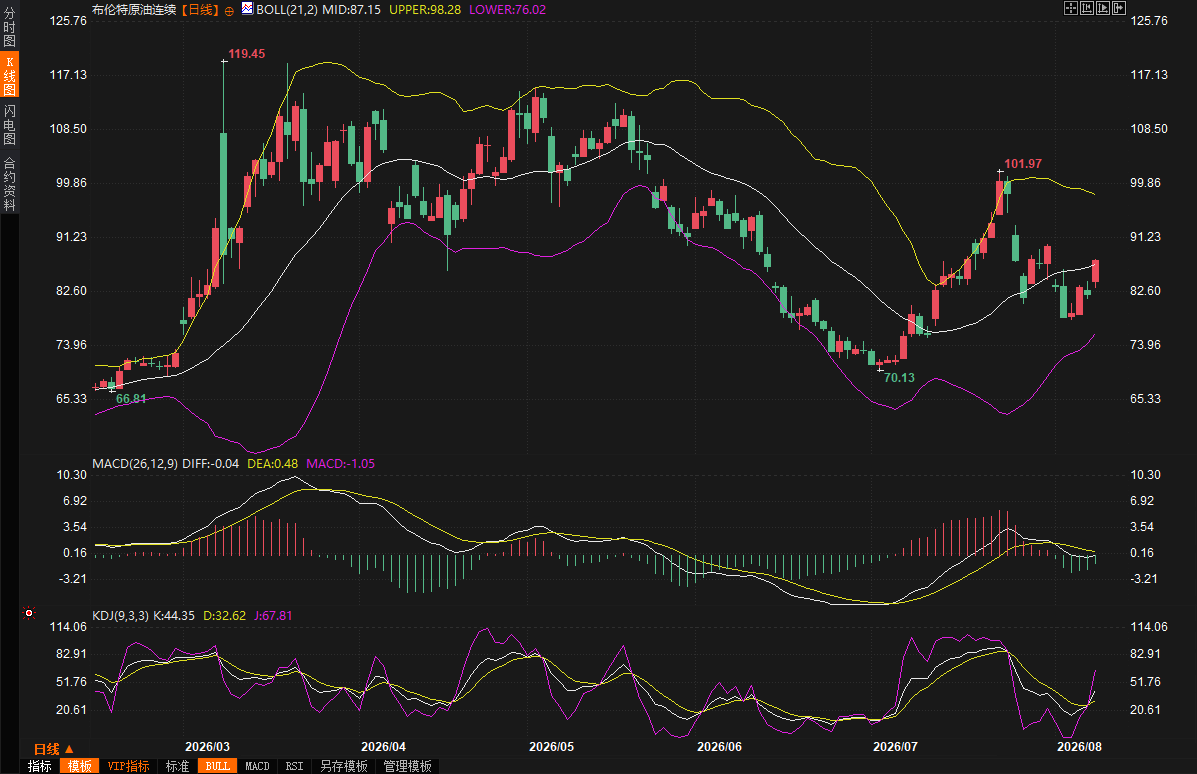
Following Trump's post, international oil prices reacted swiftly. Brent crude futures rose more than $5 from Friday's close, a gain of 6.82%, to settle at $87.82 per barrel; U.S. crude futures rose $5.22, a gain of 6.77%, to settle at $82.30 per barrel. Both benchmark oil prices recorded their largest single-day gains since July 29 and reached a one-week high. Last week, oil prices had fallen by more than 7%, boosted by expectations that Iran and Oman were close to reaching an agreement and that the Strait of Hormuz might reopen. Now, with escalating tensions between the U.S. and Iran, market concerns about a prolonged period of tight supply have risen significantly. At the same time, supply risks are also intensifying. The Houthi rebels, allied with Iran, claimed on Sunday that they had attacked Saudi Aramco's refinery in Jazan. Industry monitoring agencies indicated that the restart of the 400,000-barrel-per-day refinery has been postponed to August 30 due to two attacks in recent weeks. The Abu Dhabi National Oil Company of the United Arab Emirates also stated that 15 ships have been attacked while transiting the Strait of Hormuz since the conflict began. Data from the U.S. Department of Energy shows that U.S. strategic petroleum reserve crude oil inventories fell by approximately 6.1 million barrels last week to 298.7 million barrels, the lowest level since January 1983. These factors combined have further heightened market concerns about energy supply disruptions.Trump faces domestic political pressure
The war is extremely unpopular domestically in the United States, and Trump is under pressure to end the conflict as quickly as possible. With the November midterm elections approaching, high fuel prices have become one of the most pressing concerns for rural voters, one of his key support groups in the past. Democratic Representative Bill Keating bluntly stated on CNN, "What you're seeing now is the beginning of surrender. That's the reality, and people are gradually realizing it." Early in the conflict, Trump incited protesters to overthrow the Iranian government, while human rights organizations claim Iran has continued to suppress the opposition. His mention of the number of protester deaths in his reparations demands, and his attribution of the USS Cole incident to Iran (despite the widely held link to al-Qaeda), have further complicated the negotiating atmosphere. Overall, Trump's sudden demand for reciprocal reparations is both a strong response to Iran's earlier claims and makes the prospect of reopening negotiations in the Strait of Hormuz even more uncertain. The sharp antagonism between the two sides, coupled with significant oil price volatility and rising supply risks, has once again made the fate of this crucial energy corridor a focus of global attention. Whether future negotiations can achieve a breakthrough depends not only on whether the US and Iran can find room for compromise but also on the stability of the global energy market and the political maneuvering among relevant countries.Frequently Asked Questions
Q: Why did Trump suddenly demand compensation from Iran? How does this differ from his previous statements? A: Trump's move is a direct response to Iran's demands for compensation for losses from the past five months of military conflict. He had never publicly made a demand for reciprocal compensation before, but this time he explicitly stated that the US would seek compensation for those killed and wounded in the conflict, and demanded that Iran pay compensation to the families of the hundreds of thousands of protesters allegedly killed by Iran, extending this to Lebanon, Syria, Yemen, Gaza, and the 2000 USS Cole incident. This shift occurred after the breakdown of the initial US-Iran peace agreement, reflecting Trump's strategy of oscillating between escalating threats and a peaceful stance, aiming to increase leverage in negotiations while responding to domestic discontent over the cost of war. Q: Where are the negotiations for reopening the Strait of Hormuz currently stalled? What is the progress of the agreement between Iran and Oman? A: Iran has stated that it is close to reaching a final agreement with Oman on demarcating a new shipping lane. The two sides have largely reached an agreement on the route map, but technical issues remain to be resolved, and they have discussed potentially chargeable services such as safe navigation. However, Iran insists that the US must first meet conditions such as compensation, lifting sanctions, and ceasing military threats before the Strait will reopen. The US has ruled out any arrangements that would allow Iran to pay fees, and Trump's new demands for compensation have further exacerbated the confrontation. Currently, there are no direct negotiations between the US and Iran. Iran's foreign minister has clearly stated that consultations will not begin as long as the US violates the interim agreement, dimming the prospects for reopening. Q: Why did oil prices rise sharply after Trump's post? What does this mean for the global market? A: Oil prices closed up more than 6% on Monday, with Brent crude rising to $87.82 per barrel and US crude to $82.30 per barrel, marking the largest single-day increase in recent times. The main reason is that the US and Iran have raised mutual demands regarding compensation, leading the market to expect that the agreement to reopen the Strait of Hormuz will be delayed, and the tight supply situation may continue for longer. Last week, oil prices fell by more than 7% due to reopening expectations. Now, the escalating differences, coupled with factors such as the Houthi attack on Saudi oil refineries, attacks on UAE ships, and the decline of US strategic reserves to historic lows, have increased the risk of supply disruptions, which may further exacerbate global inflation and energy cost pressures. Q: What is the connection between the USS Cole incident and the deaths of protesters mentioned by Trump and Iran? A: Trump is demanding compensation from Iran for the 17 U.S. sailors killed in the 2000 attack on the USS Cole in Yemen, an incident widely blamed on al-Qaeda rather than Iran, making this attribution controversial. Regarding the protesters, Trump encouraged the overthrow of the Iranian government after the outbreak of war, and human rights organizations claim Iran's continued repression of the opposition, leading Trump to demand compensation for the families of hundreds of thousands of allegedly killed protesters. These demands conflate historical events with the current conflict, increasing the complexity of negotiations and reflecting the U.S. strategy of expanding the scope of claims to pressure Tehran. Q: What impact has this conflict had on Trump's domestic politics? What pressures does he face? A: War is extremely unpopular domestically, and high fuel prices have become a core concern for traditional support groups such as rural voters, especially with the November midterm elections approaching. Trump faces pressure to end the conflict quickly, with Democratic lawmakers even interpreting his recent statements as "the beginning of surrender." Meanwhile, the U.S. strategic petroleum reserve has fallen to its lowest level since 1983, further highlighting energy security risks. Trump's vacillating stance between threats and peace is an attempt to both appease domestic discontent and maintain a tough image in international negotiations, but its effectiveness still depends on whether it can truly push for the reopening of the Straits and a drop in oil prices. At 07:55 Beijing time, WTI crude oil was trading at $82.11 per barrel.- Risk Warning and Disclaimer
- The market involves risk, and trading may not be suitable for all investors. This article is for reference only and does not constitute personal investment advice, nor does it take into account certain users’ specific investment objectives, financial situation, or other needs. Any investment decisions made based on this information are at your own risk.