Japan injected 8.45 trillion yen into the market to "rescue" it, but the exchange rate rebounded by half two weeks later. Did the intervention fail?
2026-08-11 08:42:59
On Tuesday (August 11) in early Asian trading, the USD/JPY pair edged back to around 159.10, with overnight gains encountering resistance. The exchange rate has rebounded by approximately 400 points from last week's lows, essentially recovering half of the losses from its historical high near 164 to the 155 range. Previously, Japan's Ministry of Finance injected a record amount of funds in a single day to defend the exchange rate, and the following day coordinated action with the US, marking the first joint intervention in many years. However, the effects of the intervention are rapidly fading, and the market is demonstrating that even the largest intervention in history can only buy time, not a trend. 
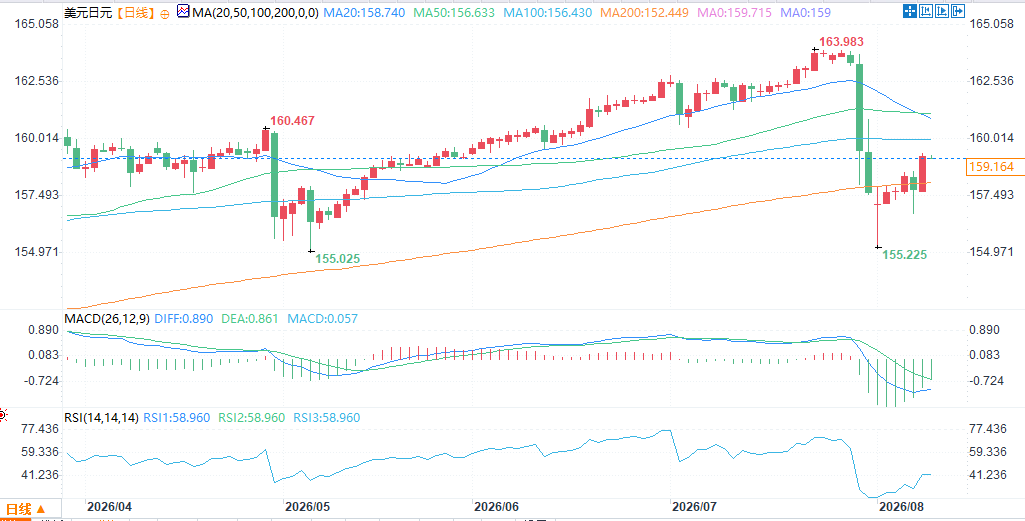 (USD/JPY daily chart, source: FX678) At 8:38 AM Beijing time on August 11, the USD/JPY exchange rate was 159.15/16.
Record-breaking intervention: The "expensive floor" before ammunition runs out.
Japan's Ministry of Finance injected 8.45 trillion yen in a single day to defend the exchange rate—not only the largest single-day intervention in Japanese history but also one of the largest unilateral operations in the global foreign exchange market since records began. The following day, Japan coordinated with the US Treasury to inject an additional approximately 5.3 trillion yen, marking the first time since 1998 that the US and Japan had jointly purchased yen. The Ministry of Finance explicitly stated that it "would not hesitate to act again" and indicated it would utilize the repurchase facility established by the Federal Reserve for foreign monetary authorities—a signal intended to demonstrate the depth of its intervention "ammunition." However, all these measures failed to maintain the dollar-yen exchange rate at a specific level for more than a few trading days. When intervention targets capital flow trends rather than price levels, it can only produce a one-off, impressive effect, failing to create a sustained buyer for the yen "next month"—the decisive moment in this game.Trade deficit: A "structural sell-off" of the yen
The intervention failed quickly because of a dramatic reversal in Japan's June current account data. The current account recorded a deficit of 92.3 billion yen in June, compared to market expectations of a surplus of approximately 1.5 trillion yen, and a reading of nearly 4 trillion yen in May—the first monthly deficit in about a year and a half, with a fluctuation exceeding 4 trillion yen in 30 days. This data was released on Sunday, just before the trading session that propelled the dollar against the yen in Asian trading on Monday. The details of the data are more important than the total—this reversal stemmed from import bills inflated by energy war premiums and the yen's depreciation making each shipment more expensive in local currency terms. A country with an external surplus automatically generates natural demand for its own currency each month, without any decision-making. A country that no longer has a surplus, however, must consciously buy its own currency—which is exactly what Japan's Ministry of Finance has been doing at a record cost.Interest rate differentials: the overwhelming force of gravity.
The policy spread across all these interventions has not narrowed by a single basis point since the operations began. The Bank of Japan's interest rate is 1.00%, while the Federal Reserve's interest rate range is 3.50% to 3.75%. Market pricing indicates a 49.93% probability of a 25 basis point rate hike on September 16 and a 50.07% probability of remaining unchanged; a 76.50% probability of at least one rate hike on October 28; and the current interest rate range is "unlikely to survive" before December 9. Such a wide spread will not narrow on its own simply because the Ministry of Finance disagrees. Cross-validation is the dollar itself—the dollar index was at its weakest level since early June in the latter half of last week and has only slightly recovered at the beginning of this week. Meanwhile, the dollar rose nearly 1% against the yen today. This is not a description of dollar demand, but rather a reflection of the yen losing ground even when the dollar is not favored by most market participants.Market Outlook: US Data Dominates Yen's Movement
This week, Japan's domestic economic calendar is almost blank, lacking any major data releases or policy events to significantly impact the market. Therefore, the USD/JPY exchange rate will heavily rely on US economic data. Investors will closely monitor the US inflation and consumer data released this week to determine if there are any new changes in the Federal Reserve's monetary policy path, which could affect the strength of the USD against the yen. Wednesday will see the release of the July Consumer Price Index (CPI). The market generally expects a 0.1% month-on-month increase in CPI, while the core CPI annual rate is expected to decline slightly from 2.6% in June to 2.5%. If the actual data meets or falls short of expectations, it will strengthen market confidence in a continued cooling of inflation, potentially weakening support for the dollar and thus benefiting the yen. Conversely, if inflation data unexpectedly strengthens, it could push up the dollar and limit the yen's rebound potential. Thursday's Producer Price Index (PPI) is also worth noting, with the market expecting a year-on-year growth rate of 4.9%. As a leading indicator of CPI, a persistently high PPI will suggest continued upstream cost pressures, potentially delaying expectations of a Fed rate cut and indirectly supporting the dollar. Around the same time, two regional Federal Reserve presidents will deliver speeches, and their comments on inflation and interest rates could further influence market sentiment. Friday will see the release of retail sales data, with an expected month-on-month increase of 0.2%. Retail sales are a key indicator of the resilience of US consumption; strong performance will boost the dollar, while weak performance could exacerbate market concerns about a US economic slowdown, thus benefiting the yen. Overall, the USD/JPY exchange rate this week will primarily revolve around US data. Investors should pay close attention to whether inflation data confirms a cooling trend and whether consumption data shows continued economic resilience. Any deviation from expectations could trigger rapid dollar fluctuations, thereby dominating the short-term direction of the yen.Summarize
Japan's record-breaking intervention provided short-term support for the yen, but did not change its long-term weakness. The USD/JPY exchange rate has given back about half of the intervention gains in two weeks. The trade deficit and interest rate differentials act as a "gravity" for the yen—the former eliminating natural buying pressure, and the latter continuously driving carry trades. Although the Japanese Ministry of Finance injected 8.45 trillion yen in a single day and had the support of the Federal Reserve's liquidity tools, the effect is destined to be short-lived when the intervention targets structural liquidity rather than price levels. The long-term direction of the yen depends on two variables: whether the Bank of Japan can substantially narrow the interest rate differential with the US, and whether Japan can reverse its trade deficit trend. Until then, every intervention has merely "bought time" for the yen, not "bought buyers." (USD/JPY daily chart, source: FX678) At 8:38 AM Beijing time on August 11, the USD/JPY exchange rate was 159.15/16.
- Risk Warning and Disclaimer
- The market involves risk, and trading may not be suitable for all investors. This article is for reference only and does not constitute personal investment advice, nor does it take into account certain users’ specific investment objectives, financial situation, or other needs. Any investment decisions made based on this information are at your own risk.