The driving forces behind aluminum prices have changed from above $3040 to above $3300.
2026-08-11 15:59:00
On Tuesday, August 11th, the pricing theme in the aluminum market is shifting back from the previous "recurring conflict premium" to "logistical constraints coupled with low inventory." The current LME aluminum price is approximately $3370 per tonne, up about 1.5% from the previous trading day, and up about 6.27% cumulatively over the past month. On August 10th, London warehouse aluminum inventories were only about 254,900 tons, continuing to be at extremely low levels in decades. Meanwhile, shipping safety incidents around the Strait of Hormuz continue, with another vessel reported being struck by an unidentified object near Oman on August 8th, indicating that the risk discount needed for supply chain recovery has not completely disappeared. 
 Macroeconomic factors also need to be considered. The Federal Reserve's July meeting maintained the target range for the federal funds rate at 3.50% to 3.75%, indicating that there are no new policy adjustments in the interest rate environment. For industrial metals, dollar liquidity and interest rate expectations still affect funding prices, but in the recent aluminum market, declining inventories and supply chain constraints are providing a stronger explanation for the commodity's own performance.
The rebound in aluminum prices is no longer primarily driven by sentiment-based trading.
The key point to note in this round of aluminum price increases is the simultaneous occurrence of price rises and inventory contraction. From August 4th to 10th, London warehouse aluminum inventories decreased from 260,900 tons to 254,900 tons, a reduction of approximately 6,000 tons in one week. On August 10th, the spot settlement price was $3,327.50 per ton, while the three-month aluminum futures price was $3,320.50 per ton, with the spot price maintaining a slight premium. This structure differs from a rebound driven solely by macroeconomic sentiment. The continued decline in inventories implies a decrease in the buffer capacity of deliverable resources, while the relatively strong spot price compared to longer-term contracts indicates that near-term metal supply still possesses a certain degree of scarcity. Therefore, the truly sensitive variable in the market has shifted from "whether news stimulates prices" to "how long the logistical disruptions will last and whether inventories can be effectively replenished." This also explains why recent news regarding negotiations has changed frequently, yet aluminum prices have not fully retraced previous gains. Once the supply chain is reorganized, transportation routes, insurance costs, inventory allocation, and delivery cycles will all lag. Even if the external situation eases temporarily, the recovery of physical logistics typically does not occur simultaneously.The Strait of Hormuz determines not production volume, but delivery capacity.
Before the conflict, the Middle East contributed nearly 10% of the global primary aluminum supply. Therefore, the market's focus on the Strait of Hormuz is not because the strait directly determines smelting capacity, but because it connects raw material inputs, finished product outputs, and energy transportation. Previously, regional smelters had already been disrupted by logistical and energy issues, forcing some to adjust their shipping routes. More importantly, aluminum is an industrial metal with a strong characteristic of continuous production. Once large-scale electrolytic aluminum facilities experience significant production reductions or even shutdowns, their recovery speed is typically slower than that of ordinary processing and manufacturing processes. Previously, a smelting facility in Qatar with an annual capacity of approximately 648,000 tons entered a shutdown process due to energy supply problems, and related information indicates that a full restart could take 6 to 12 months. Therefore, the market faces a triple layer of risk: the first layer is the availability of the shipping lanes themselves; the second layer is the delivery costs incurred by insurance, shipping schedules, and detours; and the third layer is the actual output of the smelters. Focusing solely on nominal capacity easily underestimates the impact of supply chain frictions on the spot market.Why does a 250,000-ton inventory amplify every supply disruption?
Inventory is currently the most significant amplifier in the aluminum market. On August 10th, London warehouse inventories were approximately 254,900 tons, compared to nearly 290,000 tons around July 10th. This continued decline in inventory means the exchange system's capacity to absorb sudden supply gaps is further shrinking. Hydro of Norway previously predicted that the global aluminum market's annual supply gap could reach approximately 900,000 tons, noting that if logistical disruptions in the Gulf region persist, the gap could widen further. It's important to note that 900,000 tons is not an isolated figure; it represents a significant quantitative advantage relative to current exchange-traded inventories. Therefore, the market will be more sensitive to changes in shipping schedules, production resumption times, and warehouse receipts. This is a key reason for the current divergence in price movements between aluminum and some other base metals. While macroeconomic factors continue to influence the entire metals sector, aluminum's own inventory and logistical constraints have significantly increased the weight of micro-level supply and demand factors.Technical structures are reflecting a renewed expansion of volatility.
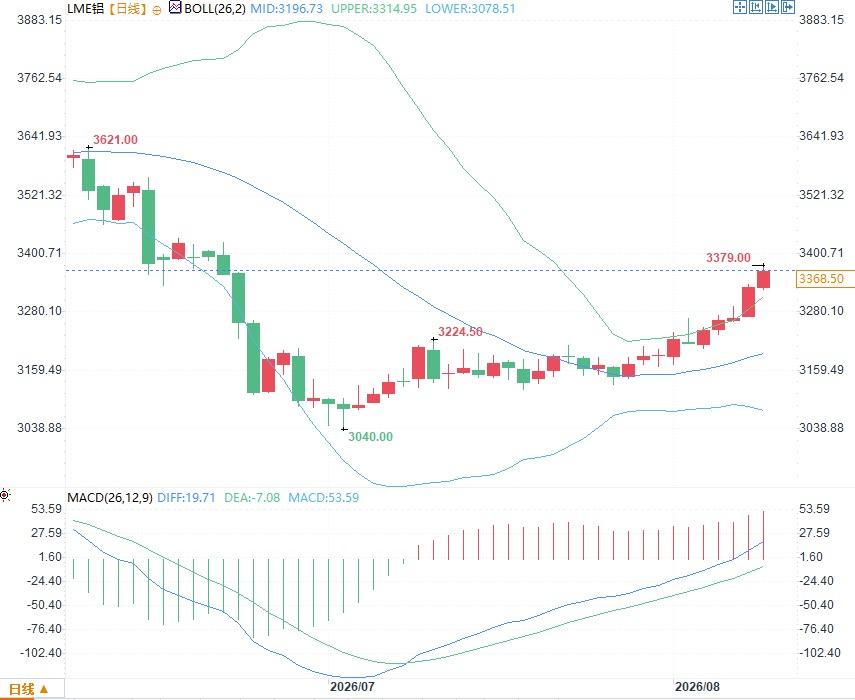
Observing the daily chart, aluminum prices entered a recovery phase after touching around $3040/ton, subsequently breaking through the previous local high of around $3224.50/ton and regaining a position above the Bollinger Middle Band. The Bollinger Middle Band is approximately $3196.73/ton, and the Upper Band is approximately $3314.95/ton. The recent price movement outside the Upper Band indicates that short-term volatility and price momentum are expanding in tandem. Regarding the MACD, the DIFF is approximately 19.71, the DEA is approximately -7.08, and the histogram is approximately 53.59, showing that the previously sustained recovery momentum has entered a more significant phase. Macroeconomic factors also need to be considered. The Federal Reserve's July meeting maintained the target range for the federal funds rate at 3.50% to 3.75%, indicating that there are no new policy adjustments in the interest rate environment. For industrial metals, dollar liquidity and interest rate expectations still affect funding prices, but in the recent aluminum market, declining inventories and supply chain constraints are providing a stronger explanation for the commodity's own performance.
- Risk Warning and Disclaimer
- The market involves risk, and trading may not be suitable for all investors. This article is for reference only and does not constitute personal investment advice, nor does it take into account certain users’ specific investment objectives, financial situation, or other needs. Any investment decisions made based on this information are at your own risk.