A cooling job market raises concerns about inflation; the Fed's policy shift hinges on a balance between price pressures and the dollar's performance.
2026-08-11 16:26:55
Following the release of the latest U.S. employment data, market focus is shifting regarding the Federal Reserve's future policy path. Previously, inflation was the core factor influencing policy decisions, but with signs of a slowdown in the labor market, the balance between employment and price pressures is becoming crucial for a market reassessment.  LPL Financial Chief Economist Jeffrey Roach stated that whether the Federal Reserve will take further action will depend on how long inflation remains at a high level. If price pressures persist, the Fed may maintain a tight stance even if the job market cools. Roach believes the current economic environment increases uncertainty in policy decisions. With slowing job growth, inflation is likely to become a major variable in the Fed's decision-making. If inflation falls slower than expected, the market may continue to bet on another Fed rate hike this year, but the room for further continuous tightening is limited. Vanguard Group analyst Hicklin stated that the July jobs report and market expectations of improved inflation will strengthen the case for the Fed to maintain stable interest rates before the end of the year. Market focus is gradually shifting from simply controlling inflation to the dynamic balance between job market performance and price stability. Previously, Fed policymakers have emphasized that inflation remains above the 2% long-term target, while changes in energy prices have increased uncertainty about future price trends. A Fed report indicated that energy supply shocks could drive up prices in some sectors, while the labor market as a whole remains relatively resilient. The market currently faces two policy scenarios: First, if CPI and core inflation continue to decline while the job market weakens further, the Federal Reserve may be more inclined to maintain current interest rates and await further confirmation from economic data. Second, if rising energy prices lead to a resurgence in inflation, the market may increase the probability of a Fed rate hike this year, thereby strengthening the dollar and increasing financial market volatility. Investors are currently awaiting the latest inflation data to determine whether the Fed will maintain its cautious policy stance. Recently, the market has significantly reduced expectations for a rapid tightening of policy in the short term, but the dollar still receives some support due to the lingering inflation risks. Looking at the dollar index, it is currently in a consolidation phase. Weak employment data limits the dollar's upside potential, but rising energy prices, inflation risks, and the expectation of a potential Fed rate hike provide some support. From a daily technical perspective, the dollar index is currently fluctuating between 99 and 100, forming a consolidation structure after a rebound. Prices are still trading near short-term moving averages, indicating a balance between bullish and bearish forces. The key resistance level to watch is around 100.20. A break above this level could see the US dollar index test the 101.00 area further; failure to break through could lead to a pullback to around 99.00 for support. On the daily chart, the dollar remains biased towards a range-bound movement, awaiting direction from macroeconomic data. Looking at the 4-hour chart, the dollar index shows weakening short-term momentum, with prices consolidating around 99.80. Technical indicators suggest a lack of clear trend; short-term focus is on a breakout from the 99.50-100.20 range. A break above 100.20 could open up further upside potential; a break below 99.50 could accelerate the pullback to the 99.00 area. Future price movements will be primarily influenced by US CPI and PPI data, as well as speeches from Federal Reserve officials.
 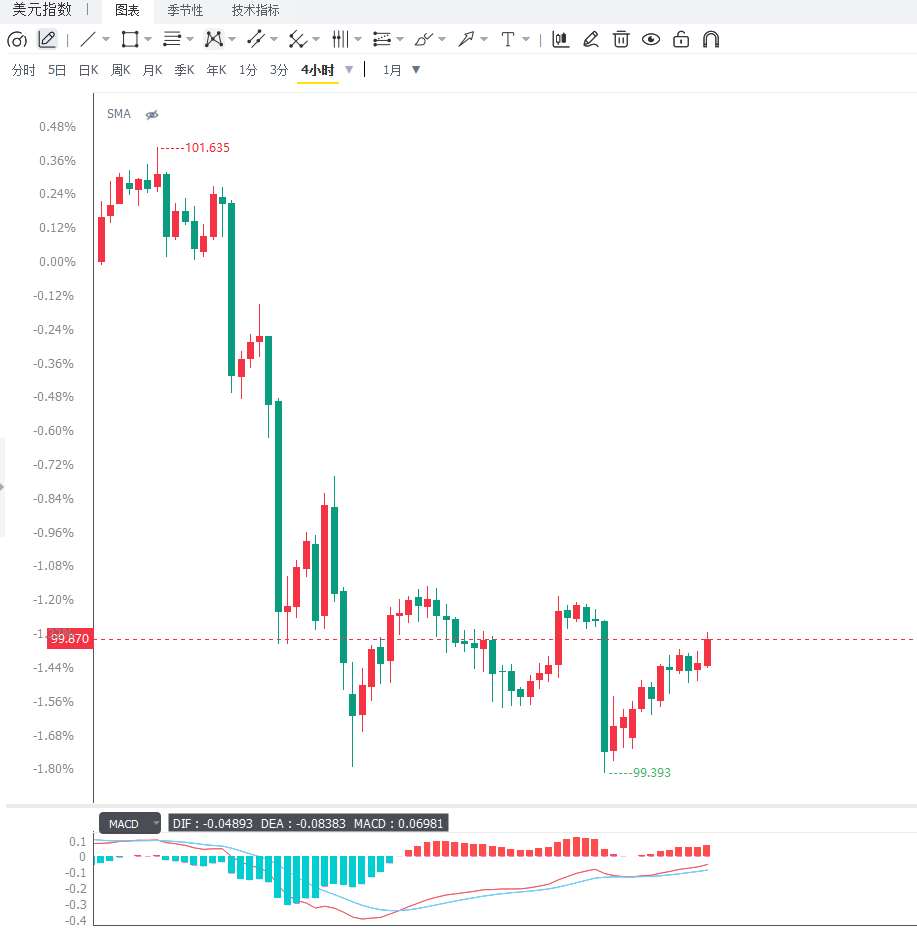 Editor's Summary: The Federal Reserve's policy is currently entering a more complex balancing phase. A cooling job market reduces the necessity for further tightening, but the inflationary risks from rising energy prices limit the possibility of a rapid shift to easing. The future direction of the US dollar will still largely depend on inflation data. If CPI continues to decline, the market may further lower its expectations for interest rate hikes, putting pressure on the dollar; however, if energy prices drive inflation back up, the probability of the Fed maintaining a hawkish stance increases, and the dollar may gain new upward momentum. Overall, the market is shifting from a "single-driven inflation" model to a model influenced by both employment and inflation. Close attention should be paid to US inflation data, changes in Treasury yields, and Fed policy signals, as these factors will determine the future trend of the dollar and the direction of global asset price fluctuations.
LPL Financial Chief Economist Jeffrey Roach stated that whether the Federal Reserve will take further action will depend on how long inflation remains at a high level. If price pressures persist, the Fed may maintain a tight stance even if the job market cools. Roach believes the current economic environment increases uncertainty in policy decisions. With slowing job growth, inflation is likely to become a major variable in the Fed's decision-making. If inflation falls slower than expected, the market may continue to bet on another Fed rate hike this year, but the room for further continuous tightening is limited. Vanguard Group analyst Hicklin stated that the July jobs report and market expectations of improved inflation will strengthen the case for the Fed to maintain stable interest rates before the end of the year. Market focus is gradually shifting from simply controlling inflation to the dynamic balance between job market performance and price stability. Previously, Fed policymakers have emphasized that inflation remains above the 2% long-term target, while changes in energy prices have increased uncertainty about future price trends. A Fed report indicated that energy supply shocks could drive up prices in some sectors, while the labor market as a whole remains relatively resilient. The market currently faces two policy scenarios: First, if CPI and core inflation continue to decline while the job market weakens further, the Federal Reserve may be more inclined to maintain current interest rates and await further confirmation from economic data. Second, if rising energy prices lead to a resurgence in inflation, the market may increase the probability of a Fed rate hike this year, thereby strengthening the dollar and increasing financial market volatility. Investors are currently awaiting the latest inflation data to determine whether the Fed will maintain its cautious policy stance. Recently, the market has significantly reduced expectations for a rapid tightening of policy in the short term, but the dollar still receives some support due to the lingering inflation risks. Looking at the dollar index, it is currently in a consolidation phase. Weak employment data limits the dollar's upside potential, but rising energy prices, inflation risks, and the expectation of a potential Fed rate hike provide some support. From a daily technical perspective, the dollar index is currently fluctuating between 99 and 100, forming a consolidation structure after a rebound. Prices are still trading near short-term moving averages, indicating a balance between bullish and bearish forces. The key resistance level to watch is around 100.20. A break above this level could see the US dollar index test the 101.00 area further; failure to break through could lead to a pullback to around 99.00 for support. On the daily chart, the dollar remains biased towards a range-bound movement, awaiting direction from macroeconomic data. Looking at the 4-hour chart, the dollar index shows weakening short-term momentum, with prices consolidating around 99.80. Technical indicators suggest a lack of clear trend; short-term focus is on a breakout from the 99.50-100.20 range. A break above 100.20 could open up further upside potential; a break below 99.50 could accelerate the pullback to the 99.00 area. Future price movements will be primarily influenced by US CPI and PPI data, as well as speeches from Federal Reserve officials. Editor's Summary: The Federal Reserve's policy is currently entering a more complex balancing phase. A cooling job market reduces the necessity for further tightening, but the inflationary risks from rising energy prices limit the possibility of a rapid shift to easing. The future direction of the US dollar will still largely depend on inflation data. If CPI continues to decline, the market may further lower its expectations for interest rate hikes, putting pressure on the dollar; however, if energy prices drive inflation back up, the probability of the Fed maintaining a hawkish stance increases, and the dollar may gain new upward momentum. Overall, the market is shifting from a "single-driven inflation" model to a model influenced by both employment and inflation. Close attention should be paid to US inflation data, changes in Treasury yields, and Fed policy signals, as these factors will determine the future trend of the dollar and the direction of global asset price fluctuations.
- Risk Warning and Disclaimer
- The market involves risk, and trading may not be suitable for all investors. This article is for reference only and does not constitute personal investment advice, nor does it take into account certain users’ specific investment objectives, financial situation, or other needs. Any investment decisions made based on this information are at your own risk.