A harsh remark jeopardized negotiations, causing crude oil risk premiums to surge.
2026-08-11 16:03:00
On Tuesday (August 11), during the Asian and European sessions, international oil prices continued to rise after holding onto Monday's 5% gain. Currently, WTI crude oil is trading around $83.95, up over 2.2%. As the US-Iran conflict enters a prolonged and dangerous stalemate, tensions in the Persian Gulf region are pushing the global oil supply chain into unprecedented turbulence. At the center of this game, US President Trump and Iran's new Supreme Leader Mojtaba Khamenei are each displaying mirror images of each other's political calculations. A deep analysis of the behavioral logic behind these two leaders helps to understand the underlying evolution of the current surge in tanker freight rates, the obstruction of navigation in the Strait of Hormuz, and the finalization of US-Iran negotiations. 
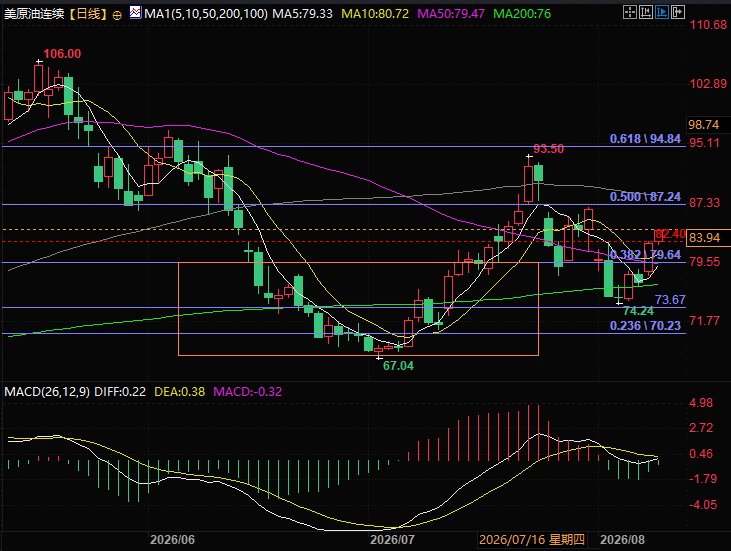 (WTI futures daily chart, source: EasyTrade) At 15:57 Beijing time, WTI crude oil futures were trading at $83.98 per barrel.
Trump's "exorbitant demands": a dual consideration of maximum pressure and domestic election prospects.
The recent US-Iran negotiations have devolved into an absurd yet inevitable tug-of-war over conditions. Faced with Iran's Foreign Ministry's demand that the US lift the port blockade, revoke sanctions, release frozen assets, and pay war reparations before reopening the Strait of Hormuz, Trump swiftly responded with fierce mockery on social media. He then filed a highly confrontational counterclaim, demanding massive compensation from Iran for US military personnel killed or wounded over decades due to its supported armed forces (including casualties from the 1983 Beirut bombing and the Iraq War) and the families of suppressed Iranian protesters, declaring this a bottom line for all future negotiations. This behavior can be interpreted as Trump adopting an uncompromising stance, his core intention not being genuinely seeking compensation from Iran, but rather a typical "maximum pressure" negotiating tactic. Domestically, with the November US midterm elections approaching, soaring oil prices have become a Achilles' heel for his political opponents. Trump must project an image of absolute toughness towards Iran to voters, avoiding any political pretext for perceived weakness or compromise. Externally, the United States attempts to force Iran to make maximum concessions on security issues without offering substantial economic relief (such as lifting the blockade) by including exorbitant demands in the negotiation framework.Iran's "strategic patience": waging a protracted war of attrition without fighting or making peace.
In contrast to Trump's high-profile counterattacks, Iran's top leadership is demonstrating a remarkably resilient long-term defensive posture. Internally, Iranian President Masoud Pezeshkian held a seven-hour meeting with the newly appointed Supreme Leader, Mojtaba. Although Mojtaba has not made a public appearance since being wounded in a US-Israeli airstrike in March, he has firmly secured military and political power by reorganizing the armed forces command and appointing the hardline former Revolutionary Guard commander, Mohsen Rezaei, to head the Supreme Security Council. Meanwhile, Majid Shakeri, an advisor to the Speaker of the Iranian Parliament, publicly revealed Tehran's strategic bottom line: "Trump will not reach any agreement with us; we will stand by him until the end of his term." This statement is quite harsh and could become a trigger for further escalation. Iran has publicly denied the possibility of negotiations with the United States, stating that its core strategy is to manage a state of "neither war nor peace," relying on ambiguity and "strategic patience" to wage a protracted war.Behavioral Interpretation:
Faced with months of bombing and economic sanctions from the United States, Tehran is experiencing a severe economic crisis and the risk of internal division. The new leader emphasizes "cohesion" and strengthening high-level security personnel to consolidate the legitimacy of his new power and prevent internal collapse. The Iranian leadership recognizes that the possibility of a breakthrough with the current US government is extremely low and has therefore decided to abandon any illusions about a quick lifting of sanctions. Through delaying tactics and by leveraging high oil prices to exert sustained pressure on the US midterm elections and the Western economic system, they are attempting to drag the US military into a costly political quagmire.Strait of Hormuz Blocked: Soaring Freight Rates and Collapse of the Crude Oil Supply Chain
The political rhetoric has directly impacted the physical crude oil transportation market, plunging the Strait of Hormuz, the world's most vital oil chokepoint, into an unprecedented navigation crisis. Due to frequent attacks on ships within the strait, the vast majority of major international shipowners have completely refused to sail into the Persian Gulf to avoid enormous risks. This has directly triggered severe turmoil in the global crude oil transportation market: chartering costs have surged, with the cost of chartering a Very Large Crude Carrier (VLCC) to transport crude oil on the industry benchmark route from the Middle East to Asia approaching $500,000 per day. The current situation is characterized by a highly homogenized navigation system; only state-owned fleets controlled by Middle Eastern oil-producing countries, a few extremely low-profile shipping companies (such as Sinokor), and small private shipowners with extremely high risk appetites still dare to traverse the route. The pricing mechanism is paralyzed, and industry litigation has ensued: with the precipitous drop in open market trading volume, the "liquidity" of the strait's navigation has severely dried up. This has rendered the main benchmark indicators for assessing tanker earnings ineffective, and has even triggered legal action by major international commodity traders against the Baltic Exchange. Furthermore, as a chain reaction, the Iranian-backed Houthi rebels in Yemen have intensified their offensive against the Red Sea and the Bab el-Mandeb Strait (such as the port of Mocha in Yemen), putting the two most critical maritime routes for global oil production in a state of high risk simultaneously.Viewpoints and Technical Analysis:
The deadlock between the US and Iran over trade issues is essentially a clash between domestic US electoral pressures and the survival logic of the Iranian Revolutionary Guard regime. Trump needs to maintain his political standing with strong rhetoric, while Tehran is using the safety of navigation in the Strait of Hormuz as leverage in a strategic game of "neither war nor peace." As long as this structural geopolitical stalemate remains unbroken, the oil industry chain will continue to bear extremely high geopolitical risk premiums, ultimately resulting in high logistics costs and the constant threat of supply disruptions. In the short term, the "high-risk, low-flow" state of Middle Eastern oil transportation will remain the norm in the global energy market. Technically, oil prices have rebounded and broken through the previous gap area, but there is significant resistance. Whether oil prices can maintain this price range will determine whether the current rebound will continue and whether it will turn into an upward trend. (WTI futures daily chart, source: EasyTrade) At 15:57 Beijing time, WTI crude oil futures were trading at $83.98 per barrel.
- Risk Warning and Disclaimer
- The market involves risk, and trading may not be suitable for all investors. This article is for reference only and does not constitute personal investment advice, nor does it take into account certain users’ specific investment objectives, financial situation, or other needs. Any investment decisions made based on this information are at your own risk.