The global oil market is shifting towards a shortage, with the IEA predicting the supply gap will widen to 1.3 million barrels per day by 2026.
2026-08-12 16:52:55
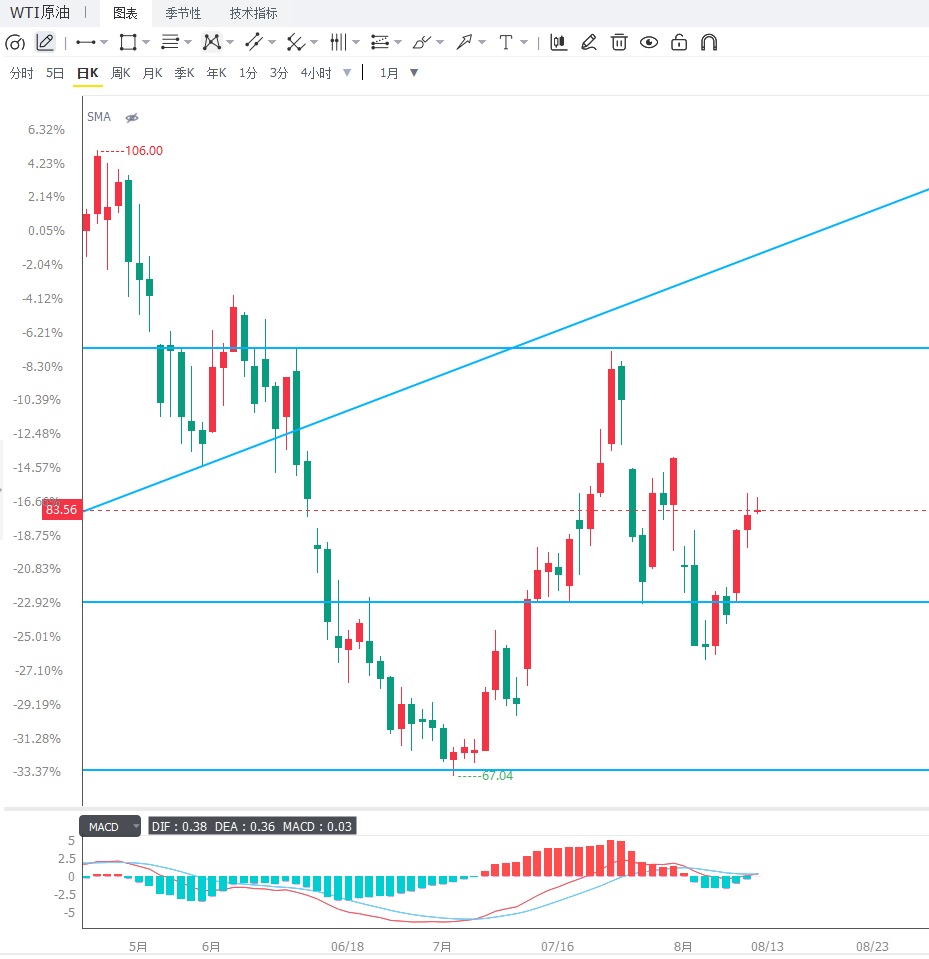
The International Energy Agency's (IEA) latest oil market assessment indicates that the global crude oil market is undergoing a significant supply-demand rebalancing. Although high oil prices have begun to suppress oil consumption through demand-damaging mechanisms, disruptions to shipping in the Strait of Hormuz and slow recovery in Middle Eastern production are exerting a stronger impact on the supply side.  The IEA projects that global oil inventories could fall more than twice as much as previously predicted due to ongoing conflicts and shipping disruptions, potentially creating a supply gap of approximately 1.8 million barrels per day (bpd) in the current quarter. If supply disruptions persist beyond expectations, 2026 could become the year with the most significant supply pressure in the global oil market in the past five years. Notably, the IEA also significantly lowered its global oil demand forecast. The agency projects that global oil demand will decline by approximately 1.56 million bpd in 2026, a further reduction of approximately 510,000 bpd from its previous forecast, bringing the total demand for the year to approximately 103.29 million bpd. This would be one of the years with the largest annual decline in global oil demand since the impact of the COVID-19 pandemic in 2020. This significant contraction in demand is closely related to rising energy prices and transportation disruptions. The Strait of Hormuz, a crucial global energy transport route, has seen its transport capacity decline, directly limiting crude oil exports and increasing shipping insurance, transportation, and refined product costs. When energy prices remain high, consumers and businesses will adjust by reducing fuel consumption and industrial activity, further depressing oil demand. However, the core contradiction in the market currently lies not in demand, but in supply. The IEA believes that even if high oil prices further suppress demand, global inventories will still decline rapidly because the recovery in supply cannot keep up with the adjustment on the consumption side. The contraction on the supply side is currently exceeding the rate of decline in demand, which is the key factor driving the global oil market back into a state of shortage. This change means that the market's previous logic that "high oil prices will inevitably lead to a decline in demand and eventually a supply glut" is temporarily invalidated, and short-term market pricing is shifting back to supply security and inventory levels. Inventory changes are particularly noteworthy. The global oil market has already experienced large-scale inventory depletion. Previous IEA data showed that in May, global observable oil inventories decreased by approximately 143 million barrels, a drop of 4.6 million barrels per day, with a significantly accelerated rate of decline; OECD government inventories also declined sharply, falling to their lowest level since December 1990. In March of this year, IEA member countries such as the United States, Japan, and Germany announced the release of a record amount of strategic petroleum reserves to alleviate supply shocks. As the market gradually returns to balance, these strategic reserves will need to be replenished in the future. Therefore, even if the conflict ends, the global oil market will still face a new source of demand: countries replenishing their strategic reserves may further increase crude oil purchases. This means that oil prices may be affected by two directions simultaneously in the future. On the one hand, the resumption of shipping through the Strait of Hormuz will release supply that was previously forced out of the market; on the other hand, the replenishment of strategic reserves by the United States, Japan, and parts of Europe may create additional crude oil demand. The IEA's forecast for 2027 reflects this high degree of uncertainty. The agency expects that if the situation between the United States and Iran gradually eases and shipping through the Strait of Hormuz resumes, global oil supply will rebound significantly. Under this assumption, global supply is expected to decline by about 4.3 million barrels per day year-on-year in 2026, while it may turn to an increase of about 8.3 million barrels per day in 2027. The global oil market may rapidly shift from a significant shortage to a large surplus within a year. The IEA predicts that the global oil market may have a supply gap of about 1.3 million barrels per day in 2026, while it may turn into a surplus of about 4.6 million barrels per day in 2027. This dramatic shift in supply and demand suggests that oil prices are likely to remain highly volatile in the future, rather than simply moving along a one-sided trend. If normal shipping through the Strait of Hormuz remains unrestored for an extended period, the widening supply gap will further push up crude oil risk premiums; conversely, if shipping recovers quickly, previously suppressed production may return to the market, creating a significant supply shock. From a demand perspective, high oil prices are themselves becoming a market self-correction mechanism. Rising crude oil prices increase the costs of gasoline, diesel, jet fuel, and industrial energy, impacting global economic activity through inflation. If prices remain high, the decline in demand may further widen, ultimately limiting the potential for continued price increases. Therefore, investors need to avoid judging oil price direction solely based on supply gaps. The biggest risk in the current crude oil market is not whether a supply gap exists, but rather how long the supply disruption will last and how quickly it will recover. If shipping recovers faster than market expectations, oil price risk premiums may contract rapidly; if supply recovery continues to be delayed, declining inventories may further drive up prices. Furthermore, the dollar's performance and global inflation expectations will also influence the financial attributes of crude oil. High oil prices could reignite inflationary pressures in the US and globally, prompting major central banks to maintain cautious monetary policies. Meanwhile, a stronger dollar could exert downward pressure on dollar-denominated crude oil from a valuation perspective. Therefore, the crude oil market may exhibit a very clear "two-stage logic" in the coming quarters: short-term driven by supply disruptions and declining inventories, and medium-term depending on the recovery of transportation, the reactivation of shut-down production capacity, and the extent of demand decline. The market's shift between these two logics will be a major reason for increased oil price volatility. WTI crude oil has recently maintained a strong rebound structure, with prices regaining ground near $82. Short-term moving averages are gradually trending upwards, and the MACD bullish momentum has strengthened. On the daily chart, the $82 level has become a crucial dividing line between bullish and bearish sentiment. The first resistance level to watch is $84.50; a decisive break above this level could lead to further tests of the $86 and $88 areas. Support levels to watch are $81, followed by $79.50 and $77. If oil prices can continue to hold above $82, the market will continue to trade on supply risk premiums. However, if geopolitical risks deteriorate rapidly while inventories continue to increase, prices may re-enter a period of high-level consolidation. From a 4-hour chart perspective, WTI crude oil maintains a short-term upward trend with consolidation. Prices have formed consecutive higher lows above $80, and while the RSI is in bullish territory, it hasn't yet reached extreme overbought levels, indicating that bulls remain in control in the short term. A break above $84.50 could open up further upside potential; however, if the rally fails and prices fall below $81, a pullback to around $79.50 should be anticipated. The current technical structure aligns with the fundamental supply risk, but chasing the price higher at these levels requires caution against a rapid reversal driven by news.
  The editor's summary of the IEA's latest assessment indicates that the global oil market is shifting from expectations of ample supply to expectations of tight supply. Demand is projected to decline significantly in 2026, but supply contraction will be even faster, leading to a continued decline in inventories. Therefore, shipping risks in the Strait of Hormuz have become a core variable determining oil price direction. In the short term, declining inventories and a supply gap will continue to provide a risk premium for WTI and Brent crude. If shipping disruptions persist, oil prices may have further upside potential; however, if the situation eases and shipping resumes, a rapid return of supply could lead to a significant pullback in oil prices. In the medium term, the potential oversupply of 4.6 million barrels per day in 2027 is particularly concerning. This means that the current supply tightness does not necessarily represent a long-term supply shortage, but may only be a temporary imbalance caused by geopolitical conflict. Investors need to closely monitor the recovery of shipping in the Strait of Hormuz, global inventories, the speed of strategic reserve replenishment, and the extent of damage to crude oil demand, seeking a new price balance between supply risks and expectations of future oversupply.
The IEA projects that global oil inventories could fall more than twice as much as previously predicted due to ongoing conflicts and shipping disruptions, potentially creating a supply gap of approximately 1.8 million barrels per day (bpd) in the current quarter. If supply disruptions persist beyond expectations, 2026 could become the year with the most significant supply pressure in the global oil market in the past five years. Notably, the IEA also significantly lowered its global oil demand forecast. The agency projects that global oil demand will decline by approximately 1.56 million bpd in 2026, a further reduction of approximately 510,000 bpd from its previous forecast, bringing the total demand for the year to approximately 103.29 million bpd. This would be one of the years with the largest annual decline in global oil demand since the impact of the COVID-19 pandemic in 2020. This significant contraction in demand is closely related to rising energy prices and transportation disruptions. The Strait of Hormuz, a crucial global energy transport route, has seen its transport capacity decline, directly limiting crude oil exports and increasing shipping insurance, transportation, and refined product costs. When energy prices remain high, consumers and businesses will adjust by reducing fuel consumption and industrial activity, further depressing oil demand. However, the core contradiction in the market currently lies not in demand, but in supply. The IEA believes that even if high oil prices further suppress demand, global inventories will still decline rapidly because the recovery in supply cannot keep up with the adjustment on the consumption side. The contraction on the supply side is currently exceeding the rate of decline in demand, which is the key factor driving the global oil market back into a state of shortage. This change means that the market's previous logic that "high oil prices will inevitably lead to a decline in demand and eventually a supply glut" is temporarily invalidated, and short-term market pricing is shifting back to supply security and inventory levels. Inventory changes are particularly noteworthy. The global oil market has already experienced large-scale inventory depletion. Previous IEA data showed that in May, global observable oil inventories decreased by approximately 143 million barrels, a drop of 4.6 million barrels per day, with a significantly accelerated rate of decline; OECD government inventories also declined sharply, falling to their lowest level since December 1990. In March of this year, IEA member countries such as the United States, Japan, and Germany announced the release of a record amount of strategic petroleum reserves to alleviate supply shocks. As the market gradually returns to balance, these strategic reserves will need to be replenished in the future. Therefore, even if the conflict ends, the global oil market will still face a new source of demand: countries replenishing their strategic reserves may further increase crude oil purchases. This means that oil prices may be affected by two directions simultaneously in the future. On the one hand, the resumption of shipping through the Strait of Hormuz will release supply that was previously forced out of the market; on the other hand, the replenishment of strategic reserves by the United States, Japan, and parts of Europe may create additional crude oil demand. The IEA's forecast for 2027 reflects this high degree of uncertainty. The agency expects that if the situation between the United States and Iran gradually eases and shipping through the Strait of Hormuz resumes, global oil supply will rebound significantly. Under this assumption, global supply is expected to decline by about 4.3 million barrels per day year-on-year in 2026, while it may turn to an increase of about 8.3 million barrels per day in 2027. The global oil market may rapidly shift from a significant shortage to a large surplus within a year. The IEA predicts that the global oil market may have a supply gap of about 1.3 million barrels per day in 2026, while it may turn into a surplus of about 4.6 million barrels per day in 2027. This dramatic shift in supply and demand suggests that oil prices are likely to remain highly volatile in the future, rather than simply moving along a one-sided trend. If normal shipping through the Strait of Hormuz remains unrestored for an extended period, the widening supply gap will further push up crude oil risk premiums; conversely, if shipping recovers quickly, previously suppressed production may return to the market, creating a significant supply shock. From a demand perspective, high oil prices are themselves becoming a market self-correction mechanism. Rising crude oil prices increase the costs of gasoline, diesel, jet fuel, and industrial energy, impacting global economic activity through inflation. If prices remain high, the decline in demand may further widen, ultimately limiting the potential for continued price increases. Therefore, investors need to avoid judging oil price direction solely based on supply gaps. The biggest risk in the current crude oil market is not whether a supply gap exists, but rather how long the supply disruption will last and how quickly it will recover. If shipping recovers faster than market expectations, oil price risk premiums may contract rapidly; if supply recovery continues to be delayed, declining inventories may further drive up prices. Furthermore, the dollar's performance and global inflation expectations will also influence the financial attributes of crude oil. High oil prices could reignite inflationary pressures in the US and globally, prompting major central banks to maintain cautious monetary policies. Meanwhile, a stronger dollar could exert downward pressure on dollar-denominated crude oil from a valuation perspective. Therefore, the crude oil market may exhibit a very clear "two-stage logic" in the coming quarters: short-term driven by supply disruptions and declining inventories, and medium-term depending on the recovery of transportation, the reactivation of shut-down production capacity, and the extent of demand decline. The market's shift between these two logics will be a major reason for increased oil price volatility. WTI crude oil has recently maintained a strong rebound structure, with prices regaining ground near $82. Short-term moving averages are gradually trending upwards, and the MACD bullish momentum has strengthened. On the daily chart, the $82 level has become a crucial dividing line between bullish and bearish sentiment. The first resistance level to watch is $84.50; a decisive break above this level could lead to further tests of the $86 and $88 areas. Support levels to watch are $81, followed by $79.50 and $77. If oil prices can continue to hold above $82, the market will continue to trade on supply risk premiums. However, if geopolitical risks deteriorate rapidly while inventories continue to increase, prices may re-enter a period of high-level consolidation. From a 4-hour chart perspective, WTI crude oil maintains a short-term upward trend with consolidation. Prices have formed consecutive higher lows above $80, and while the RSI is in bullish territory, it hasn't yet reached extreme overbought levels, indicating that bulls remain in control in the short term. A break above $84.50 could open up further upside potential; however, if the rally fails and prices fall below $81, a pullback to around $79.50 should be anticipated. The current technical structure aligns with the fundamental supply risk, but chasing the price higher at these levels requires caution against a rapid reversal driven by news. The editor's summary of the IEA's latest assessment indicates that the global oil market is shifting from expectations of ample supply to expectations of tight supply. Demand is projected to decline significantly in 2026, but supply contraction will be even faster, leading to a continued decline in inventories. Therefore, shipping risks in the Strait of Hormuz have become a core variable determining oil price direction. In the short term, declining inventories and a supply gap will continue to provide a risk premium for WTI and Brent crude. If shipping disruptions persist, oil prices may have further upside potential; however, if the situation eases and shipping resumes, a rapid return of supply could lead to a significant pullback in oil prices. In the medium term, the potential oversupply of 4.6 million barrels per day in 2027 is particularly concerning. This means that the current supply tightness does not necessarily represent a long-term supply shortage, but may only be a temporary imbalance caused by geopolitical conflict. Investors need to closely monitor the recovery of shipping in the Strait of Hormuz, global inventories, the speed of strategic reserve replenishment, and the extent of damage to crude oil demand, seeking a new price balance between supply risks and expectations of future oversupply.
- Risk Warning and Disclaimer
- The market involves risk, and trading may not be suitable for all investors. This article is for reference only and does not constitute personal investment advice, nor does it take into account certain users’ specific investment objectives, financial situation, or other needs. Any investment decisions made based on this information are at your own risk.