US July CPI is expected to cool slightly, but core inflation may rebound, putting the dollar at a critical juncture.
2026-08-12 16:58:56
The U.S. Bureau of Labor Statistics will release the July Consumer Price Index (CPI) on Wednesday. The market expects U.S. inflation to continue its slow decline, but the rate of cooling may be limited. Data shows that the overall CPI is expected to rise 0.1% month-on-month in July, with the year-on-year growth rate expected to decrease to 3.4% from 3.5% in June; the core CPI is expected to rise 0.2% month-on-month, with the year-on-year growth rate decreasing to 2.5% from 2.6%.  On the surface, overall US inflation remains on a downward trajectory, but the market's real focus is on whether core price pressures will continue to ease. The sharp decline in energy prices previously dragged down the June CPI significantly, but as this temporary factor gradually weakens, inflation may rebound somewhat in July. Crude oil prices fell continuously in May and June, even returning to pre-conflict levels, and the decline in gasoline prices significantly suppressed overall inflation. With the weakening impact of energy prices, service prices and core goods prices will once again become key indicators for judging the potential inflation trend in the US. TD Securities predicts that the core CPI may rise by about 0.20% month-on-month in July, mainly driven by a renewed acceleration in service sector prices, with significant changes likely in housing rents, landlord-equivalent rents, airfares, and medical and entertainment prices. Meanwhile, core goods prices are expected to rise for the first time after three consecutive months of decline. Whether service inflation can continue to cool will be an important indicator for judging the US inflation trend. If housing and other service prices accelerate again, even if energy costs remain relatively moderate, it may slow the decline in core inflation. The market expects the overall CPI to rise by about 0.15% month-on-month in July, with the decline in gasoline prices potentially partially offsetting the rise in food prices. Therefore, energy factors may still help keep overall inflation relatively moderate, but changes in food and service prices will determine whether new pressures emerge in the internal structure of inflation. The Federal Reserve is currently facing the dual pressures of a cooling labor market and inflation remaining above target. Previous employment data has already shown a slowdown in the labor market, providing some room for future policy adjustments. However, if service inflation rebounds while energy prices continue to rise, the Fed may need to maintain a more cautious policy stance. If the July CPI is lower than expected, the market may further increase its bets on future policy easing, potentially putting pressure on US Treasury yields and the dollar. Conversely, if the core CPI is significantly higher than expected, the market may again increase its expectations that the Fed will maintain a restrictive policy, potentially supporting the dollar and US Treasury yields. In addition, international crude oil prices have recently risen significantly due to supply risks. If oil prices continue to remain high, gasoline and transportation costs may again increase inflationary pressures. This means that even if the July CPI meets market expectations, investors still need to pay attention to whether energy prices are changing the inflation path in the coming months. From a market impact perspective, the US dollar will be the most direct trading target for this CPI data. Lower-than-expected inflation could push the dollar lower, while higher-than-expected core inflation could strengthen the dollar's bullish trend. The market will also be watching whether US Treasury yields move in tandem with the dollar to determine the sustainability of the rally. The dollar index has rebounded recently, rising to around 99.90 during Wednesday's Asian trading session, marking its third consecutive day of gains and approaching the 100 mark again. The daily chart shows a significant improvement in the dollar's short-term bullish momentum, with the MACD gradually recovering upwards and the price trading near short-term moving averages, indicating a shift from a weak, oscillating pattern to a slightly stronger one. The first resistance level to watch is the 100.00-100.50 area; a successful break and hold above this level would target the 101.20 area. Initial support is seen at 99.20, followed by the 98.50 area. A break below 98.50 could weaken the recent rebound. On the 4-hour chart, the dollar index maintains an upward oscillating structure, with short-term moving averages trending upwards and the RSI in a slightly bullish zone but not yet clearly overbought, suggesting further upside potential. The area around 99.80 has become a key short-term support level. If the CPI is lower than expected and causes the dollar to fall below this area, it may quickly retreat to around 99.20. If the data reinforces the Fed's hawkish expectations and pushes the index above 100.00, it may further test the 100.50 or even 101.00 area in the short term. Overall, the short-term direction of the dollar is highly dependent on CPI data, and the 100 level will be a crucial watershed between bullish and bearish sentiment in this round of market movements.
 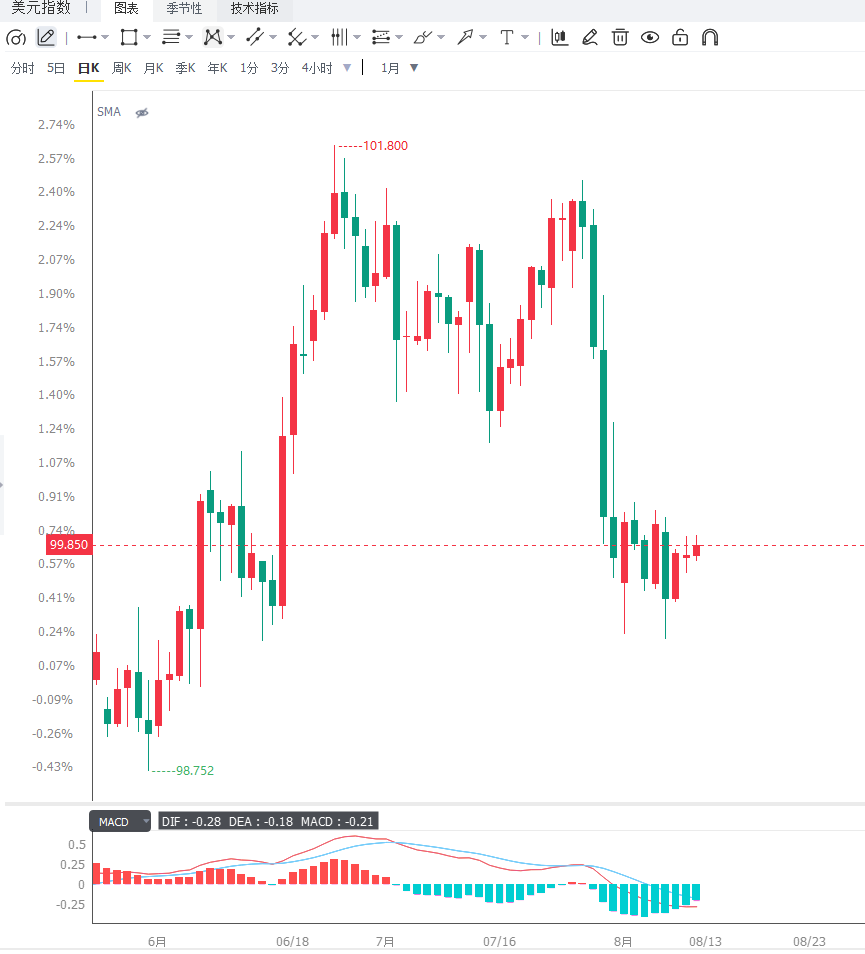 Editor's Summary: The key to the US July CPI is not just whether overall inflation declined year-on-year, but whether core service and core goods prices can continue to remain moderate. If service inflation accelerates again, the Federal Reserve may extend its restrictive policy and provide support for the dollar; if core inflation continues to cool, the market may re-strengthen expectations of policy easing. Technically, the dollar index has once again approached the 100 mark and is currently in a key breakout zone. Short-term focus is on the 99.20 support level and the 100.00-100.50 resistance zone. If a breakout occurs after the CPI release, the dollar may break out of its recent consolidation pattern and establish a new directional trend.
On the surface, overall US inflation remains on a downward trajectory, but the market's real focus is on whether core price pressures will continue to ease. The sharp decline in energy prices previously dragged down the June CPI significantly, but as this temporary factor gradually weakens, inflation may rebound somewhat in July. Crude oil prices fell continuously in May and June, even returning to pre-conflict levels, and the decline in gasoline prices significantly suppressed overall inflation. With the weakening impact of energy prices, service prices and core goods prices will once again become key indicators for judging the potential inflation trend in the US. TD Securities predicts that the core CPI may rise by about 0.20% month-on-month in July, mainly driven by a renewed acceleration in service sector prices, with significant changes likely in housing rents, landlord-equivalent rents, airfares, and medical and entertainment prices. Meanwhile, core goods prices are expected to rise for the first time after three consecutive months of decline. Whether service inflation can continue to cool will be an important indicator for judging the US inflation trend. If housing and other service prices accelerate again, even if energy costs remain relatively moderate, it may slow the decline in core inflation. The market expects the overall CPI to rise by about 0.15% month-on-month in July, with the decline in gasoline prices potentially partially offsetting the rise in food prices. Therefore, energy factors may still help keep overall inflation relatively moderate, but changes in food and service prices will determine whether new pressures emerge in the internal structure of inflation. The Federal Reserve is currently facing the dual pressures of a cooling labor market and inflation remaining above target. Previous employment data has already shown a slowdown in the labor market, providing some room for future policy adjustments. However, if service inflation rebounds while energy prices continue to rise, the Fed may need to maintain a more cautious policy stance. If the July CPI is lower than expected, the market may further increase its bets on future policy easing, potentially putting pressure on US Treasury yields and the dollar. Conversely, if the core CPI is significantly higher than expected, the market may again increase its expectations that the Fed will maintain a restrictive policy, potentially supporting the dollar and US Treasury yields. In addition, international crude oil prices have recently risen significantly due to supply risks. If oil prices continue to remain high, gasoline and transportation costs may again increase inflationary pressures. This means that even if the July CPI meets market expectations, investors still need to pay attention to whether energy prices are changing the inflation path in the coming months. From a market impact perspective, the US dollar will be the most direct trading target for this CPI data. Lower-than-expected inflation could push the dollar lower, while higher-than-expected core inflation could strengthen the dollar's bullish trend. The market will also be watching whether US Treasury yields move in tandem with the dollar to determine the sustainability of the rally. The dollar index has rebounded recently, rising to around 99.90 during Wednesday's Asian trading session, marking its third consecutive day of gains and approaching the 100 mark again. The daily chart shows a significant improvement in the dollar's short-term bullish momentum, with the MACD gradually recovering upwards and the price trading near short-term moving averages, indicating a shift from a weak, oscillating pattern to a slightly stronger one. The first resistance level to watch is the 100.00-100.50 area; a successful break and hold above this level would target the 101.20 area. Initial support is seen at 99.20, followed by the 98.50 area. A break below 98.50 could weaken the recent rebound. On the 4-hour chart, the dollar index maintains an upward oscillating structure, with short-term moving averages trending upwards and the RSI in a slightly bullish zone but not yet clearly overbought, suggesting further upside potential. The area around 99.80 has become a key short-term support level. If the CPI is lower than expected and causes the dollar to fall below this area, it may quickly retreat to around 99.20. If the data reinforces the Fed's hawkish expectations and pushes the index above 100.00, it may further test the 100.50 or even 101.00 area in the short term. Overall, the short-term direction of the dollar is highly dependent on CPI data, and the 100 level will be a crucial watershed between bullish and bearish sentiment in this round of market movements. Editor's Summary: The key to the US July CPI is not just whether overall inflation declined year-on-year, but whether core service and core goods prices can continue to remain moderate. If service inflation accelerates again, the Federal Reserve may extend its restrictive policy and provide support for the dollar; if core inflation continues to cool, the market may re-strengthen expectations of policy easing. Technically, the dollar index has once again approached the 100 mark and is currently in a key breakout zone. Short-term focus is on the 99.20 support level and the 100.00-100.50 resistance zone. If a breakout occurs after the CPI release, the dollar may break out of its recent consolidation pattern and establish a new directional trend.
- Risk Warning and Disclaimer
- The market involves risk, and trading may not be suitable for all investors. This article is for reference only and does not constitute personal investment advice, nor does it take into account certain users’ specific investment objectives, financial situation, or other needs. Any investment decisions made based on this information are at your own risk.