USD/JPY's rebound lacked momentum, with the 160 level becoming a key dividing line between bullish and bearish sentiment.
2026-08-13 15:11:02
The USD/JPY pair remained largely stable in Asian trading on Thursday, trading around 159.40. The pair has been fluctuating around the 160 yen level recently. On the one hand, the interest rate differential between the US and Japan, as well as carry trade demand, continue to support the US dollar. On the other hand, market concerns about renewed intervention by Japanese authorities in the foreign exchange market have intensified, putting strong resistance for the USD/JPY pair near the 160 level.  Japanese Finance Minister Satsuki Katayama previously stated that the US and Japan had jointly intervened in the foreign exchange market to address the recent sharp fluctuations and disorderly movements in the yen exchange rate. US President Trump also confirmed US participation in this action, calling it a "friendly signal." The impact of this policy signal on the market lies not only in the actual scale of intervention, but more importantly, in re-establishing expectations of potential official action around the 160 level. Currently, 160.00 has become the most sensitive policy and psychological barrier for USD/JPY. If USD/JPY breaks through this level rapidly again, traders may worry that the Japanese Ministry of Finance will resume yen-buying operations, thus some long positions may be reduced in advance. The market's pricing of the risk of Japanese intervention is, to some extent, limiting the upside potential of USD/JPY. However, exchange rate intervention itself does not change the fundamental logic of interest rate differentials and capital returns. Monex Group expert Jesper Cole points out that as long as Japanese funding costs remain lower than overseas asset yields, carry trades have a basis for renewed activity. This means that even if official intervention can temporarily push up the yen, as long as the US-Japan interest rate differential remains attractive, the trend of funds flowing back to high-yield assets may resume. Therefore, whether USD/JPY can continue to fall below 160 ultimately depends on whether Japan's monetary policy can form a clearer expectation of tightening. If the Bank of Japan raises interest rates further, or the market significantly increases its bets on future policy normalization, the fundamental support for the yen will strengthen, and the exchange rate may gradually move away from the high area around 160. The summary of opinions from the Bank of Japan's July meeting has already released noteworthy policy signals. Some policymakers discussed the possibility of accelerating the pace of interest rate hikes due to rising inflation risks, especially concerned about price growth exceeding the Bank of Japan's 2% target. If inflation continues to remain at a high level in the future, the Bank of Japan may further discuss policy adjustments at its September meeting. This means that the Bank of Japan's policy path is becoming an important variable affecting USD/JPY. One of the important reasons for the yen's long-term pressure was the large interest rate gap between Japan and the United States. If the Bank of Japan gradually raises policy rates, while US interest rate expectations decline due to cooling inflation, the US-Japan interest rate differential may narrow further, reducing the attractiveness of carry trades. In the US, investors are currently waiting for the July Producer Price Index (PPI). Previously, the US July CPI rose 3.4% year-on-year, and the core CPI rose 2.5% year-on-year, both lower than the previous values, indicating no renewed acceleration in inflation. This lowered market expectations for further tightening by the Federal Reserve in the near future and put some pressure on the US dollar. However, rising energy prices remain a potential risk to the US inflation outlook. If international oil prices continue to rise due to supply risks, producer costs and consumer prices may be pushed up again. If the July PPI is higher than expected, the market may reassess the US interest rate path, and the US dollar is expected to receive short-term support, pushing USD/JPY to retest 160. Conversely, if the PPI continues to be moderate, market expectations for further tightening by the Federal Reserve may continue to decline, while US Treasury yields will be suppressed, and USD/JPY will face greater downward pressure. In this case, the expectation of policy normalization by the Bank of Japan and the potential risk of intervention may resonate, and the appreciation of the yen may accelerate. From a market sentiment perspective, USD/JPY is not currently showing a clear one-sided trend. Investors are neither willing to chase the rise heavily near 160, nor do they have sufficient reason to continue shorting the US dollar given the still large interest rate differential between the US and Japan. Therefore, the market is more likely to fluctuate around the 158.50-160.00 range in the short term until new policies or economic data provide a breakthrough. Furthermore, the statements from the Japanese Ministry of Finance warrant continued attention. If Japanese officials reiterate their concerns about excessive exchange rate volatility, the market may preemptively trade intervention risks; if the official stance becomes calmer and US yields rise again, USD/JPY may retest above 160. Thus, the current USD/JPY is not merely a carry trade, but also a result of the combined effects of monetary policy and exchange rate management expectations. From a daily chart perspective, USD/JPY is currently in a consolidation phase after a recent pullback from highs, with the price trading near the 100-day moving average at 160.00 and below the 20-day Bollinger Band middle line at approximately 160.65, indicating that the short-term overall trend remains under pressure from the moving averages. The 14-day RSI is approximately 43.38, below the neutral level of 50, but not yet in oversold territory, suggesting that upward momentum is weakening, but the bears have not yet gained extreme dominance. The first resistance level to watch is the 159.50-160.00 area, with 160.00 corresponding to both the 100-day moving average and a key psychological level. If the price can effectively break through and hold above 160.00, and further break through 160.65, it would indicate a reduction in short-term bearish pressure, potentially leading to a retest of 162.00 and the upper Bollinger Band around 165.70. If selling pressure persists around 160, the exchange rate may remain in a high-level consolidation phase. On the downside, 158.50 is currently a key short-term support level. A break below this level could lead to a further short-term correction towards 157.00 and even the lower Bollinger Band around 155.60. Particular attention should be paid to whether a break below 158.50 triggers an accelerated decline, as a renewed amplification of Japanese policy expectations or intervention risks could lead to a rapid appreciation of the yen. On the 4-hour chart, USD/JPY is currently in a slightly bearish consolidation phase, with the price repeatedly facing resistance below the 160 level. If the bulls can break through 159.50 and further rise above 160.00, the short-term trend may strengthen again; however, if it continues to be suppressed by the 159.50-160.00 area and falls below 158.50, it means that the previous rebound structure has weakened further. Currently, neither the RSI nor the price structure supports aggressive buying; the market is better off waiting for a valid breakout of the key range before determining the next direction.
 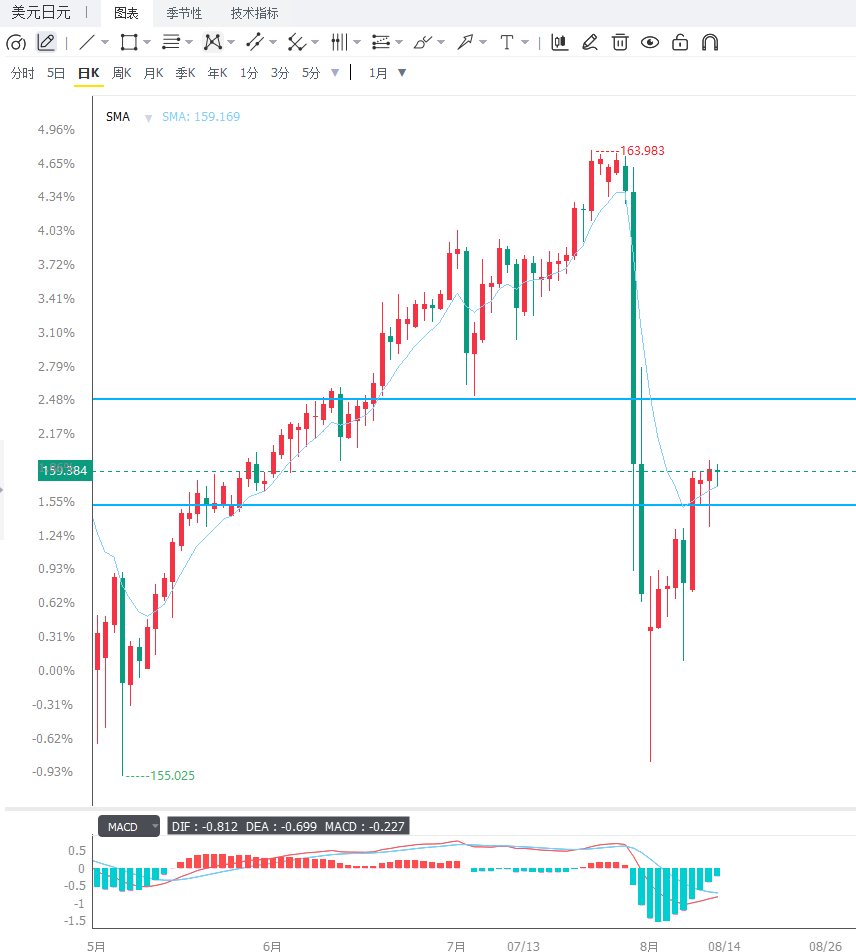 The biggest contradiction in the USD/JPY pair right now lies in the fact that while the USD/JPY interest rate differential still supports carry trades, the risk of official intervention near the 160 level is significantly limiting the dollar's upside potential. Meanwhile, the Bank of Japan's increased focus on inflation risks also increases the likelihood of future policy normalization. In the short term, 160.00 is the core area where bulls and bears clash and policy risks converge, while 158.50 is a crucial support level. If US PPI is higher than expected and pushes up US Treasury yields, USD/JPY may challenge 160 again; if US price pressures continue to ease while expectations of a Bank of Japan rate hike rise, the exchange rate may fall below 158.50 and further seek support at 157.00 or even 155.60. In the medium term, whether USD/JPY can reopen its upside potential depends on whether the USD/JPY interest rate differential continues to widen and whether the Japanese authorities intervene again. Even if carry trades still offer a yield advantage, the policy risks near 160 mean that the risk-reward ratio for chasing the rally is declining. If US inflation continues to decline and Japan's policy normalization occurs simultaneously, the medium-term adjustment pressure on the USD/JPY exchange rate may further increase.
Japanese Finance Minister Satsuki Katayama previously stated that the US and Japan had jointly intervened in the foreign exchange market to address the recent sharp fluctuations and disorderly movements in the yen exchange rate. US President Trump also confirmed US participation in this action, calling it a "friendly signal." The impact of this policy signal on the market lies not only in the actual scale of intervention, but more importantly, in re-establishing expectations of potential official action around the 160 level. Currently, 160.00 has become the most sensitive policy and psychological barrier for USD/JPY. If USD/JPY breaks through this level rapidly again, traders may worry that the Japanese Ministry of Finance will resume yen-buying operations, thus some long positions may be reduced in advance. The market's pricing of the risk of Japanese intervention is, to some extent, limiting the upside potential of USD/JPY. However, exchange rate intervention itself does not change the fundamental logic of interest rate differentials and capital returns. Monex Group expert Jesper Cole points out that as long as Japanese funding costs remain lower than overseas asset yields, carry trades have a basis for renewed activity. This means that even if official intervention can temporarily push up the yen, as long as the US-Japan interest rate differential remains attractive, the trend of funds flowing back to high-yield assets may resume. Therefore, whether USD/JPY can continue to fall below 160 ultimately depends on whether Japan's monetary policy can form a clearer expectation of tightening. If the Bank of Japan raises interest rates further, or the market significantly increases its bets on future policy normalization, the fundamental support for the yen will strengthen, and the exchange rate may gradually move away from the high area around 160. The summary of opinions from the Bank of Japan's July meeting has already released noteworthy policy signals. Some policymakers discussed the possibility of accelerating the pace of interest rate hikes due to rising inflation risks, especially concerned about price growth exceeding the Bank of Japan's 2% target. If inflation continues to remain at a high level in the future, the Bank of Japan may further discuss policy adjustments at its September meeting. This means that the Bank of Japan's policy path is becoming an important variable affecting USD/JPY. One of the important reasons for the yen's long-term pressure was the large interest rate gap between Japan and the United States. If the Bank of Japan gradually raises policy rates, while US interest rate expectations decline due to cooling inflation, the US-Japan interest rate differential may narrow further, reducing the attractiveness of carry trades. In the US, investors are currently waiting for the July Producer Price Index (PPI). Previously, the US July CPI rose 3.4% year-on-year, and the core CPI rose 2.5% year-on-year, both lower than the previous values, indicating no renewed acceleration in inflation. This lowered market expectations for further tightening by the Federal Reserve in the near future and put some pressure on the US dollar. However, rising energy prices remain a potential risk to the US inflation outlook. If international oil prices continue to rise due to supply risks, producer costs and consumer prices may be pushed up again. If the July PPI is higher than expected, the market may reassess the US interest rate path, and the US dollar is expected to receive short-term support, pushing USD/JPY to retest 160. Conversely, if the PPI continues to be moderate, market expectations for further tightening by the Federal Reserve may continue to decline, while US Treasury yields will be suppressed, and USD/JPY will face greater downward pressure. In this case, the expectation of policy normalization by the Bank of Japan and the potential risk of intervention may resonate, and the appreciation of the yen may accelerate. From a market sentiment perspective, USD/JPY is not currently showing a clear one-sided trend. Investors are neither willing to chase the rise heavily near 160, nor do they have sufficient reason to continue shorting the US dollar given the still large interest rate differential between the US and Japan. Therefore, the market is more likely to fluctuate around the 158.50-160.00 range in the short term until new policies or economic data provide a breakthrough. Furthermore, the statements from the Japanese Ministry of Finance warrant continued attention. If Japanese officials reiterate their concerns about excessive exchange rate volatility, the market may preemptively trade intervention risks; if the official stance becomes calmer and US yields rise again, USD/JPY may retest above 160. Thus, the current USD/JPY is not merely a carry trade, but also a result of the combined effects of monetary policy and exchange rate management expectations. From a daily chart perspective, USD/JPY is currently in a consolidation phase after a recent pullback from highs, with the price trading near the 100-day moving average at 160.00 and below the 20-day Bollinger Band middle line at approximately 160.65, indicating that the short-term overall trend remains under pressure from the moving averages. The 14-day RSI is approximately 43.38, below the neutral level of 50, but not yet in oversold territory, suggesting that upward momentum is weakening, but the bears have not yet gained extreme dominance. The first resistance level to watch is the 159.50-160.00 area, with 160.00 corresponding to both the 100-day moving average and a key psychological level. If the price can effectively break through and hold above 160.00, and further break through 160.65, it would indicate a reduction in short-term bearish pressure, potentially leading to a retest of 162.00 and the upper Bollinger Band around 165.70. If selling pressure persists around 160, the exchange rate may remain in a high-level consolidation phase. On the downside, 158.50 is currently a key short-term support level. A break below this level could lead to a further short-term correction towards 157.00 and even the lower Bollinger Band around 155.60. Particular attention should be paid to whether a break below 158.50 triggers an accelerated decline, as a renewed amplification of Japanese policy expectations or intervention risks could lead to a rapid appreciation of the yen. On the 4-hour chart, USD/JPY is currently in a slightly bearish consolidation phase, with the price repeatedly facing resistance below the 160 level. If the bulls can break through 159.50 and further rise above 160.00, the short-term trend may strengthen again; however, if it continues to be suppressed by the 159.50-160.00 area and falls below 158.50, it means that the previous rebound structure has weakened further. Currently, neither the RSI nor the price structure supports aggressive buying; the market is better off waiting for a valid breakout of the key range before determining the next direction. The biggest contradiction in the USD/JPY pair right now lies in the fact that while the USD/JPY interest rate differential still supports carry trades, the risk of official intervention near the 160 level is significantly limiting the dollar's upside potential. Meanwhile, the Bank of Japan's increased focus on inflation risks also increases the likelihood of future policy normalization. In the short term, 160.00 is the core area where bulls and bears clash and policy risks converge, while 158.50 is a crucial support level. If US PPI is higher than expected and pushes up US Treasury yields, USD/JPY may challenge 160 again; if US price pressures continue to ease while expectations of a Bank of Japan rate hike rise, the exchange rate may fall below 158.50 and further seek support at 157.00 or even 155.60. In the medium term, whether USD/JPY can reopen its upside potential depends on whether the USD/JPY interest rate differential continues to widen and whether the Japanese authorities intervene again. Even if carry trades still offer a yield advantage, the policy risks near 160 mean that the risk-reward ratio for chasing the rally is declining. If US inflation continues to decline and Japan's policy normalization occurs simultaneously, the medium-term adjustment pressure on the USD/JPY exchange rate may further increase.
- Risk Warning and Disclaimer
- The market involves risk, and trading may not be suitable for all investors. This article is for reference only and does not constitute personal investment advice, nor does it take into account certain users’ specific investment objectives, financial situation, or other needs. Any investment decisions made based on this information are at your own risk.