Gulf shipping capacity self-rescue and trading opportunities amid continued oil price premium
2026-08-13 16:08:55
On Thursday (August 13), during the Asian and European sessions, international oil prices rebounded slightly after hitting a low, maintaining a strong bullish consolidation trend. Currently, WTI crude oil is trading at $82.83. Affected by the ongoing geopolitical conflict between the US and Iran, the Strait of Hormuz, a key global oil shipping route, has been at a standstill for months, significantly increasing market uncertainty and directly pushing up the risk premium for crude oil. As a crucial choke point carrying approximately 20% of global crude oil exports, the disruption of shipping capacity in the Strait of Hormuz has forced major energy-exporting countries in the Gulf to accelerate the implementation of alternative transportation solutions to hedge against supply disruption risks and stabilize crude oil export channels and the global supply structure. The core focus of this shipping crisis is on the US and Iran: Iranian officials have clearly stated that they will continue to block the Strait of Hormuz until the US fulfills the June framework agreement and compensates for related violations, and refuse to restart bilateral negotiations. On the US side, President Trump has publicly released a tough signal, claiming that the US Navy has fully taken control of the strait and completed mine-clearing operations throughout the area, creating a market expectation that the shipping route is safe and controllable. This ongoing battle between bulls and bears continues to stir up volatility in crude oil prices. 
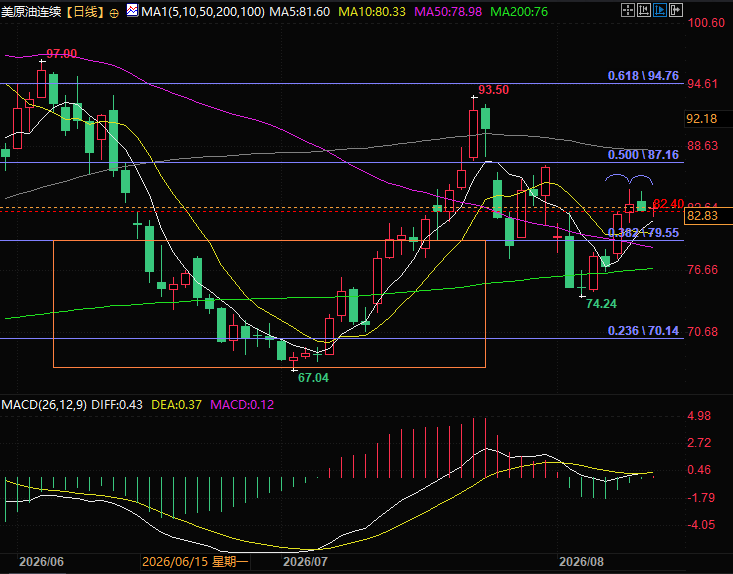 (WTI crude oil futures daily chart, source: EasyTrade) At 15:59 Beijing time, WTI oil price is currently at $82.83 per barrel.
Alternative pathways are diverging among Gulf countries, leading to a structural restructuring of the supply and demand landscape.
Under the pressure of prolonged shipping disruptions, the resilience of alternative transportation systems in the Gulf countries has diverged significantly, directly affecting the stability of crude oil exports from various countries. This has also become a core variable influencing the pace of regional crude oil supply and driving structural fluctuations in oil prices, with Saudi Arabia and the UAE showing a stark contrast in their performance.Saudi Arabia: Alternative pipelines have been implemented and are proving effective, significantly enhancing export resilience.
Saudi Arabia, with its mature cross-border pipeline system, became the only core Gulf oil-producing country to effectively divert shipping capacity during this crisis. Relying on its domestic east-west oil pipelines, Saudi Arabia directly transports crude oil from its main eastern oil fields to Yanbu Port on the Red Sea coast, completely bypassing the Strait of Hormuz and establishing an independent export channel. International Monetary Fund port monitoring data confirms the practical value of this alternative: from April to May this year, Saudi Arabia's crude oil freight volume along the Persian Gulf plummeted from 47.5 million tons in the same period last year to 6.3 million tons, while Red Sea port exports surged from 29.6 million tons to 54.8 million tons, with the additional volume successfully offsetting 61% of the freight shortfall on the Persian Gulf route. This means that Saudi Arabia's east-west oil pipelines have long transcended their emergency backup function, becoming a core strategic facility ensuring the continuity of crude oil exports under geopolitical risks. Even though the Houthi rebels in Yemen, with Iranian support, have declared a maritime blockade against Saudi Arabia, it has not yet had a substantial impact on its Red Sea crude oil export system. Currently, Saudi Arabia continues to optimize its pipeline system, remove shipping bottlenecks, and further strengthen its supply resilience.UAE: Hardware infrastructure is complete, but risks remain; alternative solutions have failed.
Compared to Saudi Arabia, the UAE's alternative transportation network has thoroughly exposed the risks and weaknesses of small and medium-sized oil-producing countries in the region, offering extremely limited stability to the crude oil market. The UAE has already established a comprehensive hardware transportation system, utilizing the Abu Dhabi oil pipeline to transport crude oil from the Habshan production area to the ports of Fujairah and Khorfakhan on the Gulf of Oman, theoretically avoiding the risks posed by the Strait of Hormuz. However, the core vulnerability lies in the fact that these ports are adjacent to Iran's sphere of influence, making them highly susceptible to precision strikes by drones and missiles. In the current conflict, ships sailing in and around Fujairah have been attacked multiple times, indicating that the geopolitical risks have not been substantially eliminated. Data shows that UAE crude oil exports collapsed entirely in April and May of this year, with cargo volume at Persian Gulf ports plummeting from 68.5 million tons in the same period of 2025 to 12 million tons. Cargo volume at eastern ports, originally planned as an alternative route, also fell from 13.7 million tons to 6.3 million tons. The UAE's alternative ports are not only unable to absorb the diverted shipping capacity, but their own throughput capacity continues to shrink. On the one hand, they are constrained by the hardware capacity limit of Fujairah Port, making it difficult to fill the huge gaps in core ports such as Jebel Ali; on the other hand, extremely high geopolitical risks have led to increased risk aversion among shipowners and insurance institutions, significantly reducing the actual hedging value of alternative shipping routes and failing to effectively stabilize the crude oil supply chain. Currently, the UAE can only passively cope with the export crisis by planning pipeline expansion and adding parallel shipping capacity.Medium- to long-term alternatives are difficult to implement and cannot offset the short-term supply crisis.
From a medium- to long-term perspective, none of the various large-scale alternative infrastructure projects hotly debated in the market can resolve the current short-term supply crisis in the crude oil market. The cross-border oil pipelines planned by the industry, such as those between Iraq and Oman and Iraq and Jordan, as well as the ocean shipping routes around the Cape of Good Hope in Africa, all have fatal flaws. These transnational pipeline projects involve investments of up to $8 billion to $15 billion, with construction periods of 5 to 7 years, meaning their implementation is far from addressing the immediate crisis. Furthermore, the route around the Cape of Good Hope would significantly increase the cost of shipping per vessel, further increasing the pressure on crude oil trade logistics and pushing up terminal oil prices. At the same time, most alternative routes suffer from the fatal problem of risk substitution, failing to fundamentally avoid geopolitical shocks. While the Red Sea route bypasses the Strait of Hormuz, the Bab el-Mandeb Strait, through which it passes, has long been subjected to Houthi attacks, putting continuous pressure on commercial shipping security. The market is merely replacing one risk node with another shipping bottleneck; the uncertainty of crude oil supply remains. Israel's proposed oil and gas pipeline plan, which spans the Arabian Peninsula and connects to Mediterranean ports, is seen as the ultimate solution to completely break free from the constraints of the two straits. However, it remains only a strategic concept and has no timetable for implementation, making it difficult to have a substantial impact on the current and medium-term crude oil supply pattern.Weak oil-producing countries have no alternative sources, and the risk of supply contraction looms.
Compared to Saudi Arabia and Afghanistan, Qatar, Kuwait, and Bahrain face far more severe oil export difficulties with no short-term solution. These three countries lack coastlines beyond the Persian Gulf and have no independent alternative shipping routes. All export plans rely on cross-border infrastructure cooperation with neighboring countries such as Iraq, Jordan, and Israel, making geopolitical coordination extremely difficult and costly. This also means that this round of geopolitical conflict has thoroughly exposed the structural weaknesses in their energy transportation systems. In the short term, they will continue to be highly dependent on shipping through the Strait of Hormuz, exhibiting extremely poor export resilience and easily becoming a potential variable in the contraction of oil supply.Key findings: The Straits' pivotal role is irreplaceable, and the pattern of high oil price volatility will continue.
From a game theory perspective, this round of Strait of Hormuz blockade is not a one-way market shock. Iran itself also faces strict strategic constraints. If the blockade continues for a long time, market expectations that "supply disruption is a short-term event" will be completely reversed, and a broad global anti-Iran coalition may be formed to impose comprehensive sanctions on Iran. While the overall narrative is currently favorable for maintaining high oil prices, Iran ultimately wants the Strait to be open for navigation so they can sell oil. Meanwhile, Pakistan and Gulf states are still actively coordinating and advancing US-Iran negotiations. Therefore, further price increases are easily suppressed by positive news of peace talks. The final result is that although the central oil price continues to rise, good long positions often arise when there is temporary good news from the US and Iran, while good short positions arise when the US issues threats, as Trump will ultimately agree to TACO. From a fundamental perspective, none of the alternative transportation systems can currently overturn the Strait of Hormuz's core energy hub status, and the supply vulnerability of the crude oil market remains prominent. Before the conflict, the daily crude oil and refined oil transport volume through the Strait of Hormuz reached 20 million barrels, while the current combined capacity of all alternative routes is only a tiny fraction of that, and the short-term capacity gap cannot be filled. More importantly, all energy infrastructure, whether pipelines, ports, or storage and transportation terminals, are high-risk targets in wartime. There are no absolutely safe transportation channels, and simply expanding infrastructure cannot fundamentally solve the geopolitical supply risks. Therefore, Iran's core strategy is to control the scale of the blockade and manage the pace of the game to avoid becoming passively isolated. This keeps the global crude oil market in a state of "repeated risks and wide fluctuations." Unless the United States makes significant concessions or Iran lowers its demands for peace talks, the high volatility and high premium of oil prices in the short term are unlikely to reverse. Technical analysis: WTI oil prices rose more than 13% in four trading days, quickly reaching the vicinity of the previous gap, and only slightly pulled back, maintaining a strong bullish trend. The support level to watch is the gradually rising 5-day moving average, and the resistance is around 87.33. (WTI crude oil futures daily chart, source: EasyTrade) At 15:59 Beijing time, WTI oil price is currently at $82.83 per barrel.
- Risk Warning and Disclaimer
- The market involves risk, and trading may not be suitable for all investors. This article is for reference only and does not constitute personal investment advice, nor does it take into account certain users’ specific investment objectives, financial situation, or other needs. Any investment decisions made based on this information are at your own risk.