Maersk predicts Suez Canal will resume this year, leading to a slight decline in oil prices.
2026-08-13 17:56:55
On Wednesday (August 13), during the Asian and European sessions, international oil prices saw a slight pullback. Following a systematic assessment of the security environment in the Red Sea and the Bab el-Mandeb Strait, the Danish shipping giant Maersk's CEO stated that conditions are ripe for the full resumption of navigation through the Suez Canal by 2026. The company is gradually expanding the scope of the resumption based on its security assessment. Currently, WTI crude oil futures are trading around $81.78, down 1.84%. This move, seen by the financial markets as a "geosecurity barometer," quickly triggered a chain reaction in the commodity market: the geopolitical risk premium that previously supported high oil prices accelerated its decline, putting short-term downward pressure on international crude oil prices, and significantly strengthening expectations for a downward adjustment in domestic refined oil prices. Maersk's statement represents a multi-dimensional indication of the possibility of restoring shipping capacity in the Suez and Bab el-Mandeb Straits, considering factors such as navigation levels and insurance prices. While it plays a qualitative role—that overall shipping conditions are expected to improve within the year—the impact on oil prices is relatively limited due to the vague timeframe of 2026. 
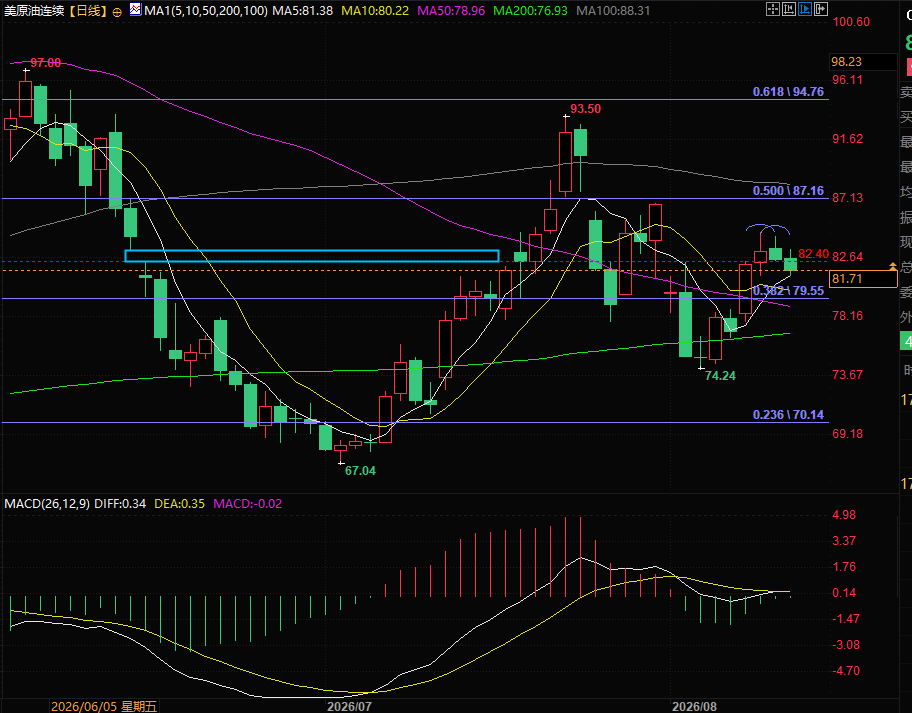 (WTI crude oil futures contract daily chart, source: EasyTrade) At 17:47 Beijing time, WTI crude oil futures contract is currently trading at $81.81 per barrel.
Clarifying the Current Status of Shipping Routes Behind Maersk's Decision to Resume Flights
The complete Eurasian energy and cargo transport corridor is comprised of the Indian Ocean → Bab el-Mandeb Strait → Red Sea → Suez Canal, forming a tightly interconnected network. Previously, threatened by attacks on ships in the Red Sea, most merchant ships were forced to circumnavigate the Cape of Good Hope in Africa. This circumnavigation was costly, adding 10-14 days to the one-way journey, causing a surge in fuel costs, ship chartering fees, and war risk insurance premiums. These transportation costs were directly factored into the spot discounts on crude oil and commodities upon arrival at ports. After completing multiple sea trials and confirming improved channel safety, Maersk officially initiated a structural resumption of service. This indicates that the threat in the Bab el-Mandeb Strait has diminished from an "uncontrollable high-risk situation" to a "safe situation suitable for commercial defense," eliminating the need for oil tankers and cargo ships to make long detours.The restoration of the Suez Canal's transmission mechanism to international oil prices
Although Maersk primarily deals in containers, it believes that the resumption of operations by tankers (VLCCs and product tankers) has paved the way for improved shipping safety, putting downward pressure on crude oil prices through four mechanisms: 1. Lower shipping insurance premiums and spot costs: Reduced shipping risks have prompted the London marine insurance market to lower war risk surcharges. With tanker operations resuming, the cost of shipping crude oil per barrel can decrease by $4-6/barrel, leading to a drop in spot procurement costs and dragging down futures prices. 2. Improved capacity turnover efficiency, alleviating supply shortage expectations: A 10-14 day reduction in voyage time means an increase in the effective turnover rate of the global tanker fleet by approximately 12%-15%. Without increasing the number of tankers, the actual delivery efficiency from the Middle East to Europe and the East Coast of North America has increased significantly, eliminating concerns about short-term supply and demand gaps. 3. Removal of geopolitical "tail risks," leading to a concentrated exit of long positions: Previous crude oil prices included a geopolitical premium of $5-8/barrel. Maersk's substantial investment in resuming shipping operations confirms the safety of shipping lanes, prompting profit-taking by long positions and putting downward pressure on WTI and Brent crude oil prices. Saudi Arabia and Middle Eastern exports have regained flexibility: crude oil transported to Yanbu Port via the Saudi East-West Pipeline can now smoothly pass through the Bab el-Mandeb Strait directly to Asian markets, significantly enhancing the flexibility of crude oil exports and further limiting the potential for price rebounds.Summarize:
The market is digesting the cost reductions and increased shipping capacity resulting from the resumption of shipping routes, leading to a simultaneous weakening of both spot and futures crude oil prices, which is being passed on to domestic refined oil price adjustments. Medium-term (3-6 months): The period of freight rate benefit transmission. As shipping capacity returns to normal, ocean freight rates remain low, reducing refinery procurement costs and continuously suppressing refining profits. Key variables and risk warnings: The current resumption of shipping is still in a "phased testing phase." If the situation in the Middle East deteriorates again or a sudden attack on ships occurs, shipping companies retain the right to revert to their Cape of Good Hope detour plans at any time. At that time, geopolitical premiums may be quickly restored, and investors need to closely monitor real-time ship traffic data in the Red Sea. Meanwhile, Maersk is currently in the earnings release period, and it is expected that the CEO will announce the positive news of the strait's resumption of traffic within the year. Therefore, the specific impact on oil prices will depend on continued monitoring of the Bab el-Mandeb Strait and the latest movements of the Houthi rebels. Technical analysis: Oil prices are currently facing resistance near the previous gap and a small double-top pattern formed by the two-day candlestick chart above, with support at the 5-day moving average. Currently, oil prices are still in a strong consolidation phase after an upward trend. (WTI crude oil futures contract daily chart, source: EasyTrade) At 17:47 Beijing time, WTI crude oil futures contract is currently trading at $81.81 per barrel.
- Risk Warning and Disclaimer
- The market involves risk, and trading may not be suitable for all investors. This article is for reference only and does not constitute personal investment advice, nor does it take into account certain users’ specific investment objectives, financial situation, or other needs. Any investment decisions made based on this information are at your own risk.