The US dollar weakened as both US CPI and PPI fell, while the New Zealand dollar rebounded from a two-week low.
2026-08-14 11:06:58
On Friday (August 14) during Asian trading hours, the New Zealand dollar (NZD) rose against the US dollar, currently hovering around 0.5860, a gain of approximately 0.2%, continuing its overnight recovery from a two-week low. Benefiting from easing US inflation data that pressured the dollar, the NZD is poised to end its four-day losing streak. Successive US CPI and PPI data showed cooling inflation, prompting the market to lower its expectations for a Fed rate hike, thus putting pressure on the dollar and providing some breathing room for the NZD. However, escalating tensions between the US and Iran and ongoing tensions in the Strait of Hormuz provided safe-haven support for the dollar, limiting the NZD's upside potential. Meanwhile, slowing domestic inflation expectations in New Zealand weakened the rationale for the Reserve Bank of New Zealand to further tighten policy, putting the strength of the NZD's rebound to a double test. 
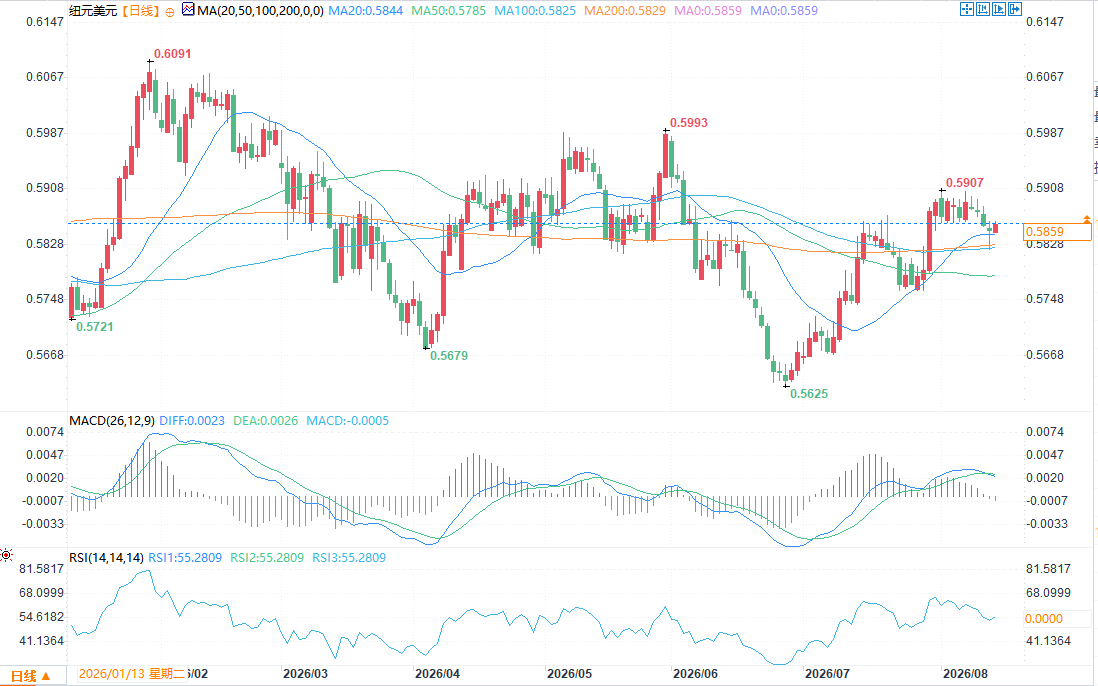 (NZD/USD daily chart, source: EasyTrade) At 11:04 Beijing time on August 14, the NZD/USD exchange rate was 0.5860/61.
Signs of cooling inflation in the US and a lower probability of a Federal Reserve rate hike are putting pressure on the dollar.
This week, the US released its July Consumer Price Index (CPI) and Producer Price Index (PPI), both pointing to continued easing of inflationary pressures. Following the data release, market expectations for a September rate hike by the Federal Reserve have dropped from a 50/50 split at the end of July to 34.8%. Interest rate futures pricing indicates that traders are rapidly reducing their bets on further tightening by the Fed this year, thus depriving the US dollar of its most crucial recent support. The weakening dollar provided a direct boost to the New Zealand dollar. As a currency highly sensitive to risk sentiment and the dollar's movements, the New Zealand dollar finally saw a technical rebound after being under pressure for the first four trading days of the week, recovering from the 0.5820 area (a two-week low) on Thursday and further rising above 0.5850 in Asian trading on Friday.Escalating US-Iran standoff and tensions in the Hormuz region provided safe-haven buying for the US dollar.
However, the dollar's decline did not widen further, with geopolitical risks providing a floor for the currency. US Treasury Secretary Bessenter announced on Thursday that unprecedented economic sanctions would be imposed on Iran. Mohammad Reza Naqdi, a senior advisor to the Iranian Revolutionary Guard, responded strongly, stating that Iran's strategy is to make the cost of any conflict so high that future US government actions would be "reconsiderable" before military action. Tensions in the Strait of Hormuz continue to escalate. US President Trump reiterated his claim of "complete control" over the strategic waterway, while Iran vowed to keep it closed until all its claims were met. Meanwhile, the Iranian-backed Houthi rebels in Yemen escalated attacks on ships in the Red Sea and the Bab el-Mandeb Strait, targeting Saudi vessels. These geopolitical risks, on the one hand, have increased the war risk premium on oil prices, thus maintaining inflation concerns to some extent and preventing the market from completely eliminating expectations of at least one Fed rate hike in 2026; on the other hand, geopolitical uncertainty itself has directly spurred safe-haven demand for the dollar, limiting its downside potential.Slowing inflation expectations in New Zealand weaken the Reserve Bank of New Zealand's case for raising interest rates.
Domestic fundamentals in New Zealand are also constraining the New Zealand dollar. The Reserve Bank of New Zealand's (RBNZ) latest quarterly survey shows that inflation expectations have fallen to 2.34% from 2.53% in the previous quarter. This easing of inflation expectations means that businesses and consumers are less concerned about future price increases, reducing the urgency for the RBNZ to further tighten monetary policy. For the New Zealand dollar, this means that support from the "interest rate differential" is weakening. With expectations of a Fed rate hike cooling and the RBNZ also lacking a rationale for raising rates, the New Zealand dollar's rebound will rely more on the continued weakening of the US dollar than on a proactive strengthening of domestic fundamentals.Summarize
In summary, the core driver of the New Zealand dollar's recent rebound stems from a correction in expectations of a Federal Reserve rate hike due to cooling US inflation, with a weaker US dollar being the primary contributor. However, the rebound faces three constraints: first, the ongoing US-Iran standoff and tensions in the Strait of Hormuz continue to provide safe-haven buying for the US dollar; second, slowing domestic inflation expectations in New Zealand have reduced the necessity for the Reserve Bank of New Zealand to raise interest rates; and third, if the geopolitical premium for oil prices persists, inflation concerns could reignite bets on a Fed rate hike. Currently, the New Zealand dollar is trading above 0.5850, but sustained upward movement requires more catalysts—including US retail sales data, evolving geopolitical situations, and subsequent policy signals from the Reserve Bank of New Zealand. In the absence of a clear directional breakout, the New Zealand dollar is more likely to exhibit a range-bound trading pattern. (NZD/USD daily chart, source: EasyTrade) At 11:04 Beijing time on August 14, the NZD/USD exchange rate was 0.5860/61.
- Risk Warning and Disclaimer
- The market involves risk, and trading may not be suitable for all investors. This article is for reference only and does not constitute personal investment advice, nor does it take into account certain users’ specific investment objectives, financial situation, or other needs. Any investment decisions made based on this information are at your own risk.