With 1,346 trillion yen in debt, how much room does the Bank of Japan have to raise interest rates?
2026-08-14 19:48:55
On Friday, August 14th, the USD/JPY pair was trading around 159.15. The exchange rate had previously fallen rapidly from around 163.99 to around 155.20, but subsequently returned to around 159, indicating that the price shock from intervention did not simultaneously translate into structural changes in interest rate differentials, real interest rates, and fiscal expectations. The Bank of Japan maintained its interest rate at 1.0% on July 31st, a decision passed by the policy board with an 8-1 vote. One member advocated raising the rate to 1.25%, showing a more pronounced internal divergence regarding inflation risks and the pace of policy. However, foreign exchange market pricing does not solely compare nominal policy rates. The latest official data shows that overall consumer prices rose 1.7% year-on-year in June, meaning that while Japan's nominal interest rate is significantly higher than during the previous prolonged period near zero, the real interest rate environment has not yet tightened significantly.  This is also key to understanding the yen's reaction. As long as overseas interest rates remain significantly higher than those in Japan, the interest rate compensation from holding yen assets is relatively limited. Recently, the yield on 10-year US Treasury bonds has remained close to 4.7%, while the yield on 10-year Japanese government bonds has been below 2.9%, indicating a still significant long-term interest rate differential. Therefore, even if the Bank of Japan continues to raise interest rates, it needs to observe whether the actual interest rate differential changes continuously in tandem, rather than simply equating "interest rate hikes" with "yen strengthening." Japanese monetary policy also faces a unique constraint: rising interest rates will quickly transmit to government financing costs. As of the end of June 2026, the outstanding balance of Japanese government bonds and borrowings reached 1346.68 trillion yen, of which government bonds accounted for approximately 1211.75 trillion yen. Previous official fiscal data estimated that long-term central and local government debt was equivalent to approximately 211% of GDP. This means that the Bank of Japan faces not just a simple inflation management issue, but a complex trade-off between inflation, exchange rates, fiscal financing costs, and economic affordability. The higher the interest rate, the easier it is for the cost of new government bonds and the rolling over of maturing debt to rise, and the interest burden on fiscal expenditures will gradually increase. Therefore, the long-term equilibrium level of the Bank of Japan's policy rate is likely to be significantly lower than that of some major economies. What the market is truly concerned about is not whether there will be a single rate hike, but rather how high the Bank of Japan can raise rates and how long it can maintain that level. Another easily overlooked issue is that rate hikes are no longer entirely unexpected policy variables. Traders have already priced in at least one further rate hike this year, and at one point priced in approximately 72 basis points of further tightening by June 2027. Therefore, the foreign exchange market focuses on changes in policy relative to expectations, rather than the policy actions themselves. If the policy path is roughly in line with the pace previously reflected in market prices, then the incremental new information is limited. Conversely, only significant adjustments in inflation assessments, policy communication, meeting voting structures, and future interest rate paths can reshape the pricing of the yield curve and exchange rate risk premium. The July meeting already saw some members supporting a 1.25% interest rate, which is more noteworthy than simply maintaining 1.0%, as it reflects a changing acceptance of further normalization within the policy committee. The core message of future meetings will increasingly focus on the policy function, rather than a single 25 basis point adjustment. Observing the daily chart, the USD/JPY pair previously plunged from around 163.983 to around 155.225, before rebounding to around 159, forming a typical post-event price rebalancing pattern. The Bollinger Bands have a middle band at approximately 160.894, an upper band at approximately 165.616, and a lower band at approximately 156.173. The current price remains below the middle band, and the Bollinger Bands are beginning to readjust after their sharp expansion.
 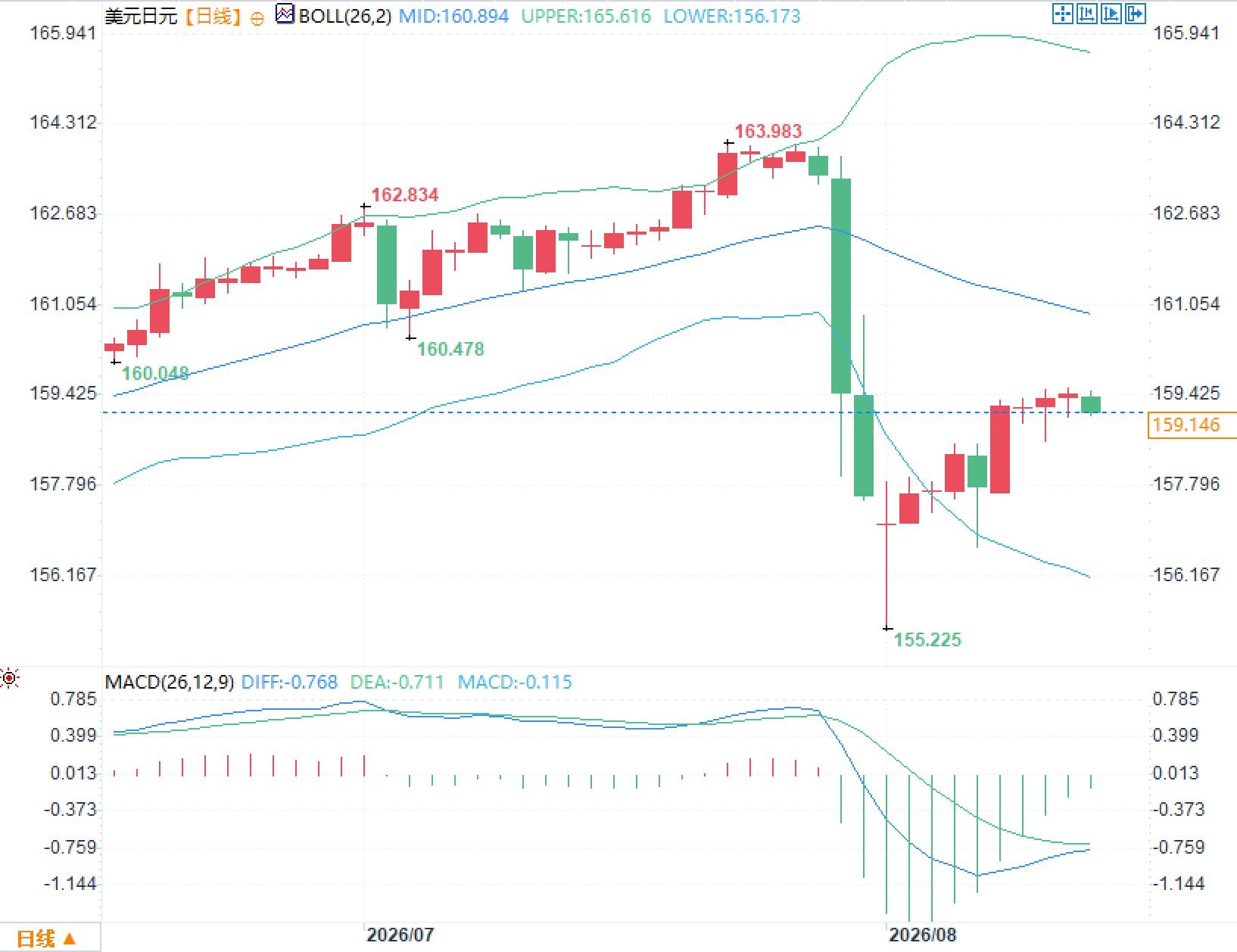 Regarding the MACD, the DIFF is around -0.768 and the DEA is around -0.711, both still below the zero line, but the negative histogram has shrunk significantly compared to the previous extreme phase. From a technical perspective, the most noteworthy factors at present are not a specific price, but three variables: whether the Bollinger Bands continue to converge, whether the relationship between the price and the middle band is stable, and whether the recovery from the negative MACD range continues.
This is also key to understanding the yen's reaction. As long as overseas interest rates remain significantly higher than those in Japan, the interest rate compensation from holding yen assets is relatively limited. Recently, the yield on 10-year US Treasury bonds has remained close to 4.7%, while the yield on 10-year Japanese government bonds has been below 2.9%, indicating a still significant long-term interest rate differential. Therefore, even if the Bank of Japan continues to raise interest rates, it needs to observe whether the actual interest rate differential changes continuously in tandem, rather than simply equating "interest rate hikes" with "yen strengthening." Japanese monetary policy also faces a unique constraint: rising interest rates will quickly transmit to government financing costs. As of the end of June 2026, the outstanding balance of Japanese government bonds and borrowings reached 1346.68 trillion yen, of which government bonds accounted for approximately 1211.75 trillion yen. Previous official fiscal data estimated that long-term central and local government debt was equivalent to approximately 211% of GDP. This means that the Bank of Japan faces not just a simple inflation management issue, but a complex trade-off between inflation, exchange rates, fiscal financing costs, and economic affordability. The higher the interest rate, the easier it is for the cost of new government bonds and the rolling over of maturing debt to rise, and the interest burden on fiscal expenditures will gradually increase. Therefore, the long-term equilibrium level of the Bank of Japan's policy rate is likely to be significantly lower than that of some major economies. What the market is truly concerned about is not whether there will be a single rate hike, but rather how high the Bank of Japan can raise rates and how long it can maintain that level. Another easily overlooked issue is that rate hikes are no longer entirely unexpected policy variables. Traders have already priced in at least one further rate hike this year, and at one point priced in approximately 72 basis points of further tightening by June 2027. Therefore, the foreign exchange market focuses on changes in policy relative to expectations, rather than the policy actions themselves. If the policy path is roughly in line with the pace previously reflected in market prices, then the incremental new information is limited. Conversely, only significant adjustments in inflation assessments, policy communication, meeting voting structures, and future interest rate paths can reshape the pricing of the yield curve and exchange rate risk premium. The July meeting already saw some members supporting a 1.25% interest rate, which is more noteworthy than simply maintaining 1.0%, as it reflects a changing acceptance of further normalization within the policy committee. The core message of future meetings will increasingly focus on the policy function, rather than a single 25 basis point adjustment. Observing the daily chart, the USD/JPY pair previously plunged from around 163.983 to around 155.225, before rebounding to around 159, forming a typical post-event price rebalancing pattern. The Bollinger Bands have a middle band at approximately 160.894, an upper band at approximately 165.616, and a lower band at approximately 156.173. The current price remains below the middle band, and the Bollinger Bands are beginning to readjust after their sharp expansion. Regarding the MACD, the DIFF is around -0.768 and the DEA is around -0.711, both still below the zero line, but the negative histogram has shrunk significantly compared to the previous extreme phase. From a technical perspective, the most noteworthy factors at present are not a specific price, but three variables: whether the Bollinger Bands continue to converge, whether the relationship between the price and the middle band is stable, and whether the recovery from the negative MACD range continues.
- Risk Warning and Disclaimer
- The market involves risk, and trading may not be suitable for all investors. This article is for reference only and does not constitute personal investment advice, nor does it take into account certain users’ specific investment objectives, financial situation, or other needs. Any investment decisions made based on this information are at your own risk.