Gold Trading Alert: "Terrifying Data" Weighs on the Dollar, Gold Price Targets $4500? This Week's Focus: Fed Meeting Minutes
2026-08-17 07:34:56
The past week saw a dramatic tug-of-war between bulls and bears in the global gold market. Spot gold opened at $4,346 per ounce on Monday (August 11th), surging to a two-month high near $4,450 mid-week. However, profit-taking led to a sharp 1.3% drop on Thursday, and gold further retreated to a weekly low near $4,310 on Friday. Just when the bears thought they had the upper hand, unexpectedly weak US retail sales data reversed the tide, resulting in a textbook V-shaped reversal for gold prices, ultimately closing at $4,375.80 per ounce, a weekly gain of approximately 0.8%. The price fluctuated by about 140 points within a week, with gold closing with a long lower shadow, signaling the resilience of the bulls. This was a result of the combined effects of cooling US economic data, expectations of a Fed rate cut, and escalating geopolitical tensions in the Middle East. Currently, bullish sentiment in the market is clearly rising, but the future direction remains highly dependent on changes in Fed rate hike expectations. This week, the Fed meeting minutes will be a key focus. On Monday (August 17) in early Asian trading, spot gold traded in a narrow range, currently around $4,375 per ounce. 
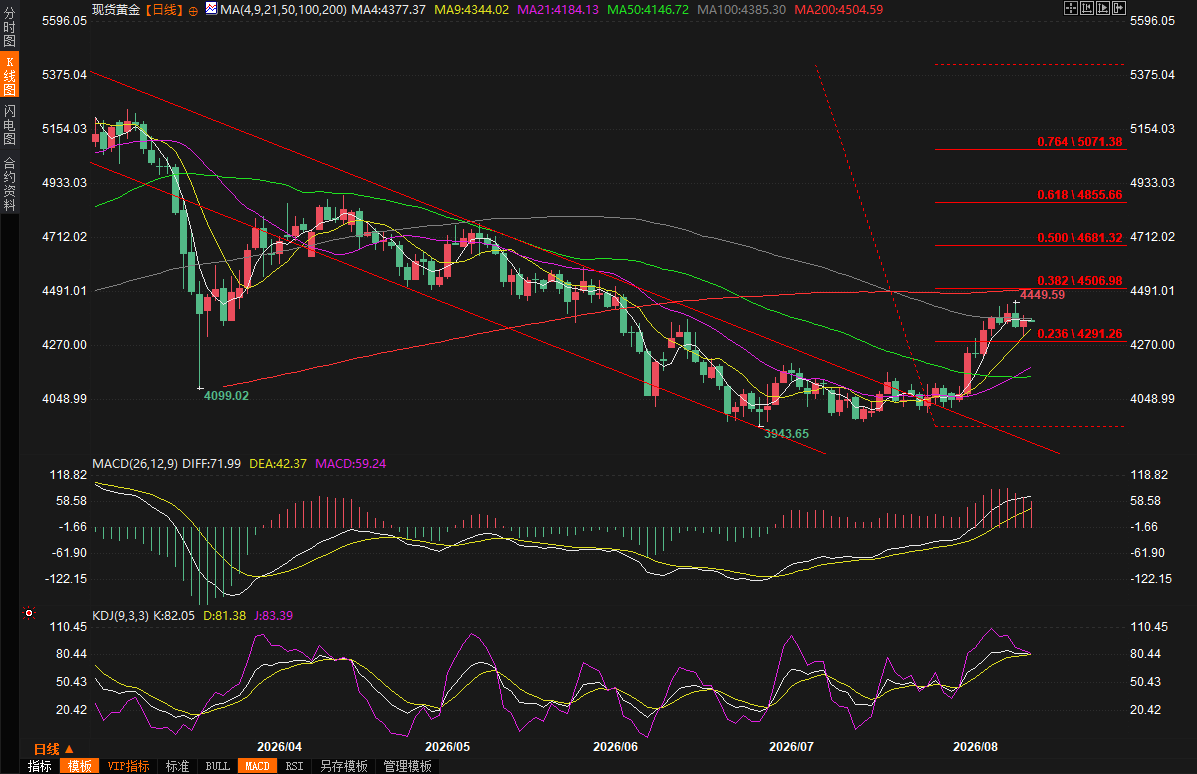 (Spot gold daily chart, source: EasyTrade) At 07:22 Beijing time, spot gold is currently trading at $4376.00 per ounce.
Dollar Depression: From "Interest Rate Premium" to "Data Defeat"
The US dollar, the anchor for gold pricing, suffered a systemic blow last week. The dollar index closed at 99.64 on Friday, having fallen to a three-month low during the session. From opening at 99.58 to closing at 99.63, the actual weekly gain was a mere 5 points—almost standing still. Behind this near-stagnation lies a complete repricing of the market's expectations for the Federal Reserve's policy path. The unexpected decline in non-farm payrolls in July was the first warning sign. Subsequent data showed that the July CPI rose only slightly by 0.1% month-on-month, and the year-on-year growth slowed to 3.4% from 3.5% in June, fully in line with market expectations; the PPI remained flat month-on-month, and the year-on-year growth rate plummeted from 5.5% in June to 4.7%. The continued cooling of inflation led the market to quickly lower its bets on interest rate hikes. The CME FedWatch tool showed that the probability of a Fed rate hike in September plummeted from 55% a week earlier to about 33%—meaning that the market now believes there is a 67.5% probability of maintaining the current interest rate in September. What truly disarmed the dollar bulls was the "terrifying data" released last Friday. U.S. retail sales fell 0.6% month-over-month in July, marking the first decline in nine months and the largest drop in 14 months, while economists had expected a slight increase of 0.1%. Juan Perez, trading director at Monex USA, stated bluntly, "We are clearly seeing signs of weak consumption, and this evidence clearly indicates that the U.S. economy is slowing." The dollar index fell 0.3%, directly providing external market support for dollar-denominated gold. Jim Wyckoff, an analyst at American Gold Exchange, explicitly stated, "The weaker dollar index provided favorable external market support for gold prices on Friday." Commerzbank even asserted in a report, "Given our expectation that the Fed will not raise interest rates, gold prices still have room to rise further."Interest rate hike expectations cool: a stunning reversal from "75% probability" to "33% probability".
If a weakening dollar is the "fuel" for rising gold prices, then the collapse of interest rate hike expectations is the "fuse" that ignited that fuel. Just a month ago, the market priced in a 75% chance of a Fed rate hike in September. In just a few weeks, that probability has plummeted from 75% in late July to about 33%—a veritable "crash of the rate hike trade." The unexpected decline in non-farm payrolls, the continued cooling of CPI and PPI, and the unexpected drop in retail sales—this combination of data completely shattered market expectations for a Fed rate hike, erasing all the "hawkish" premium accumulated since Kevin Warsh took over as Fed chairman. Although the Fed held rates steady for the fifth consecutive time at its July meeting, maintaining the target range for the federal funds rate at 3.50% to 3.75%, three officials voted against a 25 basis point hike. This 9-3 split vote precisely illustrates that the divisions within the Fed are far more intense than they appear. The market's focus this week will shift to the release of the July FOMC monetary policy meeting minutes on Wednesday. Investors will scrutinize the minutes for any clues about future policy inclinations, especially given the presence of three dissenters at previous meetings, making this session more intriguing than usual. If the minutes reveal that more officials are hesitant about raising interest rates, gold will gain further upward momentum.Middle East turmoil: Soaring oil prices cast a lingering shadow of interest rate hikes.
The ongoing conflict over the Strait of Hormuz is not simply a safe-haven boon for gold. This week, as the standoff between Iran and the United States escalated further—with attacks on two UAE ships, Iran's declaration of permanently expelling US troops from the Persian Gulf, and the US threatening an indefinite blockade—international oil prices surged. Brent crude closed at $88.52 per barrel on Friday, a weekly gain of 6%, while US crude also rose to $82.40. This seemingly volatile situation should have triggered safe-haven buying of gold, but the financial markets have played out a completely different story: the soaring oil prices have ignited fears of renewed inflation, fueling expectations of a Fed rate hike, which in turn has become a sword of Damocles hanging over gold prices. The core contradiction in market trading has shifted. When oil prices surged by more than 5% in just one week, approaching the $90 mark, investors quickly shifted their focus from the geopolitical conflict itself to its macroeconomic consequences. As the lifeblood of industry, rising crude oil prices will directly push up transportation costs and raw material prices, ultimately impacting end-consumer goods and reversing the recent cooling trend in inflation. Previously, the US July CPI had slowed to 3.4% year-on-year, and the PPI had plummeted to 4.7% year-on-year, leading the market to believe that inflation was under control. However, the risk of a closure of the Strait of Hormuz is threatening to shatter this optimistic expectation. This concern is quickly reflected in interest rate pricing. Although the unexpected decline in US retail sales this week initially lowered the probability of a September rate hike to 31%, the market's expectation of a December rate hike remained around 67% as oil prices surged last week. More importantly, the continued rise in oil prices will erode consumer purchasing power, further suppressing consumption, but at the same time, it will push up nominal inflation, putting the Federal Reserve in a "stagflation" dilemma—in this environment, the Federal Reserve often prioritizes fighting inflation rather than maintaining growth, and the expectation of a rate hike may resurface due to rising oil prices. As a non-interest-bearing asset, gold is extremely sensitive to changes in real interest rates (nominal interest rate minus inflation expectations). The rise in inflation expectations caused by soaring oil prices may lower real interest rates in the short term, but the market will soon expect the Federal Reserve to respond with more aggressive rate hikes, thereby pushing up nominal interest rates and causing real interest rates to rise instead of fall. This is precisely the fundamental reason why gold prices plunged 1.3% after surging to $4,450 on Thursday and even dipped to $4,310 during Friday's trading session—profit-taking wasn't simply a matter of taking profits, but rather smart money trading in advance on the negative transmission chain of "oil prices—inflation—interest rate hikes." More alarming is the inherently time-sensitive and fragile nature of safe-haven demand driven by geopolitical conflicts. Once any signs of easing tensions emerge—such as the resumption of US-Iran negotiations or a temporary ceasefire agreement—oil prices will quickly relinquish their risk premium, and safe-haven buying of gold will simultaneously withdraw, leading to a "double whammy" drop in gold prices. Historically, during the 1973 oil crisis and the 1990 Gulf War, gold did indeed rise initially due to safe-haven demand, but as soaring oil prices triggered aggressive interest rate hikes by central banks, gold prices often faced downward pressure in the mid-term. The current Strait of Hormuz crisis is replaying this classic scenario. In fact, US Defense Secretary Hergace has stated that the US military can "maintain the blockade indefinitely," Treasury Secretary Bessant has predicted "more measures to be announced in the coming week" to impose unprecedented economic isolation on Iran, and Trump has publicly called on the American people to "accept a slight increase in gasoline prices." These statements mean that oil prices are unlikely to fall in the short term, and inflationary pressures will persist. Against this backdrop, gold's safe-haven appeal is being gradually eroded by the shadow of interest rate hikes—geopolitical risks are pushing up oil prices, oil prices are reinforcing expectations of interest rate hikes, and interest rate hikes are suppressing gold prices. This negative cycle is currently dominating the true direction of the gold market.Central bank gold purchases and market sentiment: What gives the bulls their confidence?
Beyond the dual narratives of macroeconomics and geopolitics, there is another structural force that cannot be ignored—the continued gold purchases by global central banks. Data updated by the People's Bank of China on August 7th shows that as of the end of July 2026, China's gold reserves reached 76.08 million ounces (approximately 2366.35 tons), an increase of 640,000 ounces from the end of June. This marks the 21st consecutive month of increases in gold reserves by the People's Bank of China, with the increase further expanding from the 480,000 ounces in the previous month. Against the backdrop of escalating global uncertainty, the official level continues to actively allocate gold as a strategic reserve. Regarding market sentiment, Kitco News' latest weekly gold survey shows that Wall Street professionals are almost unanimously bullish on the outlook for gold—9 out of 10 analysts surveyed, or 90%, expect gold prices to continue rising next week, with only 1 bearish and no neutral. Meanwhile, among 222 retail investors, 150 (68%) are bullish on gold. This rare high degree of resonance between Wall Street and retail investors provides strong psychological support for gold. Of course, not everyone is blindly optimistic. Barchart senior market analyst Darin Newsom pointed out that from a technical perspective, the December gold futures daily closing chart may be entering a short-term downtrend, with a risk of further pullback next week. Adrian Day, president of Adrian Day Asset Management, also stated that gold is experiencing a "moderate rise" in the short term, but the price is still trading within a range and is not yet sufficient to drive a significant upward breakout.Outlook: Three key uncertainties will determine the direction of gold prices
Looking ahead to the coming week, three key questions will determine whether gold can break through the $4,450 resistance level and target the $4,500 mark. The first is the Federal Reserve. The minutes of the July FOMC meeting, released on Wednesday, are the most important document of the week. The market will pay close attention to the wording in the minutes, such as "a few members," "several members," and "a majority of members," and the resulting shifts in stance. If the minutes show that more officials favor keeping interest rates unchanged, a further decline in rate hike expectations will open up upside potential for gold. The second is the Strait of Hormuz. The US-Iran standoff continues, with Iran clearly stating that it will not reopen the strait until its conditions are met. Any new military conflict or shipping attacks could support oil prices and Fed rate hike expectations, limiting gold price gains. The third is US economic data. This week will see the release of the New York Fed Empire State Manufacturing Index, housing starts and building permits, pending home sales, initial jobless claims, and the preliminary S&P Global US Composite PMI. If these data continue to point to an economic slowdown, it will further strengthen expectations that the Federal Reserve will remain on hold, which is beneficial for gold. Conversely, if the data is unexpectedly strong, it may reignite concerns about interest rate hikes, suppressing gold prices. UBS previously predicted that gold prices could rise to $5,000/ounce by the first half of 2027. Gold may still be caught in a tug-of-war between bulls and bears in the short term: on one hand, weak consumption data and the Fed's dovish stance provide support, and on the other hand, energy inflation and expectations of policy tightening exert downward pressure. However, if it breaks through the two-month high of $4,450, gold prices will need to watch the dual resistance of the 200-day moving average and the $4,500 level, followed by further strong resistance near the April 17 high of $4,889; but if oil prices remain high, gold prices may even face the risk of retracing below $4,300. Investors need to closely monitor the wording regarding inflation risks in this week's FOMC meeting minutes, as well as any diplomatic signals that may ease tensions in the Taiwan Strait. (Spot gold daily chart, source: EasyTrade) At 07:22 Beijing time, spot gold is currently trading at $4376.00 per ounce.- Risk Warning and Disclaimer
- The market involves risk, and trading may not be suitable for all investors. This article is for reference only and does not constitute personal investment advice, nor does it take into account certain users’ specific investment objectives, financial situation, or other needs. Any investment decisions made based on this information are at your own risk.