Why has the Australian dollar risen so restrainedly after Reserve Bank of Australia Governor Bullock said "rates will be raised if necessary"?
2026-08-17 08:12:56
The Australian dollar edged higher against the US dollar in early Asian trading on Monday (August 17), trading around 0.7090. US retail sales data for July unexpectedly declined by 0.6% (month-on-month), far below market expectations of a 0.1% increase, further weakening market bets on a September rate hike by the Federal Reserve – the CME FedWatch tool showed the probability of a rate hike had fallen from about 50% a week ago to 33.1%, putting pressure on the US dollar and providing support for the Australian dollar. Meanwhile, Reserve Bank of Australia (RBA) Assistant Governor Christopher Kent stated last week that tightening policies are working as designed, while Governor Michele Bullock clearly stated that the RBA will "not hesitate to act if necessary," maintaining a hawkish stance. 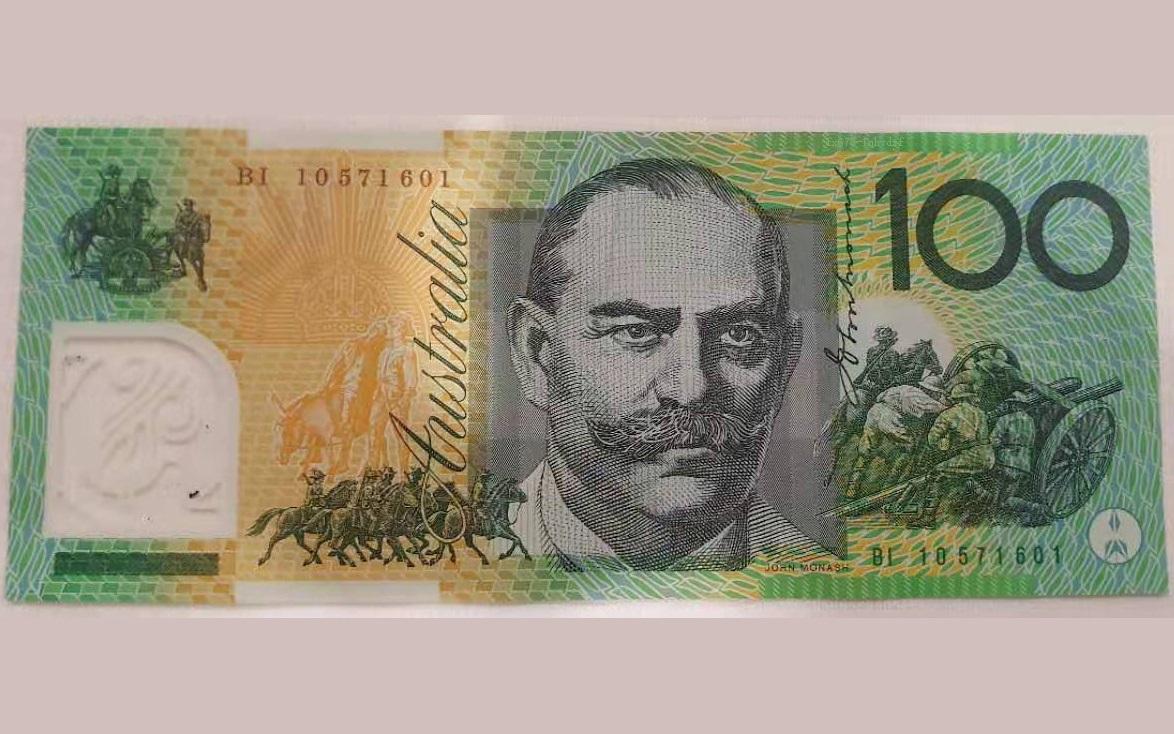
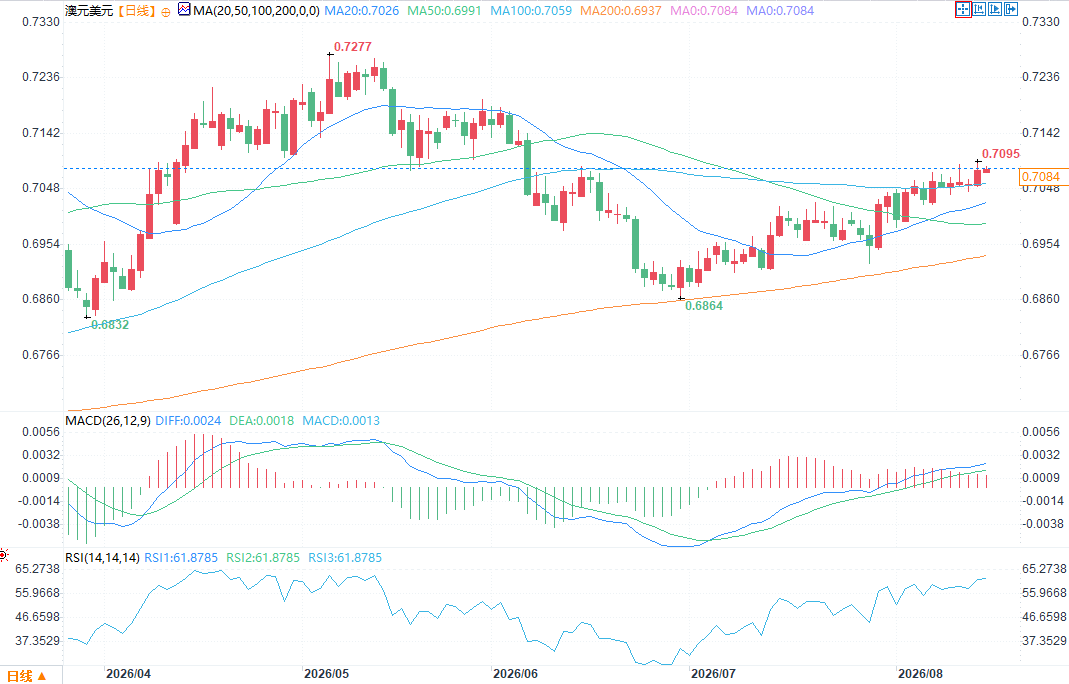 (Australian dollar against US dollar daily chart, source: EasyForex) At 8:08 AM Beijing time on August 17, the Australian dollar was trading at 0.7089/90 against the US dollar.
US retail sales fell sharply short of expectations, further reducing the probability of a Fed rate hike in September.
Data released by the U.S. Census Bureau last Friday showed that retail sales fell 0.6% month-on-month in July, far below market expectations of a 0.1% increase, with the previous figure revised down from 0.2% to 0.2% (revised). On an annualized basis, retail sales rose 5.0% year-on-year in July, a significant slowdown from the previous figure of 6.8% (revised up from 6.7%). This follows this week's CPI and PPI data, signaling further weakness in U.S. economic data – consumer spending is losing momentum, further confirming the simultaneous cooling of inflationary pressures and economic growth. The CME FedWatch tool shows that the market's implied probability of a Fed rate hike in September has fallen to 33.1%, compared to around 50% a week ago. This rapid readjustment in market pricing indicates that traders are accelerating the withdrawal of bets made since the end of last year on further Fed tightening.The Reserve Bank of Australia maintained a hawkish tone, with Kent stating that tightening policies are "working."
Reserve Bank of Australia (RBA) Assistant Governor Kent said last week that tightening monetary policy would take "some time to have a full impact on economic activity and inflation," but early evidence suggested the policy was working as designed. This statement was consistent with the RBA's hawkish tone in its August statement, which indicated a readiness to raise the cash rate further if upside risks to inflation materialize. Analysts at Societe Generale emphasized that the RBA's latest policy communication "maintained a distinctly firm tone," noting that "the statement was hawkish, and Chairman Bullock announced that they would not hesitate to act if necessary." The institution believes this reinforces the signal that policymakers remain vigilant about inflation risks and are prepared to further tighten policy if price pressures fail to ease as expected. The RBA's hawkish stance, contrasting with the cooling of expectations for a Fed rate hike, provides support for the Australian dollar from the perspective of policy divergence.The ongoing situation in the Middle East continues to weigh on market sentiment, and safe-haven demand may provide support for the US dollar.
According to media reports last Sunday, Israel has resumed airstrikes in the region in recent days after scaling back its attacks on Lebanon earlier this month. Traders are closely watching developments in the Middle East conflict, as any signs of escalation could boost safe-haven demand, providing short-term support for the US dollar and thus creating headwinds for the Australian dollar against the US dollar. This geopolitical risk factor partly explains why the Australian dollar's gains have remained modest despite multiple positive news – the market is pricing in potential geopolitical escalation, limiting the upside potential of the risk currency, the Australian dollar.This week's focus
On Monday, the market will see the release of China's July retail sales and industrial production data. As Australia's largest trading partner, China's economic data has a significant impact on the Australian dollar's exchange rate. Better-than-expected data will boost market confidence in the global demand outlook, providing additional support for the Australian dollar; conversely, weak data could weaken the Australian dollar's rebound momentum. Furthermore, the RBA's August meeting minutes will be released on Tuesday (August 18th), with the market looking for more details about the policymakers' "hawkish pause" stance and their assessment of the inflation and economic growth prospects.Summarize
In summary, the Australian dollar benefits in the short term from the cooling of expectations for a Federal Reserve rate hike due to weak US economic data, with a weaker US dollar being the main driver. The RBA's hawkish policy stance and potentially better-than-expected Chinese economic data may provide additional support for the Australian dollar. However, three factors limit the upside potential of the Australian dollar: firstly, continued uncertainty in the Middle East continues to provide safe-haven buying for the US dollar; secondly, market expectations for a Fed rate hike at the end of the year have not completely disappeared; and thirdly, if Chinese data falls short of expectations, it could put downward pressure on the Australian dollar. (Australian dollar against US dollar daily chart, source: EasyForex) At 8:08 AM Beijing time on August 17, the Australian dollar was trading at 0.7089/90 against the US dollar.
- Risk Warning and Disclaimer
- The market involves risk, and trading may not be suitable for all investors. This article is for reference only and does not constitute personal investment advice, nor does it take into account certain users’ specific investment objectives, financial situation, or other needs. Any investment decisions made based on this information are at your own risk.