The dollar index fluctuated lower, while the pound sterling approached a three-month high against the dollar.
2026-08-17 10:46:57
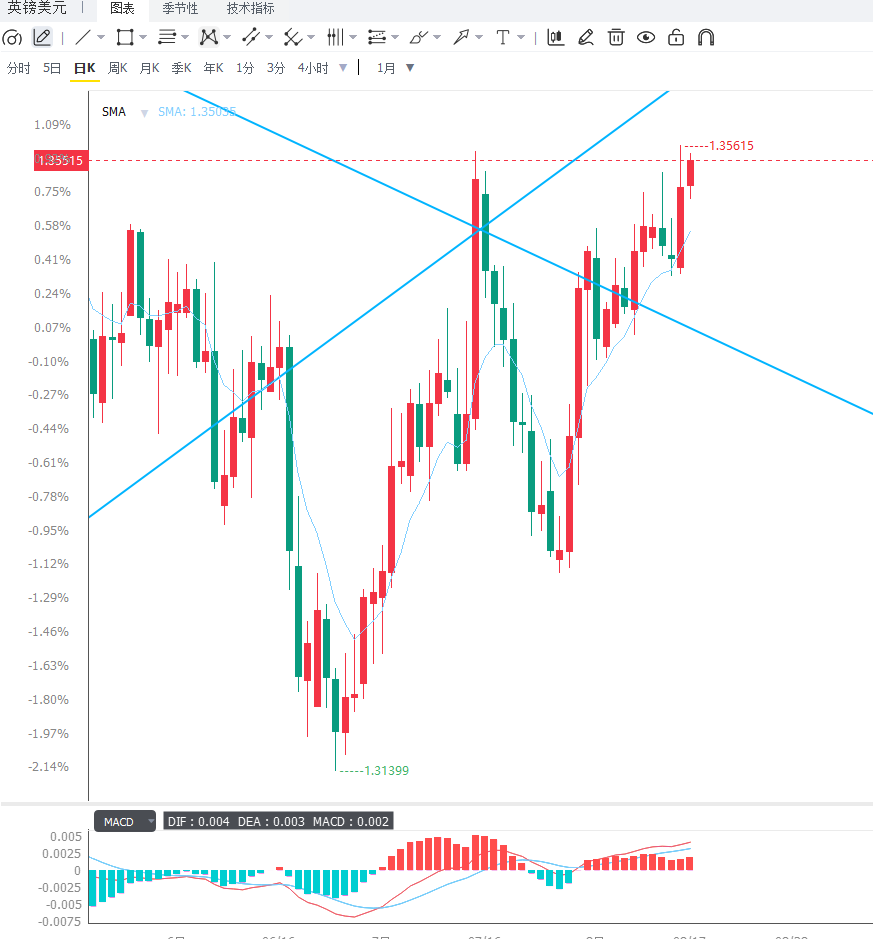
The pound attracted bargain hunters during Asian trading hours on Monday, rising back above 1.3550 against the dollar, just shy of the more than three-month high reached last Friday. Overall selling pressure on the dollar remained significant, while relatively robust UK economic data kept the pound sterling on a relatively strong side. The core trading logic in the current market continues to revolve around the divergence in interest rate expectations between the US and Europe, with a weaker dollar being a major driver of the pound's rise.  Recent US economic data is continuously altering market perceptions of the Federal Reserve's policy path. Last week's US inflation data generally signaled easing price pressures, a trend further reinforced by the subsequent July retail sales figures. Data showed that US retail sales fell 0.6% month-over-month in July, the largest monthly decline since May 2025, significantly lower than June's 0.2% growth and also below the market's previous expectation of approximately 0.1%. While a single-month decline in retail sales is insufficient to prove that US consumption has entered a sustained contraction, this data at least indicates a significant cooling in consumer spending momentum. With inflationary pressures easing marginally, the emergence of signs of weakening consumption has naturally led the market to lower its expectations for further tightening by the Federal Reserve in the near term. The repricing in the interest rate market directly reduces the dollar's yield advantage, putting pressure on the dollar index and providing upward potential for the pound against the dollar. Currently, market bets on a September rate hike by the Federal Reserve have fallen to about 30%, significantly lower than the previous week. Although the US inflation rate remains above the policy target, and the Federal Reserve has not completely ruled out the possibility of further tightening this year, the market is no longer as worried as before about a sudden rate hike in the short term. If subsequent US economic data continues to signal a slowdown in growth, the dollar's interest rate advantage may narrow further. UK economic data, however, provides another layer of support for the pound. UK GDP grew by 0.3% month-on-month in June, indicating that economic activity remained relatively resilient in the latter part of the first half of the year. While the UK economy grew by 0.4% in the second quarter from 0.6% in the first quarter, it remained in expansionary territory overall. Combined with the first half's economic performance, the UK's economic growth rate is relatively high among major developed economies, reducing market concerns about a rapid slowdown in the UK economy. More importantly, the resilience of the UK economy provides room for the Bank of England to maintain a relatively cautious policy stance. The market currently still believes that the Bank of England may further adjust interest rates in 2026. If inflation in the labor market and services sector remains relatively sticky in the future, the Bank of England may adopt a more gradual approach to interest rate cuts, thereby maintaining the pound's interest rate advantage relative to the dollar. The pound has recently significantly outperformed other major currencies, becoming one of the best-performing major currencies since August, with the pound/dollar exchange rate regaining the 1.3500 level. Market analysts believe that the resilience of the UK economy is offsetting some of the negative impact of energy price volatility on economic growth, which is a key reason for the recent strength of the pound. However, the current rise in the pound is not without risks. Energy price volatility could still push up UK inflation again and increase the complexity of the Bank of England's policy decisions. If energy prices rise rapidly, it may push up inflation expectations in the short term, but in the long term, it may compress real income and consumption capacity, thus not necessarily a one-way benefit for the pound. At the same time, the situation in the Middle East and international energy transportation risks could still change global market risk appetite. Once risk aversion intensifies significantly, the US dollar, as a traditional safe-haven asset, may see renewed inflows, thus limiting further gains for the pound against the dollar. In addition, investors may proactively reduce their positions before the release of key data, causing short-term fluctuations in the exchange rate. This week is packed with UK macroeconomic data, and the market will focus on UK employment and consumer inflation data. If the employment market continues to perform stably while inflation remains somewhat sticky, it will strengthen expectations of the Bank of England's cautious policy adjustments, providing support for the pound; if employment and inflation both cool significantly, it may reignite market expectations for further easing by the Bank of England. In the US, the Federal Reserve meeting minutes are also a key risk event in the latter half of this week. If the minutes show policymakers remain highly vigilant about inflation, the dollar may rebound; if they indicate more officials are focusing on economic growth and labor market risks, the dollar may come under further pressure, pushing the pound against the dollar to test previous highs. From a daily chart perspective, the pound against the dollar maintains a clear upward trend, with the exchange rate regaining ground around 1.3550 and continuing to trade above the recent upward channel. The price had previously reached a more than three-month high, and the recent pullback has seen renewed buying, indicating that the bulls remain in control. As long as the exchange rate can remain above 1.3500, the daily uptrend structure will not be significantly disrupted in the short term. The first resistance level to watch is 1.3600, a key psychological resistance that the bulls need to overcome for further gains. If this level is effectively broken and held on the daily chart, the pound against the dollar is expected to test previous highs and open up new upside potential. If significant profit-taking occurs around 1.3600, the price may enter a period of high-level consolidation in the short term. The first support level to watch is around 1.3500, a key psychological level that also represents a significant dividing line between bulls and bears in the near term. A break below this level would target the 1.3450-1.3400 area, a crucial support zone for determining whether the current uptrend has entered a deeper correction phase. On the 4-hour chart, GBP/USD remains in an upward-trending structure, with buying quickly returning after short-term pullbacks, indicating that market funds still favor buying on dips. Short-term momentum remains strong, but given the price is near a recent high, fluctuations are possible before a break above 1.3600. A successful break above 1.3600 on the 4-hour chart with consecutive closing confirmation could extend the uptrend further; conversely, a failed attempt to break higher and a subsequent drop below 1.3500 could trigger a short-term correction, with the price potentially seeking support around 1.3450.
  Editor's Summary: The British pound is currently in a relatively favorable fundamental environment against the US dollar. A 0.6% decline in US retail sales in July, easing inflationary pressures, and reduced expectations of a Fed rate hike have all weakened the dollar. Meanwhile, UK GDP growth of 0.3% in June and 0.4% in the second quarter indicate that the UK economy's resilience has not significantly diminished, providing strong fundamental support for the pound. In the short term, the pound/dollar pair still has the potential to test previous highs. 1.3500 is a key support level for the bulls, while 1.3600 is the next crucial breakthrough point. If UK employment and inflation data are strong, and the Fed meeting minutes release relatively dovish signals, the pound may continue to receive support from interest rate expectations. Conversely, if UK inflation declines rapidly, employment deteriorates significantly, or global risk aversion leads to renewed dollar inflows, the pound's recent strength may face a temporary reversal. Therefore, the main focus of the currency market this week will gradually shift from "whether the dollar will continue to weaken" to "whether US and European economic data will further confirm changes in interest rate differentials." As long as this logic does not reverse significantly, the short-term outlook for the British pound against the US dollar remains bullish. However, as it approaches previous highs, the risk of chasing the rally is also increasing.
Recent US economic data is continuously altering market perceptions of the Federal Reserve's policy path. Last week's US inflation data generally signaled easing price pressures, a trend further reinforced by the subsequent July retail sales figures. Data showed that US retail sales fell 0.6% month-over-month in July, the largest monthly decline since May 2025, significantly lower than June's 0.2% growth and also below the market's previous expectation of approximately 0.1%. While a single-month decline in retail sales is insufficient to prove that US consumption has entered a sustained contraction, this data at least indicates a significant cooling in consumer spending momentum. With inflationary pressures easing marginally, the emergence of signs of weakening consumption has naturally led the market to lower its expectations for further tightening by the Federal Reserve in the near term. The repricing in the interest rate market directly reduces the dollar's yield advantage, putting pressure on the dollar index and providing upward potential for the pound against the dollar. Currently, market bets on a September rate hike by the Federal Reserve have fallen to about 30%, significantly lower than the previous week. Although the US inflation rate remains above the policy target, and the Federal Reserve has not completely ruled out the possibility of further tightening this year, the market is no longer as worried as before about a sudden rate hike in the short term. If subsequent US economic data continues to signal a slowdown in growth, the dollar's interest rate advantage may narrow further. UK economic data, however, provides another layer of support for the pound. UK GDP grew by 0.3% month-on-month in June, indicating that economic activity remained relatively resilient in the latter part of the first half of the year. While the UK economy grew by 0.4% in the second quarter from 0.6% in the first quarter, it remained in expansionary territory overall. Combined with the first half's economic performance, the UK's economic growth rate is relatively high among major developed economies, reducing market concerns about a rapid slowdown in the UK economy. More importantly, the resilience of the UK economy provides room for the Bank of England to maintain a relatively cautious policy stance. The market currently still believes that the Bank of England may further adjust interest rates in 2026. If inflation in the labor market and services sector remains relatively sticky in the future, the Bank of England may adopt a more gradual approach to interest rate cuts, thereby maintaining the pound's interest rate advantage relative to the dollar. The pound has recently significantly outperformed other major currencies, becoming one of the best-performing major currencies since August, with the pound/dollar exchange rate regaining the 1.3500 level. Market analysts believe that the resilience of the UK economy is offsetting some of the negative impact of energy price volatility on economic growth, which is a key reason for the recent strength of the pound. However, the current rise in the pound is not without risks. Energy price volatility could still push up UK inflation again and increase the complexity of the Bank of England's policy decisions. If energy prices rise rapidly, it may push up inflation expectations in the short term, but in the long term, it may compress real income and consumption capacity, thus not necessarily a one-way benefit for the pound. At the same time, the situation in the Middle East and international energy transportation risks could still change global market risk appetite. Once risk aversion intensifies significantly, the US dollar, as a traditional safe-haven asset, may see renewed inflows, thus limiting further gains for the pound against the dollar. In addition, investors may proactively reduce their positions before the release of key data, causing short-term fluctuations in the exchange rate. This week is packed with UK macroeconomic data, and the market will focus on UK employment and consumer inflation data. If the employment market continues to perform stably while inflation remains somewhat sticky, it will strengthen expectations of the Bank of England's cautious policy adjustments, providing support for the pound; if employment and inflation both cool significantly, it may reignite market expectations for further easing by the Bank of England. In the US, the Federal Reserve meeting minutes are also a key risk event in the latter half of this week. If the minutes show policymakers remain highly vigilant about inflation, the dollar may rebound; if they indicate more officials are focusing on economic growth and labor market risks, the dollar may come under further pressure, pushing the pound against the dollar to test previous highs. From a daily chart perspective, the pound against the dollar maintains a clear upward trend, with the exchange rate regaining ground around 1.3550 and continuing to trade above the recent upward channel. The price had previously reached a more than three-month high, and the recent pullback has seen renewed buying, indicating that the bulls remain in control. As long as the exchange rate can remain above 1.3500, the daily uptrend structure will not be significantly disrupted in the short term. The first resistance level to watch is 1.3600, a key psychological resistance that the bulls need to overcome for further gains. If this level is effectively broken and held on the daily chart, the pound against the dollar is expected to test previous highs and open up new upside potential. If significant profit-taking occurs around 1.3600, the price may enter a period of high-level consolidation in the short term. The first support level to watch is around 1.3500, a key psychological level that also represents a significant dividing line between bulls and bears in the near term. A break below this level would target the 1.3450-1.3400 area, a crucial support zone for determining whether the current uptrend has entered a deeper correction phase. On the 4-hour chart, GBP/USD remains in an upward-trending structure, with buying quickly returning after short-term pullbacks, indicating that market funds still favor buying on dips. Short-term momentum remains strong, but given the price is near a recent high, fluctuations are possible before a break above 1.3600. A successful break above 1.3600 on the 4-hour chart with consecutive closing confirmation could extend the uptrend further; conversely, a failed attempt to break higher and a subsequent drop below 1.3500 could trigger a short-term correction, with the price potentially seeking support around 1.3450. Editor's Summary: The British pound is currently in a relatively favorable fundamental environment against the US dollar. A 0.6% decline in US retail sales in July, easing inflationary pressures, and reduced expectations of a Fed rate hike have all weakened the dollar. Meanwhile, UK GDP growth of 0.3% in June and 0.4% in the second quarter indicate that the UK economy's resilience has not significantly diminished, providing strong fundamental support for the pound. In the short term, the pound/dollar pair still has the potential to test previous highs. 1.3500 is a key support level for the bulls, while 1.3600 is the next crucial breakthrough point. If UK employment and inflation data are strong, and the Fed meeting minutes release relatively dovish signals, the pound may continue to receive support from interest rate expectations. Conversely, if UK inflation declines rapidly, employment deteriorates significantly, or global risk aversion leads to renewed dollar inflows, the pound's recent strength may face a temporary reversal. Therefore, the main focus of the currency market this week will gradually shift from "whether the dollar will continue to weaken" to "whether US and European economic data will further confirm changes in interest rate differentials." As long as this logic does not reverse significantly, the short-term outlook for the British pound against the US dollar remains bullish. However, as it approaches previous highs, the risk of chasing the rally is also increasing.
- Risk Warning and Disclaimer
- The market involves risk, and trading may not be suitable for all investors. This article is for reference only and does not constitute personal investment advice, nor does it take into account certain users’ specific investment objectives, financial situation, or other needs. Any investment decisions made based on this information are at your own risk.