Japan's second-quarter GDP growth fell short of expectations, and the dollar weakened, leading to continued adjustments in the USD/JPY exchange rate.
2026-08-17 14:02:59
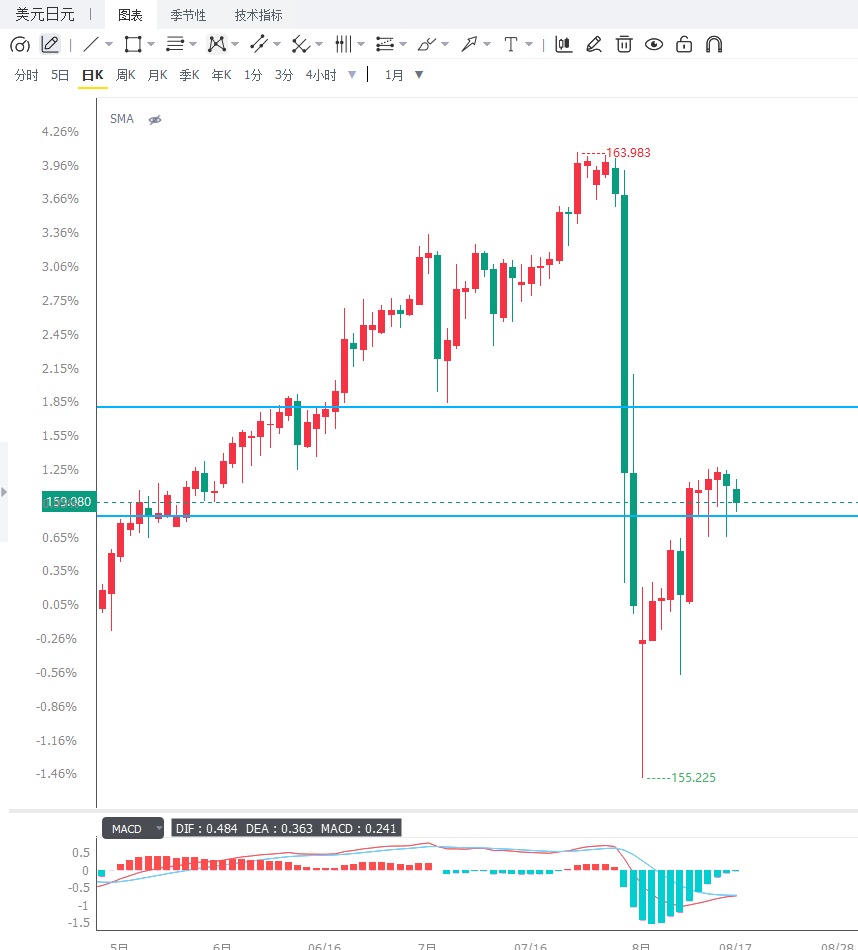
The dollar fell against the yen for the second consecutive trading day in Asian trading on Monday, retreating to around 159.10. The yen has been relatively strong recently, influenced by adjustments in policy expectations following the release of Japanese economic data, and driven by a weaker dollar. Meanwhile, the Japanese authorities' recent stance on a phased appreciation of the yen is also noteworthy, as the policy pressure from rapid currency depreciation has eased somewhat.  Japan's economic growth data fell short of market expectations. Preliminary data showed that Japan's GDP grew by 0.3% quarter-on-quarter in the second quarter of 2026, lower than the 0.5% in the first quarter and also lower than the market's previous forecast of 0.5%. On an annualized basis, second-quarter GDP growth was approximately 1.1%, significantly lower than the market expectation of 2.0% and also lower than the 1.8% in the previous quarter. From the data structure, the Japanese economy remains in expansion, but the growth momentum has clearly slowed. In particular, the lower-than-expected actual growth has led the market to reassess the pace of the Bank of Japan's (BOJ) future policy normalization. The BOJ has been gradually moving away from its ultra-loose policy framework, and one of the key factors for further interest rate adjustments is whether domestic demand can remain resilient. If consumption and domestic demand continue to underperform expectations, the BOJ will need to be more cautious about further interest rate hikes. However, the weak GDP data did not immediately translate into significant selling pressure on the yen, because the currency market is currently trading not only on Japanese economic growth. The persistent weakness of the yen in recent times has become a major concern for Japanese policymakers, and the recent period of yen appreciation has actually alleviated some policy pressure. Market surveys indicate that some strategists believe the recent moderate appreciation of the yen may have provided some relief to policymakers such as the Japanese Ministry of Finance, as the import costs and inflationary pressures resulting from the yen's continued rapid depreciation have lessened. Meanwhile, weakening US economic data is becoming a significant factor driving the USD/JPY exchange rate lower. US retail sales fell 0.6% month-on-month in July, lower than June's 0.2% growth and significantly weaker than the market expectation of approximately 0.1%. Although July retail sales still grew 5.0% year-on-year, this was a significant slowdown compared to the revised 6.8% in June, indicating a decline in the marginal momentum of US consumer spending. This data echoes recent cooling signals from US CPI and PPI, causing the market to readjust its assessment of the Federal Reserve's policy. While US inflationary pressures remain above the policy target, recent data shows that price pressures have not accelerated significantly further, while consumption has shown signs of slowing, reducing market confidence in the Fed's continued tightening in the short term. The market's pricing probability of a Fed rate hike in September has fallen to approximately 33.1%, significantly lower than the approximately 44% level of the previous week. Declining expectations of interest rate hikes mean that US Treasury yields and the US dollar may lose some of their interest rate advantage, directly compressing the upside potential of the USD/JPY pair. Since the USD/JPY pair has long been influenced by the US-Japan interest rate differential, changes in US interest rate expectations often quickly transmit to the currency market. However, the possibility of the Federal Reserve continuing to adjust interest rates this year remains. US inflation remains above the 2% policy target, and service prices and some core inflation indicators still exhibit some stickiness. If subsequent US employment and consumption data return to strength, or inflation rebounds, the market may increase the probability of interest rate hikes again, thereby providing renewed support for the US dollar. Japan also faces uncertainty regarding policy expectations. The significantly weaker-than-expected second-quarter GDP means that the Bank of Japan may need more data to confirm economic resilience before further interest rate hikes, but the recent strengthening of the yen has reduced the pressure from rapid currency depreciation. For the Bank of Japan, future policy needs to find a balance between controlling inflation, maintaining economic growth, and avoiding excessive yen volatility. From a market sentiment perspective, the USD/JPY pair is currently in a rather unique phase: declining US interest rate expectations are bearish for the dollar, while weak Japanese economic data limits the yen's potential for continued appreciation. Therefore, the subsequent exchange rate movement is likely to be determined by the relative changes in the policy expectations of the central banks of the US and Japan, rather than by a single economic data point. If the US economy continues to cool, the probability of a Fed rate hike further decreases, and the Japanese authorities continue to signal a stable exchange rate, the USD/JPY pair may still face downward pressure. Conversely, if the US economy shows renewed resilience, and Japan's GDP slowdown further delays the Bank of Japan's policy normalization, the USD/JPY pair may regain upward momentum. From a daily chart perspective, the USD/JPY pair has currently fallen back to around 159.10, weakening for two consecutive trading days, indicating a decrease in bullish momentum. The key issue for the current exchange rate is not simply whether the upward trend has ended, but whether the psychological level of 159.00 can provide effective support. If the price can stabilize in this area, a technical rebound is still possible; if the daily chart breaks below 159.00, it means that the recent high-level consolidation structure will further adjust downwards, and lower support areas need to be monitored. The first resistance level to watch is around 160.00, which not only has psychological significance as a psychological level but may also become an important position for the bulls to regroup and launch an offensive. If USD/JPY regains its footing above 160.00, its short-term weakness may be mitigated, and it could retest previous highs. On the downside, the key support level is 158.50-158.00. If this area provides sustained buying support, the pair may maintain its range-bound trading. However, a further break below this level could indicate a further expansion of the yen's appreciation trend, putting more significant downward pressure on USD/JPY. Looking at the 4-hour chart, USD/JPY has formed a clear pullback structure in the short term, with prices consistently trading below recent highs, indicating that sellers currently hold the upper hand. If the 4-hour chart continues to be capped by the 159.50 level and breaks below 159.00, the short-term downtrend may continue. If the price quickly falls to around 158.50 and then shows clear signs of stabilizing, recovering above 159.50, a technical rebound driven by profit-taking should be anticipated. Currently, the market should focus on the 159.00 level as a key support/resistance level and whether it breaks above 160.00.
  Editor's Summary: The USD/JPY pair is currently facing a dual challenge: declining US interest rate expectations and a slowdown in Japanese economic growth. US retail sales unexpectedly fell 0.6% in July, reducing the probability of a Fed rate hike in September from approximately 44% to 33.1%, significantly pressuring the dollar. While Japan's Q2 GDP fell short of expectations, the recent appreciation of the yen has alleviated some policy pressure, continuing to weigh on the USD/JPY pair. From a medium-term perspective, the USD/JPY interest rate differential remains the core variable determining the exchange rate direction. If the US economy continues to cool and the Fed further lowers its rate hike expectations, while Japan's inflation and wage environment still support policy normalization, the yen may continue to receive support. However, the significant slowdown in Japanese economic growth also means there is a risk of a delay in the Bank of Japan's rate hike pace.
Japan's economic growth data fell short of market expectations. Preliminary data showed that Japan's GDP grew by 0.3% quarter-on-quarter in the second quarter of 2026, lower than the 0.5% in the first quarter and also lower than the market's previous forecast of 0.5%. On an annualized basis, second-quarter GDP growth was approximately 1.1%, significantly lower than the market expectation of 2.0% and also lower than the 1.8% in the previous quarter. From the data structure, the Japanese economy remains in expansion, but the growth momentum has clearly slowed. In particular, the lower-than-expected actual growth has led the market to reassess the pace of the Bank of Japan's (BOJ) future policy normalization. The BOJ has been gradually moving away from its ultra-loose policy framework, and one of the key factors for further interest rate adjustments is whether domestic demand can remain resilient. If consumption and domestic demand continue to underperform expectations, the BOJ will need to be more cautious about further interest rate hikes. However, the weak GDP data did not immediately translate into significant selling pressure on the yen, because the currency market is currently trading not only on Japanese economic growth. The persistent weakness of the yen in recent times has become a major concern for Japanese policymakers, and the recent period of yen appreciation has actually alleviated some policy pressure. Market surveys indicate that some strategists believe the recent moderate appreciation of the yen may have provided some relief to policymakers such as the Japanese Ministry of Finance, as the import costs and inflationary pressures resulting from the yen's continued rapid depreciation have lessened. Meanwhile, weakening US economic data is becoming a significant factor driving the USD/JPY exchange rate lower. US retail sales fell 0.6% month-on-month in July, lower than June's 0.2% growth and significantly weaker than the market expectation of approximately 0.1%. Although July retail sales still grew 5.0% year-on-year, this was a significant slowdown compared to the revised 6.8% in June, indicating a decline in the marginal momentum of US consumer spending. This data echoes recent cooling signals from US CPI and PPI, causing the market to readjust its assessment of the Federal Reserve's policy. While US inflationary pressures remain above the policy target, recent data shows that price pressures have not accelerated significantly further, while consumption has shown signs of slowing, reducing market confidence in the Fed's continued tightening in the short term. The market's pricing probability of a Fed rate hike in September has fallen to approximately 33.1%, significantly lower than the approximately 44% level of the previous week. Declining expectations of interest rate hikes mean that US Treasury yields and the US dollar may lose some of their interest rate advantage, directly compressing the upside potential of the USD/JPY pair. Since the USD/JPY pair has long been influenced by the US-Japan interest rate differential, changes in US interest rate expectations often quickly transmit to the currency market. However, the possibility of the Federal Reserve continuing to adjust interest rates this year remains. US inflation remains above the 2% policy target, and service prices and some core inflation indicators still exhibit some stickiness. If subsequent US employment and consumption data return to strength, or inflation rebounds, the market may increase the probability of interest rate hikes again, thereby providing renewed support for the US dollar. Japan also faces uncertainty regarding policy expectations. The significantly weaker-than-expected second-quarter GDP means that the Bank of Japan may need more data to confirm economic resilience before further interest rate hikes, but the recent strengthening of the yen has reduced the pressure from rapid currency depreciation. For the Bank of Japan, future policy needs to find a balance between controlling inflation, maintaining economic growth, and avoiding excessive yen volatility. From a market sentiment perspective, the USD/JPY pair is currently in a rather unique phase: declining US interest rate expectations are bearish for the dollar, while weak Japanese economic data limits the yen's potential for continued appreciation. Therefore, the subsequent exchange rate movement is likely to be determined by the relative changes in the policy expectations of the central banks of the US and Japan, rather than by a single economic data point. If the US economy continues to cool, the probability of a Fed rate hike further decreases, and the Japanese authorities continue to signal a stable exchange rate, the USD/JPY pair may still face downward pressure. Conversely, if the US economy shows renewed resilience, and Japan's GDP slowdown further delays the Bank of Japan's policy normalization, the USD/JPY pair may regain upward momentum. From a daily chart perspective, the USD/JPY pair has currently fallen back to around 159.10, weakening for two consecutive trading days, indicating a decrease in bullish momentum. The key issue for the current exchange rate is not simply whether the upward trend has ended, but whether the psychological level of 159.00 can provide effective support. If the price can stabilize in this area, a technical rebound is still possible; if the daily chart breaks below 159.00, it means that the recent high-level consolidation structure will further adjust downwards, and lower support areas need to be monitored. The first resistance level to watch is around 160.00, which not only has psychological significance as a psychological level but may also become an important position for the bulls to regroup and launch an offensive. If USD/JPY regains its footing above 160.00, its short-term weakness may be mitigated, and it could retest previous highs. On the downside, the key support level is 158.50-158.00. If this area provides sustained buying support, the pair may maintain its range-bound trading. However, a further break below this level could indicate a further expansion of the yen's appreciation trend, putting more significant downward pressure on USD/JPY. Looking at the 4-hour chart, USD/JPY has formed a clear pullback structure in the short term, with prices consistently trading below recent highs, indicating that sellers currently hold the upper hand. If the 4-hour chart continues to be capped by the 159.50 level and breaks below 159.00, the short-term downtrend may continue. If the price quickly falls to around 158.50 and then shows clear signs of stabilizing, recovering above 159.50, a technical rebound driven by profit-taking should be anticipated. Currently, the market should focus on the 159.00 level as a key support/resistance level and whether it breaks above 160.00. Editor's Summary: The USD/JPY pair is currently facing a dual challenge: declining US interest rate expectations and a slowdown in Japanese economic growth. US retail sales unexpectedly fell 0.6% in July, reducing the probability of a Fed rate hike in September from approximately 44% to 33.1%, significantly pressuring the dollar. While Japan's Q2 GDP fell short of expectations, the recent appreciation of the yen has alleviated some policy pressure, continuing to weigh on the USD/JPY pair. From a medium-term perspective, the USD/JPY interest rate differential remains the core variable determining the exchange rate direction. If the US economy continues to cool and the Fed further lowers its rate hike expectations, while Japan's inflation and wage environment still support policy normalization, the yen may continue to receive support. However, the significant slowdown in Japanese economic growth also means there is a risk of a delay in the Bank of Japan's rate hike pace.
- Risk Warning and Disclaimer
- The market involves risk, and trading may not be suitable for all investors. This article is for reference only and does not constitute personal investment advice, nor does it take into account certain users’ specific investment objectives, financial situation, or other needs. Any investment decisions made based on this information are at your own risk.