The $1 trillion in interest is just the beginning; the US Treasury market is entering a new pricing logic.
2026-08-17 19:44:59
On Monday, August 17th, the US Treasury market presented a noteworthy structural contrast: concerns about fiscal sustainability continued to escalate, but the market had not yet seen a systemic asset adjustment commensurate with these concerns. Recent research shows that bond investors, ordinary voters, and those with graduate degrees in economics or finance gave an average subjective probability of nearly 50% regarding a US debt crisis within the next 10 years. However, in practice, most surveyed investors did not change their asset allocations as a result. Meanwhile, the interest rate market itself remained in a high-yield environment. The 10-year US Treasury yield was approximately 4.69%, and the 2-year yield was approximately 4.15%; the US dollar index was around 99.4, a relatively low level since June. In July, the US Consumer Price Index rose 3.4% year-on-year, and the core index rose 2.5% year-on-year, indicating a slight easing of inflationary pressures. However, the fiscal deficit, debt supply, and long-term interest burden did not improve in tandem.  The most valuable aspect of this National Bureau of Economic Research (NBER) survey is not simply the conclusion that "investors are worried about US debt," but rather the revelation of a deeper asset pricing phenomenon: high-risk perception does not necessarily lead to drastic portfolio adjustments. The study shows that among respondents who expressed concern about debt, 72.0% of bond investors did not take concrete portfolio adjustments. After showing respondents the current debt level and the latest fiscal forecasts, their assessment of the probability of a debt crisis over the next 10 years increased by an average of 14.9 percentage points, but the proportion reducing their willingness to buy US Treasury bonds only increased by 4.2 percentage points. This means that the market's approach to fiscal risk is not simply "high risk, therefore sell bonds." For institutional funds, US Treasury bonds simultaneously serve functions such as liquidity management, collateral, repurchase financing, duration allocation, liability matching, and derivatives pricing benchmarks. Even if investors increase their long-term fiscal risk assessment, as long as these market functions are not effectively replaced by other assets, behavioral adjustments may lag behind changes in risk perception. Assessing fiscal risk cannot solely rely on the total amount of debt; more crucially, it depends on the relationship between debt growth rate, average financing costs, and nominal economic growth rate. The latest official baseline forecast shows that the ratio of publicly held federal debt to GDP is expected to rise from 101% in 2026 to 120% in 2036. The fiscal deficit is projected to be approximately $1.9 trillion in fiscal year 2026, representing 5.8% of GDP, and is expected to expand to $3.1 trillion in 2036, representing 6.7% of GDP. More noteworthy is interest expense. Net interest expense is projected to rise from approximately $1 trillion in 2026 to $2.1 trillion in 2036, increasing from 3.3% to 4.6% of GDP. Conversely, the primary deficit as a percentage of GDP is projected to decrease from 2.6% to 2.1% during the same period. In other words, future deficit expansion will increasingly stem from the financing costs incurred by rolling over existing debt, rather than simply from new primary fiscal spending. This is why the framework for analyzing the bond market needs to change. Once fiscal pressure is increasingly reflected in interest expenses, a clear interest rate feedback mechanism will emerge: higher market financing costs will lead to greater fiscal interest expenses; greater interest expenses will lead to higher future financing demand; and increased financing demand may in turn raise the maturity compensation demanded by investors. These mechanisms are typically not reflected in single-day price changes, but are more readily apparent in long-term term premiums, auction margins, primary dealer inventories, and long-term volatility. From a market microstructure perspective, demand for US Treasury bonds does not stem solely from a single assessment of fiscal fundamentals. Large leveraged institutions have become significant participants in the Treasury market. The latest research from the Federal Reserve shows that as of September 2025, large hedge funds will hold approximately $4 trillion in total exposure to US Treasury bonds, including approximately $2.4 trillion in long positions and approximately $1.6 trillion in short positions. Basis trading between cash Treasury bonds and futures contracts will amount to approximately $830 billion, accounting for about 35% of these institutions' long Treasury bond exposure. These positions do not necessarily indicate that investors are simply bullish on US fiscal credit. Many positions are essentially relative value trades, meaning they simultaneously hold cash bonds and the opposite futures or swaps exposure, with returns primarily derived from price spreads, financing costs, and capital efficiency. This explains why "concerns about debt sustainability" and "continued holding of Treasury bonds" can coexist. What truly needs to be observed is not whether there are still buyers for US Treasury bonds, but rather what kind of risk compensation marginal buyers are demanding, and how much of these purchases are based on high leverage and a stable financing environment. The Federal Reserve's Financial Stability Report in May of this year pointed out that hedge fund leverage remains near record highs since complete statistics began, and the correlation between the financial system and the relative value trading of Treasury bonds remains high. As of August 17, the yield on 10-year US Treasury bonds was approximately 4.69%, and the yield on 2-year bonds was approximately 4.15%. Previously, on August 14, the yield on 10-year bonds closed at approximately 4.68%, and the yield on 2-year bonds at approximately 4.17%, with longer-term yields still significantly higher than shorter-term yields.
 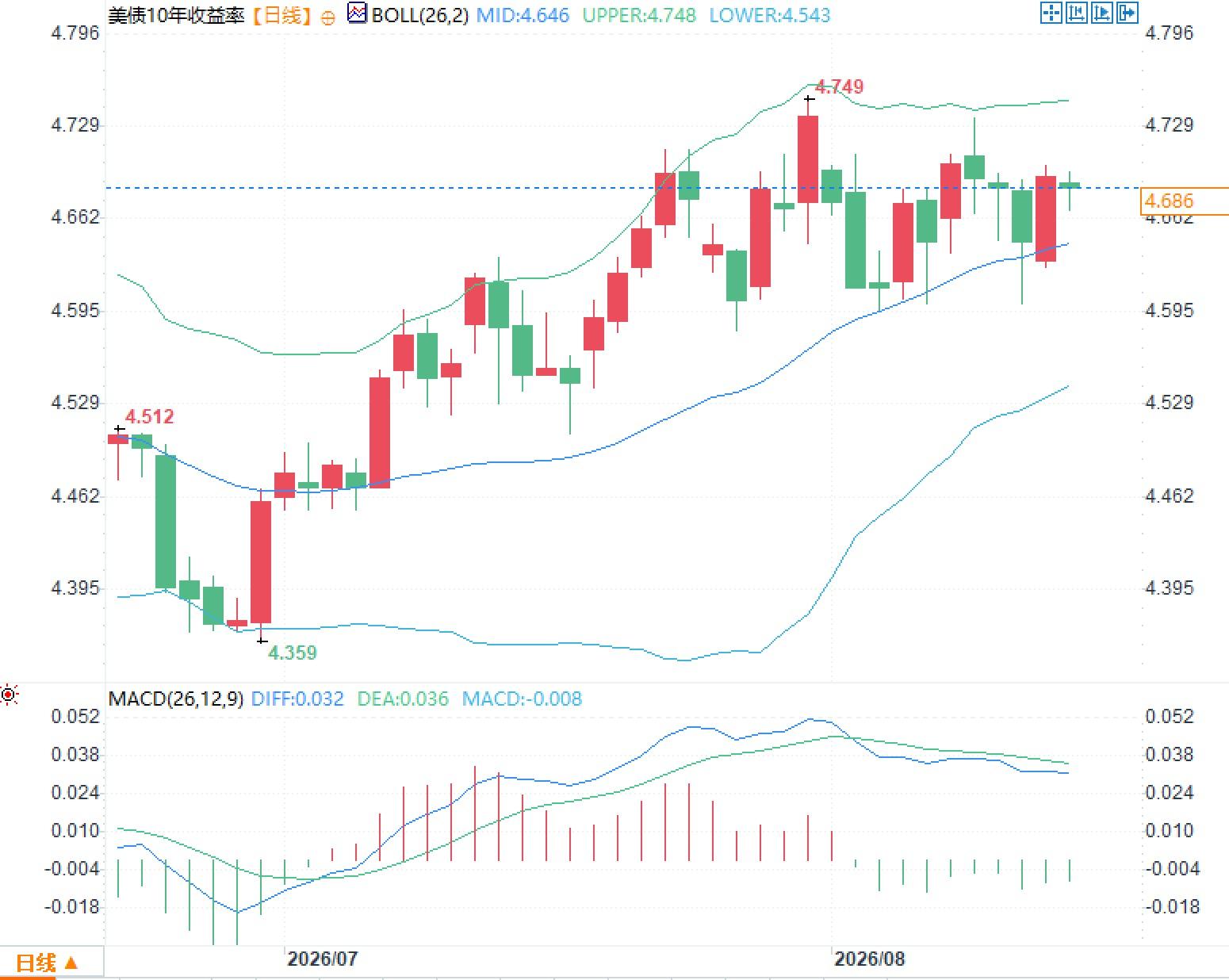 This yield structure incorporates multiple factors, including monetary policy, inflation, real interest rates, Treasury supply, and term premiums. Therefore, high long-term yields cannot be simply attributed to concerns about a debt crisis. Recent weakness in US retail sales and a slight easing of inflation data have lowered market expectations for further policy rate hikes by the Federal Reserve, thus putting some downward pressure on short-term yields. At the same time, the pressure from long-term fiscal deficits and Treasury supply has not significantly disappeared, preventing long-term interest rates from changing entirely in sync with short-term policy expectations.
The most valuable aspect of this National Bureau of Economic Research (NBER) survey is not simply the conclusion that "investors are worried about US debt," but rather the revelation of a deeper asset pricing phenomenon: high-risk perception does not necessarily lead to drastic portfolio adjustments. The study shows that among respondents who expressed concern about debt, 72.0% of bond investors did not take concrete portfolio adjustments. After showing respondents the current debt level and the latest fiscal forecasts, their assessment of the probability of a debt crisis over the next 10 years increased by an average of 14.9 percentage points, but the proportion reducing their willingness to buy US Treasury bonds only increased by 4.2 percentage points. This means that the market's approach to fiscal risk is not simply "high risk, therefore sell bonds." For institutional funds, US Treasury bonds simultaneously serve functions such as liquidity management, collateral, repurchase financing, duration allocation, liability matching, and derivatives pricing benchmarks. Even if investors increase their long-term fiscal risk assessment, as long as these market functions are not effectively replaced by other assets, behavioral adjustments may lag behind changes in risk perception. Assessing fiscal risk cannot solely rely on the total amount of debt; more crucially, it depends on the relationship between debt growth rate, average financing costs, and nominal economic growth rate. The latest official baseline forecast shows that the ratio of publicly held federal debt to GDP is expected to rise from 101% in 2026 to 120% in 2036. The fiscal deficit is projected to be approximately $1.9 trillion in fiscal year 2026, representing 5.8% of GDP, and is expected to expand to $3.1 trillion in 2036, representing 6.7% of GDP. More noteworthy is interest expense. Net interest expense is projected to rise from approximately $1 trillion in 2026 to $2.1 trillion in 2036, increasing from 3.3% to 4.6% of GDP. Conversely, the primary deficit as a percentage of GDP is projected to decrease from 2.6% to 2.1% during the same period. In other words, future deficit expansion will increasingly stem from the financing costs incurred by rolling over existing debt, rather than simply from new primary fiscal spending. This is why the framework for analyzing the bond market needs to change. Once fiscal pressure is increasingly reflected in interest expenses, a clear interest rate feedback mechanism will emerge: higher market financing costs will lead to greater fiscal interest expenses; greater interest expenses will lead to higher future financing demand; and increased financing demand may in turn raise the maturity compensation demanded by investors. These mechanisms are typically not reflected in single-day price changes, but are more readily apparent in long-term term premiums, auction margins, primary dealer inventories, and long-term volatility. From a market microstructure perspective, demand for US Treasury bonds does not stem solely from a single assessment of fiscal fundamentals. Large leveraged institutions have become significant participants in the Treasury market. The latest research from the Federal Reserve shows that as of September 2025, large hedge funds will hold approximately $4 trillion in total exposure to US Treasury bonds, including approximately $2.4 trillion in long positions and approximately $1.6 trillion in short positions. Basis trading between cash Treasury bonds and futures contracts will amount to approximately $830 billion, accounting for about 35% of these institutions' long Treasury bond exposure. These positions do not necessarily indicate that investors are simply bullish on US fiscal credit. Many positions are essentially relative value trades, meaning they simultaneously hold cash bonds and the opposite futures or swaps exposure, with returns primarily derived from price spreads, financing costs, and capital efficiency. This explains why "concerns about debt sustainability" and "continued holding of Treasury bonds" can coexist. What truly needs to be observed is not whether there are still buyers for US Treasury bonds, but rather what kind of risk compensation marginal buyers are demanding, and how much of these purchases are based on high leverage and a stable financing environment. The Federal Reserve's Financial Stability Report in May of this year pointed out that hedge fund leverage remains near record highs since complete statistics began, and the correlation between the financial system and the relative value trading of Treasury bonds remains high. As of August 17, the yield on 10-year US Treasury bonds was approximately 4.69%, and the yield on 2-year bonds was approximately 4.15%. Previously, on August 14, the yield on 10-year bonds closed at approximately 4.68%, and the yield on 2-year bonds at approximately 4.17%, with longer-term yields still significantly higher than shorter-term yields. This yield structure incorporates multiple factors, including monetary policy, inflation, real interest rates, Treasury supply, and term premiums. Therefore, high long-term yields cannot be simply attributed to concerns about a debt crisis. Recent weakness in US retail sales and a slight easing of inflation data have lowered market expectations for further policy rate hikes by the Federal Reserve, thus putting some downward pressure on short-term yields. At the same time, the pressure from long-term fiscal deficits and Treasury supply has not significantly disappeared, preventing long-term interest rates from changing entirely in sync with short-term policy expectations.
- Risk Warning and Disclaimer
- The market involves risk, and trading may not be suitable for all investors. This article is for reference only and does not constitute personal investment advice, nor does it take into account certain users’ specific investment objectives, financial situation, or other needs. Any investment decisions made based on this information are at your own risk.