Risk appetite is improving, but the bond market harbors hidden dangers, leaving the Federal Reserve in a dilemma.
2026-08-17 21:06:57
Recently, risk appetite in the US equity and gold markets has rebounded significantly. Driven by the realization of AI profits, US stock indices continue to approach historical highs, and market breadth has also improved. The equal-weighted S&P 500 index outperformed the market capitalization-weighted benchmark, indicating that the market is no longer solely reliant on a few tech giants. However, amidst the stellar performance of equities and gold, the bond market has issued warning signals, exhibiting a highly fragmented pattern: on the one hand, long-term US Treasury yields continue to rise, with the 30-year Treasury auction yield hitting a 25-year high, while Trump has again threatened to bomb Oman if it obstructs the US. On the other hand, influenced by a significant decline in expectations of US interest rate hikes, risk appetite for gold and equities has improved. Combined with the latest inflation and livelihood data, it can be seen that the concerns in the bond market are not unfounded, pushing the Federal Reserve into a policy dilemma. 
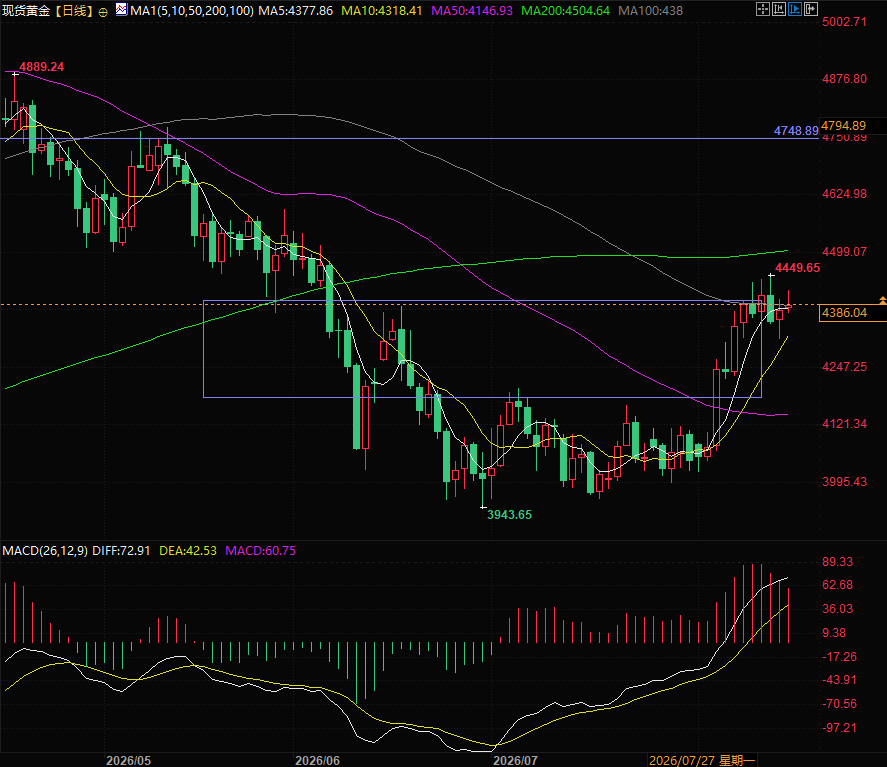 (Spot gold daily chart, source: EasyTrade) At 21:02 Beijing time, spot gold is currently trading at $4383 per ounce.
Trump said the US would bomb Oman if it obstructed the US.
In an interview, Trump made numerous statements regarding the situation in various parts of the Middle East. Regarding Iran, he stated he was "not in a hurry" and revealed that the US has secret communication channels with the Iranian Islamic Revolutionary Guard Corps. He also said Iran should raise the white flag and surrender, praising Iranians as excellent poker players. He further threatened that if Oman hinders the US, the US will bomb Oman. Additionally, Trump indicated he might endorse a candidate in the Israeli election.Inflation Phenomena and Reality: CPI Marginally Easing, Energy-Driven Inflation Remains Sticky
On the inflation front, the US CPI rose only 0.1% month-on-month and 3.4% year-on-year in July, showing a slight easing of overall inflation. This also led the market to lower its expectations for further interest rate hikes by the Federal Reserve. However, the structural risks within inflation have not been eliminated. Affected by the US-Iran conflict disrupting shipping in the Strait of Hormuz, Brent crude oil prices approached $90 per barrel, and gasoline and diesel prices remained high. Inflation in the Northeast was still as high as 4.3% year-on-year, and inflation for food categories such as fruits and vegetables reached 5.1%. The energy supply shock has led to a decline in the overall CPI, but residents' actual perceived price pressure remains significant. Gasoline prices in Connecticut have risen by nearly $1 compared to the same period last year, and diesel prices have surged by 46% year-on-year, continuing to pass on costs to downstream consumer goods. With the winter heating oil contract season approaching, the inflation risk from energy remains unresolved. The elderly and low-income groups in the United States feel the effects of rising prices particularly acutely. The US Social Security cost-of-living adjustment ratio is projected to reach 3.6% in 2027, meaning pensions would need to increase by 3.6% to keep pace with inflation. This reflects that the actual cost of living has not cooled in tandem with the statistical CPI of 3.4%. This marginal easing of statistical inflation, coupled with the persistent stickiness of energy-driven inflation, is a key underlying reason for the persistently high yields on long-term US Treasury bonds.Fiscal supply coupled with inflation concerns: High yields on long-term bonds coexist with a weak economy.
Another key variable driving up long-term yields comes from fiscal debt pressure. The US federal debt is about to surpass $40 trillion, and the continuously expanding fiscal deficit brings a massive supply of Treasury bonds. Bond investors are demanding higher term premiums to compensate for inflation and fiscal risks, ultimately reflected in a sharp rise in the 30-year US Treasury yield. It's worth noting that the rise in long-term yields does not entirely correspond to a strong economy: the latest economic data shows that the US is experiencing job losses, a sharp decline in retail sales, and a significant weakening of consumer confidence, indicating that the fundamentals of the real economy are actually showing signs of fatigue. Thus, a contradictory picture emerges in the market: while the real economy is weakening, the equity market is experiencing increased risk appetite driven by AI profits, and gold and silver prices are also boosted. However, long-term Treasury yields remain high due to inflationary concerns and fiscal supply pressures. High risk-free interest rates, in turn, suppress stock valuations and the holding costs of gold and precious metals, creating potential risks for this round of rebound.The Federal Reserve faces a policy dilemma: silent communication amplifies market uncertainty.
This complex situation directly tests the policy framework of the new Federal Reserve Chairman, Warsh. Currently, the Fed has abandoned traditional forward guidance, adopting a "silent" policy communication approach, no longer providing the market with a clear interest rate path, and allowing the market to interpret policy signals from economic data, further amplifying market uncertainty. This has led to the Fed facing a dilemma. If it chooses to further raise interest rates: while this could suppress inflation risks, already weakening employment and consumption will suffer a greater blow, amplifying the downside risks to the real economy. High long-term bond yields coupled with policy rate hikes will further increase the interest burden on federal government debt, amplifying the negative fiscal feedback. If it maintains interest rates or even shifts to easing: the inflation risks from energy have not been fully cleared. Once monetary conditions are relaxed, inflation expectations may rise again, the bond market will continue to sell long-term bonds, and long-term yields will rise further, failing to alleviate market concerns. A real contradiction has emerged in market transactions: the probability of a September rate hike has fallen significantly, which the equity market interprets as a positive, and risk appetite has increased; however, the bond market has not fully embraced this, and long-term yields have not followed the decline in interest rate hike expectations. Bond trading is about long-term inflation and fiscal risks, not whether there will be a short-term rate hike. The stock market expects a marginal easing of the monetary environment, while the bond market continues to price in long-term risks, creating a tug-of-war between the two forces.Tail risks are accumulating, and the trend of real interest rates is becoming key to asset pricing.
The core tail risk facing the market has shifted from simply whether to raise interest rates to the complex evolution of real interest rates. A particularly alarming scenario is that if recent employment market data continues to weaken, it will significantly limit the Federal Reserve's room for interest rate hikes, and may even force it to maintain current rates. In this situation, a paradoxical situation may arise: on the one hand, geopolitical factors such as the Middle East conflict could cause energy prices to surge again, pushing up market inflation expectations; on the other hand, weak economic data would prevent the Federal Reserve from tightening monetary policy rashly, leading to nominal interest rates remaining at current levels or even lower. This creates a situation of "rising inflation expectations but no rise in nominal interest rates," the direct consequence of which is a passive decline in real interest rates (nominal interest rate minus inflation expectations). Compared to equities, gold is more likely to benefit in this environment. The market is holding its breath awaiting the Jackson Hole Economic Symposium at the end of August, hoping to find policy clues in the keynote speech of the new Federal Reserve Chairman, Kevin Warsh. Meanwhile, the minutes of the September policy meeting will be crucial, as the market will interpret how officials weigh the complex relationship between bond market signals, inflation stickiness, and a weakening real economy. This will determine whether the stock-bond conflict can be eased in the short term, and the ultimate direction of real interest rates. (Spot gold daily chart, source: EasyTrade) At 21:02 Beijing time, spot gold is currently trading at $4383 per ounce.
- Risk Warning and Disclaimer
- The market involves risk, and trading may not be suitable for all investors. This article is for reference only and does not constitute personal investment advice, nor does it take into account certain users’ specific investment objectives, financial situation, or other needs. Any investment decisions made based on this information are at your own risk.