Why did Bessant bet on the success of this yen exchange rate intervention?
2026-08-17 22:03:10
Market analysts believe that U.S. Treasury Secretary Scott Bessant is very optimistic that this yen intervention will be effective. Looking back at key policy interventions in Sweden and Mexico in 2023, such interventions often foreshadow a significant shift in foreign exchange market trends. Bessant, who made his name through currency speculation, now appears to be betting on a yen appreciation.  Timing Determines Success or Failure Unlike the 1990s and early 2000s, currency intervention in major currency pairs is now a rare occurrence. The joint US-Japan intervention at the end of July was the first joint intervention to buy yen since the 1998 Asian financial crisis. Bessant invested heavily in this intervention, and he undoubtedly hoped the final result would prove his decision correct. As a former hedge fund portfolio manager, he knew that timing was everything. Japan's unilateral intervention in the summer of 2024 was effective: it coincided with a turning point in the Fed's monetary policy cycle, and later that year the Fed cut interest rates by a total of 75 basis points, reversing market trends. But what gave the US Treasury Secretary the confidence to intervene in the currency again? This article will analyze the logic behind this intervention. The timing of the intervention stemmed from two factors: firstly, subjective judgment—the yen was already undervalued; secondly, a bet on Japan's impending policies favorable to the yen. During the intervention, Bessant claimed the yen was "severely undervalued." ING FX strategist Francisco Pesole, using a fair value model, stated that a behavioral equilibrium exchange rate model is typically used to assess the fair value of exchange rates in the medium term. This model uses quarterly data such as terms of trade, productivity, current account balance, and government spending to estimate the real fair value. This analytical framework deliberately excludes the influence of short-term factors such as interest rates and the stock market, allowing us to accurately understand the true impact of economic fundamentals on exchange rates. In the USD/JPY currency pair, the continued depreciation of the yen is clearly inconsistent with long-term economic fundamentals; throughout 2026, the real overvaluation of this currency pair will remain above 20%. This is clearly seen in the USD/JPY currency pair, where the yen's depreciation is not aligned with long-term economic fundamentals. Throughout 2026, the real overvaluation of USD/JPY will remain above 20%.
 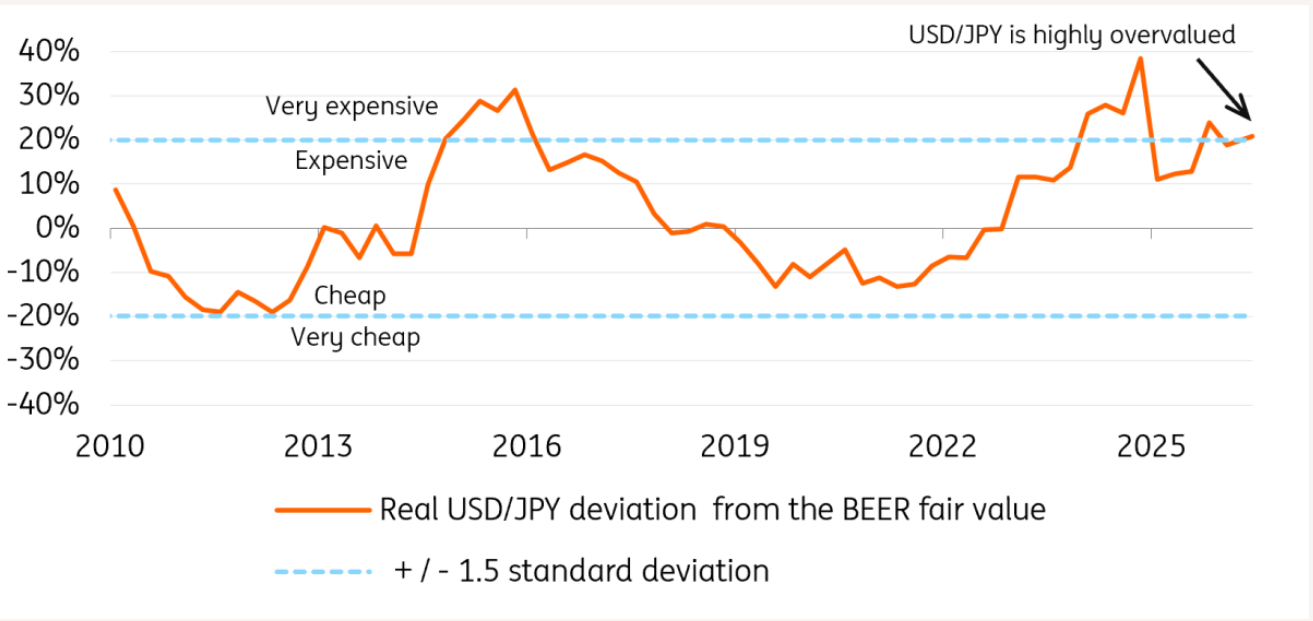 (The strengthening of the USD/JPY is diverging from economic fundamentals) Policymakers can grasp the turning point of the trend. With a daily trading volume of $480 billion for the USD/JPY, many doubt whether joint US-Japan intervention can have a substantial effect in such a large market. However, intervention has a strong signaling effect, conveying to the market that the exchange rate has overshooted. In recent years, there have been two instances where central banks proactively defended their currencies, and the market ultimately followed suit. In June 2023, the Swedish central bank unexpectedly announced a foreign exchange reserve hedging plan. At first glance, this move seemed perplexing, but as analyzed at the time, it reflected the Swedish central bank's judgment: the Swedish krona was undervalued, and if the krona strengthened, the central bank's own equity capital would face significant losses. At that time, the euro was trading near 12.00 against the Swedish krona, and the exchange rate hardly rose further afterward. It is estimated that the hedging operation itself only pushed the euro down by 2-3% against the Swedish krona, but the central bank's signal that the krona was undervalued resonated widely in the market. Also in September 2023, the Mexican central bank announced it would close a $7.5 billion forward position in the US dollar against the Mexican peso. This position was established by the central bank in 2017 and 2020 to support the peso's exchange rate. At the time of the announcement, the US dollar was trading around 17.00 against the Mexican peso, conveying the central bank's view that the peso's appreciation had gone too far. The timing was equally precise; since then, the US dollar has struggled to hold above 17.00 against the Mexican peso. Will Bessant's judgment be validated? Bessant's core betting logic was that the yen's downside potential was limited; a decline in the US dollar against the yen would enhance the competitiveness of US manufacturing companies, both in Japan and in third-party overseas markets. This move clearly reflects Trump's policy inclinations. Bessant also admitted that the intervention had another purpose: to prevent other Asian economies from competing with Japan through currency devaluation. The market generally believes that the sharp devaluation of the renminbi in 1994 was one of the triggers for the 1997-1998 Asian foreign exchange crisis. However, for this highly anticipated intervention to truly succeed, it requires supportive fundamentals. A key element is Japan's interest rate hike. Therefore, both Bessant's own statements and related reports from Tokyo signal that the Japanese government will accept the Bank of Japan's accelerated tightening of monetary policy, no longer limited to a pace of 25 basis points every six months. Current market pricing indicates a roughly 75% probability of the Bank of Japan raising rates earlier than expected in September. However, for the yen to achieve sustained appreciation, domestic capital needs to remain in Japan, or overseas capital needs to flow back. This is precisely why the difference in economic growth rates and the attractiveness of investment returns are so crucial. In July, Tokyo announced a new growth strategy, planning to implement a total of 370 trillion yen (equivalent to US$2.3 trillion) in public-private partnerships by 2040. The United States supports this strategy, hoping that Japan will become a stable defensive barrier in the region geopolitically, and commercially, expecting Japan to grow into a larger export market. The Intrinsic Link Between Investment Returns and the Yen The effectiveness of Japan's growth strategy is directly linked to the yen's exchange rate. Asian economies like Japan and South Korea face a common problem: an aging population coupled with sluggish productivity, leading to a continuous outflow of capital seeking higher returns overseas. A recent research report by economists at the Bank of Korea is highly valuable, emphasizing the importance of the relative strength of cross-border investment returns. The report points out that South Korea is following a similar path to Japan: the proportion of investment income in its current account surplus is constantly rising. While a large current account surplus looks impressive on paper, the problem is that higher returns on overseas investments cause these profits to remain abroad in the form of reinvestment. The report lists the reinvestment rates of overseas investment income as follows: Japan 46%, South Korea 40%, Germany 28%, and Taiwan 18%. While policies like South Korea's 2023 exemption from overseas dividend tax can certainly guide the repatriation of retained profits in the short term, the report authors mention that the long-term solution relies on domestic investment to achieve sustained productivity growth, which is also the starting point for Japan's current large-scale investment plan. Bessant clearly supports this approach, betting that timely exchange rate intervention can at least buy time for the policy to take effect. Furthermore, Japanese companies have enjoyed a 95% tax exemption on overseas retained earnings since 2009, so new tax incentives are unlikely to significantly alter the yen's trend. Other structural solutions exist, such as including Japanese government bonds in the NISA small-investment savings account and adjusting the asset allocation of the Government Pension Investment Fund of Japan (GPIF), a point of considerable market attention. Currently, GPIF's benchmark allocation is 25% Japanese government bonds and 50% domestic assets. The market has begun speculating that the Bank of Japan and GPIF may replicate the "financial big bang" policy linkage of October 2014, with the window potentially opening at the Bank of Japan's interest rate meeting on October 30th: the Bank of Japan raising interest rates while GPIF announces an increase in its domestic asset allocation. These policy scenarios remain speculative. Bessant, who made his fortune through currency speculation, is now betting on yen appreciation. While joint US-Japan intervention has provided a catalyst, the yen's sustained strength ultimately depends on improved domestic investment returns, a recovery in economic growth, and the Bank of Japan's corresponding monetary policy path. ING's baseline scenario is that the economic growth rate and interest rate differential between the US and Japan will gradually converge; the USD/JPY exchange rate will reach 158 by the end of 2026 and fall back to 152 by the end of 2027.
Timing Determines Success or Failure Unlike the 1990s and early 2000s, currency intervention in major currency pairs is now a rare occurrence. The joint US-Japan intervention at the end of July was the first joint intervention to buy yen since the 1998 Asian financial crisis. Bessant invested heavily in this intervention, and he undoubtedly hoped the final result would prove his decision correct. As a former hedge fund portfolio manager, he knew that timing was everything. Japan's unilateral intervention in the summer of 2024 was effective: it coincided with a turning point in the Fed's monetary policy cycle, and later that year the Fed cut interest rates by a total of 75 basis points, reversing market trends. But what gave the US Treasury Secretary the confidence to intervene in the currency again? This article will analyze the logic behind this intervention. The timing of the intervention stemmed from two factors: firstly, subjective judgment—the yen was already undervalued; secondly, a bet on Japan's impending policies favorable to the yen. During the intervention, Bessant claimed the yen was "severely undervalued." ING FX strategist Francisco Pesole, using a fair value model, stated that a behavioral equilibrium exchange rate model is typically used to assess the fair value of exchange rates in the medium term. This model uses quarterly data such as terms of trade, productivity, current account balance, and government spending to estimate the real fair value. This analytical framework deliberately excludes the influence of short-term factors such as interest rates and the stock market, allowing us to accurately understand the true impact of economic fundamentals on exchange rates. In the USD/JPY currency pair, the continued depreciation of the yen is clearly inconsistent with long-term economic fundamentals; throughout 2026, the real overvaluation of this currency pair will remain above 20%. This is clearly seen in the USD/JPY currency pair, where the yen's depreciation is not aligned with long-term economic fundamentals. Throughout 2026, the real overvaluation of USD/JPY will remain above 20%. (The strengthening of the USD/JPY is diverging from economic fundamentals) Policymakers can grasp the turning point of the trend. With a daily trading volume of $480 billion for the USD/JPY, many doubt whether joint US-Japan intervention can have a substantial effect in such a large market. However, intervention has a strong signaling effect, conveying to the market that the exchange rate has overshooted. In recent years, there have been two instances where central banks proactively defended their currencies, and the market ultimately followed suit. In June 2023, the Swedish central bank unexpectedly announced a foreign exchange reserve hedging plan. At first glance, this move seemed perplexing, but as analyzed at the time, it reflected the Swedish central bank's judgment: the Swedish krona was undervalued, and if the krona strengthened, the central bank's own equity capital would face significant losses. At that time, the euro was trading near 12.00 against the Swedish krona, and the exchange rate hardly rose further afterward. It is estimated that the hedging operation itself only pushed the euro down by 2-3% against the Swedish krona, but the central bank's signal that the krona was undervalued resonated widely in the market. Also in September 2023, the Mexican central bank announced it would close a $7.5 billion forward position in the US dollar against the Mexican peso. This position was established by the central bank in 2017 and 2020 to support the peso's exchange rate. At the time of the announcement, the US dollar was trading around 17.00 against the Mexican peso, conveying the central bank's view that the peso's appreciation had gone too far. The timing was equally precise; since then, the US dollar has struggled to hold above 17.00 against the Mexican peso. Will Bessant's judgment be validated? Bessant's core betting logic was that the yen's downside potential was limited; a decline in the US dollar against the yen would enhance the competitiveness of US manufacturing companies, both in Japan and in third-party overseas markets. This move clearly reflects Trump's policy inclinations. Bessant also admitted that the intervention had another purpose: to prevent other Asian economies from competing with Japan through currency devaluation. The market generally believes that the sharp devaluation of the renminbi in 1994 was one of the triggers for the 1997-1998 Asian foreign exchange crisis. However, for this highly anticipated intervention to truly succeed, it requires supportive fundamentals. A key element is Japan's interest rate hike. Therefore, both Bessant's own statements and related reports from Tokyo signal that the Japanese government will accept the Bank of Japan's accelerated tightening of monetary policy, no longer limited to a pace of 25 basis points every six months. Current market pricing indicates a roughly 75% probability of the Bank of Japan raising rates earlier than expected in September. However, for the yen to achieve sustained appreciation, domestic capital needs to remain in Japan, or overseas capital needs to flow back. This is precisely why the difference in economic growth rates and the attractiveness of investment returns are so crucial. In July, Tokyo announced a new growth strategy, planning to implement a total of 370 trillion yen (equivalent to US$2.3 trillion) in public-private partnerships by 2040. The United States supports this strategy, hoping that Japan will become a stable defensive barrier in the region geopolitically, and commercially, expecting Japan to grow into a larger export market. The Intrinsic Link Between Investment Returns and the Yen The effectiveness of Japan's growth strategy is directly linked to the yen's exchange rate. Asian economies like Japan and South Korea face a common problem: an aging population coupled with sluggish productivity, leading to a continuous outflow of capital seeking higher returns overseas. A recent research report by economists at the Bank of Korea is highly valuable, emphasizing the importance of the relative strength of cross-border investment returns. The report points out that South Korea is following a similar path to Japan: the proportion of investment income in its current account surplus is constantly rising. While a large current account surplus looks impressive on paper, the problem is that higher returns on overseas investments cause these profits to remain abroad in the form of reinvestment. The report lists the reinvestment rates of overseas investment income as follows: Japan 46%, South Korea 40%, Germany 28%, and Taiwan 18%. While policies like South Korea's 2023 exemption from overseas dividend tax can certainly guide the repatriation of retained profits in the short term, the report authors mention that the long-term solution relies on domestic investment to achieve sustained productivity growth, which is also the starting point for Japan's current large-scale investment plan. Bessant clearly supports this approach, betting that timely exchange rate intervention can at least buy time for the policy to take effect. Furthermore, Japanese companies have enjoyed a 95% tax exemption on overseas retained earnings since 2009, so new tax incentives are unlikely to significantly alter the yen's trend. Other structural solutions exist, such as including Japanese government bonds in the NISA small-investment savings account and adjusting the asset allocation of the Government Pension Investment Fund of Japan (GPIF), a point of considerable market attention. Currently, GPIF's benchmark allocation is 25% Japanese government bonds and 50% domestic assets. The market has begun speculating that the Bank of Japan and GPIF may replicate the "financial big bang" policy linkage of October 2014, with the window potentially opening at the Bank of Japan's interest rate meeting on October 30th: the Bank of Japan raising interest rates while GPIF announces an increase in its domestic asset allocation. These policy scenarios remain speculative. Bessant, who made his fortune through currency speculation, is now betting on yen appreciation. While joint US-Japan intervention has provided a catalyst, the yen's sustained strength ultimately depends on improved domestic investment returns, a recovery in economic growth, and the Bank of Japan's corresponding monetary policy path. ING's baseline scenario is that the economic growth rate and interest rate differential between the US and Japan will gradually converge; the USD/JPY exchange rate will reach 158 by the end of 2026 and fall back to 152 by the end of 2027.
- Risk Warning and Disclaimer
- The market involves risk, and trading may not be suitable for all investors. This article is for reference only and does not constitute personal investment advice, nor does it take into account certain users’ specific investment objectives, financial situation, or other needs. Any investment decisions made based on this information are at your own risk.