The stagflation dilemma: Behind aggressive interest rate hikes, the euro's weaknesses are exposed.
2026-08-17 21:40:58
The ongoing global geopolitical situation, with the Middle East crisis entering its sixth month, disrupted fossil fuel shipping through the Strait of Hormuz, and persistently high international oil prices, has fueled a global inflationary rebound. Against this backdrop, major central banks worldwide face a thorny monetary policy dilemma: high inflation necessitates tightening policies to suppress it, while sluggish economic growth urgently requires easing policies to support it. In contrast to the cautious approach and deliberate weighing of options by the Federal Reserve and the Bank of England, the European Central Bank (ECB) initiated interest rate hikes this year, aggressively tightening monetary policy. However, its mistimed and misjudged approach has sparked widespread controversy, making it the most criticized central bank by the market and academia. 
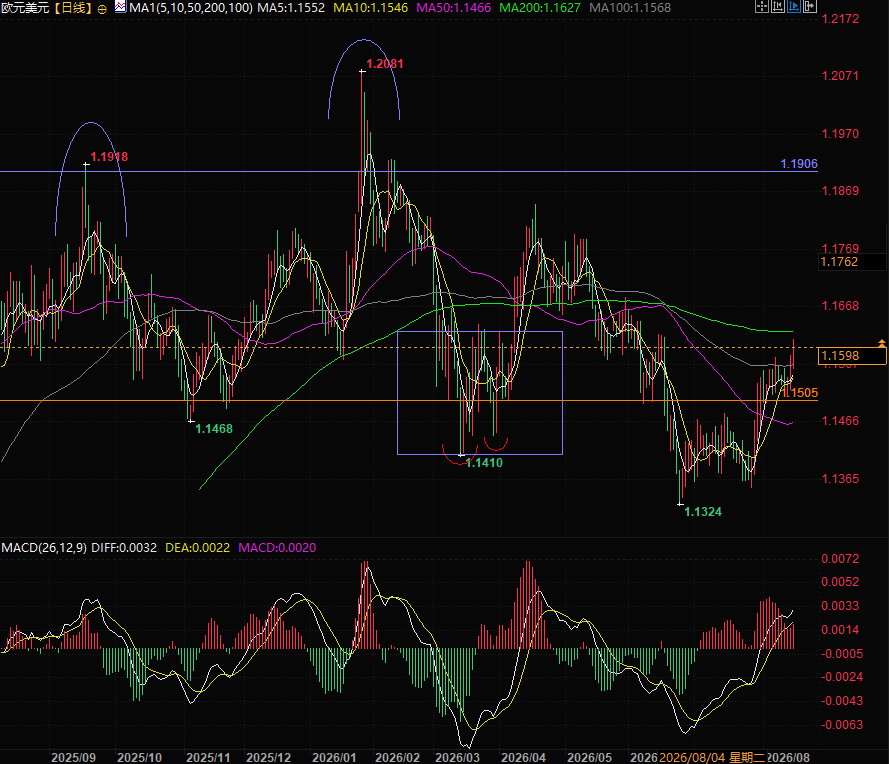 (Euro/USD daily chart, source: FX678) At 21:37 Beijing time, the euro/dollar exchange rate is currently 1.1594/95.
Imported energy shocks cause eurozone inflation to rise again.
The core trigger for this round of inflation rebound in the Eurozone is the external energy shock, while domestic inflation control has inherent weaknesses. The ongoing turmoil in the Middle East continues to push up international oil prices, coupled with the lingering effects of the energy market turmoil from the previous Russia-Ukraine conflict. The Eurozone, highly dependent on energy imports, is bearing the brunt, with imported inflationary pressures continuing to rise. Higher oil prices directly increase costs across the entire energy production and transportation value chain, and this price pressure is gradually being transmitted downstream, covering various consumer sectors such as goods manufacturing and public services. This has completely reversed the previous steady decline in Eurozone inflation, putting the European Central Bank's 2% inflation target at risk of being breached again, and posing a serious challenge to the policy bottom line of price stability.Aggressive interest rate hikes spark controversy: a policy misjudgment detached from fundamentals.
Faced with signs of a slight rise in inflation, the European Central Bank (ECB) decisively raised interest rates in June, tightening market borrowing costs. However, this decision has been widely criticized by economists and market analysts, with the core controversy focusing on the premature timing of the rate hike and the severely unbalanced pace of policy. Compared to the more resilient economies of the United States and the United Kingdom, the Eurozone's economic recovery is extremely weak, still struggling to recover from the sluggish growth caused by the energy shock, suffering from insufficient industrial vitality, weak consumption and investment, and a severe lack of endogenous growth momentum. Against the backdrop of an already downward-stricken economy, a hasty rate hike is tantamount to "adding insult to injury," further increasing corporate financing costs, suppressing consumer spending, and exacerbating downward economic pressure. Neil Schilling, chief economist at Capital Economics, explicitly pointed out that the ECB's rate hike is a "behind-the-scenes decision to address past crises," completely detached from the current economic fundamentals of the Eurozone. He analyzed that the current high oil prices have already naturally suppressed the Eurozone economy by pushing up production costs and compressing market demand. The tightening effect of interest rate hikes and the suppressive effect of high oil prices are highly superimposed, and the dual pressure continues to drag down economic vitality. Not only can it not solve the problem of external imported inflation at its root, but it is also very likely to push the Eurozone economy to the risk of stagnation. This passive "anti-inflation battle" is not worth the effort.The policy framework has shortcomings, and the decision-making logic is vague and disordered.
Beyond misjudging the timing of short-term policies, the European Central Bank's long-standing flaws in its monetary policy framework and its confused decision-making logic have also been fully exposed. In recent years, the Federal Reserve and the Bank of England have gradually abandoned rigid forward guidance models, no longer rigidly locking in future interest rate paths, and instead relying on real-time economic data and adapting to market dynamics to flexibly adjust policies, resulting in greater policy adaptability. In contrast, while the European Central Bank has removed the rigid constraints of traditional forward guidance, it has failed to establish a clear and comprehensive policy response mechanism. Faced with the dual complexities of fluctuating inflation and a weakening economy, the ECB's policy judgments have wavered, and its response logic has been confused. The market cannot accurately predict its subsequent actions, greatly weakening the guiding role and credibility of its monetary policy.Market expectations diverge, and the path of interest rate hikes remains highly uncertain.
There is a significant divergence between market and professional institutions' predictions regarding the European Central Bank's (ECB) policies, with the expectation gap widening. Financial markets widely bet that the ECB will raise interest rates by another 25 basis points at its September meeting, increasing the main deposit rate to 2.5%, and that the tightening pace will likely continue next year. However, leading senior analysts, represented by Schilling, strongly disagree, arguing that the market's optimistic rate hike expectations are severely detached from the Eurozone's fundamental realities. With the risk of stagflation remaining prominent, continued rate hikes cannot resolve the imported inflation problem caused by geopolitical conflicts; they will only further deplete the Eurozone's economic growth potential. Therefore, the ECB is highly likely to revise its current aggressive tightening pace, slowing down or even pausing rate hikes.The unique predicament of the Eurosystem and the intractable problem of policy balance
Ultimately, the European Central Bank (ECB) is mired in a dilemma of stagflation-driven monetary policy unique to the Eurosystem, a core monetary control challenge compared to the US dollar and the British pound. From a monetary perspective, the euro, as the unified regional currency, bears the core function of balancing the economies of multiple Eurozone countries and stabilizing regional prices, yet it faces the structural weakness of a "single currency, decentralized fiscal policy." Without interest rate hikes, high imported inflation will continue to erode the purchasing power of Eurozone residents, exceeding the central bank's inflation target and weakening the euro's value stability and credit foundation. Continued interest rate hikes will further damage the already fragile regional real economy, exacerbate economic divergence among countries, and amplify the recession risk of peripheral member states. Unlike the unified fiscal and monetary policy coordination system of the US and UK, the economic fundamentals of Eurozone countries are uneven, and their fiscal policies are independent, making it impossible to offset the negative impact of monetary tightening through fiscal coordination, further amplifying the ECB's control difficulties. Finding the right balance between controlling inflation, stabilizing the euro, and ensuring stable regional economic growth has become a core challenge that the European Central Bank has struggled to solve for a long time. Every monetary policy decision it makes directly affects the euro's trajectory and the economic outlook of the entire eurozone, continuously impacting the global financial markets. (Euro/USD daily chart, source: FX678) At 21:37 Beijing time, the euro/dollar exchange rate is currently 1.1594/95.
- Risk Warning and Disclaimer
- The market involves risk, and trading may not be suitable for all investors. This article is for reference only and does not constitute personal investment advice, nor does it take into account certain users’ specific investment objectives, financial situation, or other needs. Any investment decisions made based on this information are at your own risk.