The US dollar rebounded from 155 to 159 against the Japanese yen, with the market gradually eroding the gains of the joint intervention.
2026-08-18 12:10:59
On Tuesday (August 18) during the Asian session, the USD/JPY pair traded in a narrow range, currently hovering around 159.50. This level falls between the intervention high of 164.00 and the joint intervention low of 155.00. Westpac believes the effectiveness of the joint US-Japan intervention is rapidly waning, with the USD/JPY pair rebounding above 159 within days of hitting a low of 155, indicating the market is actively testing the tolerance limits of both countries' authorities. The bank expects the yen to struggle to establish a sustained upward trend until a shift in US monetary policy expectations later in 2026, with the USD/JPY pair more likely to consolidate around 160 rather than retest 165. 
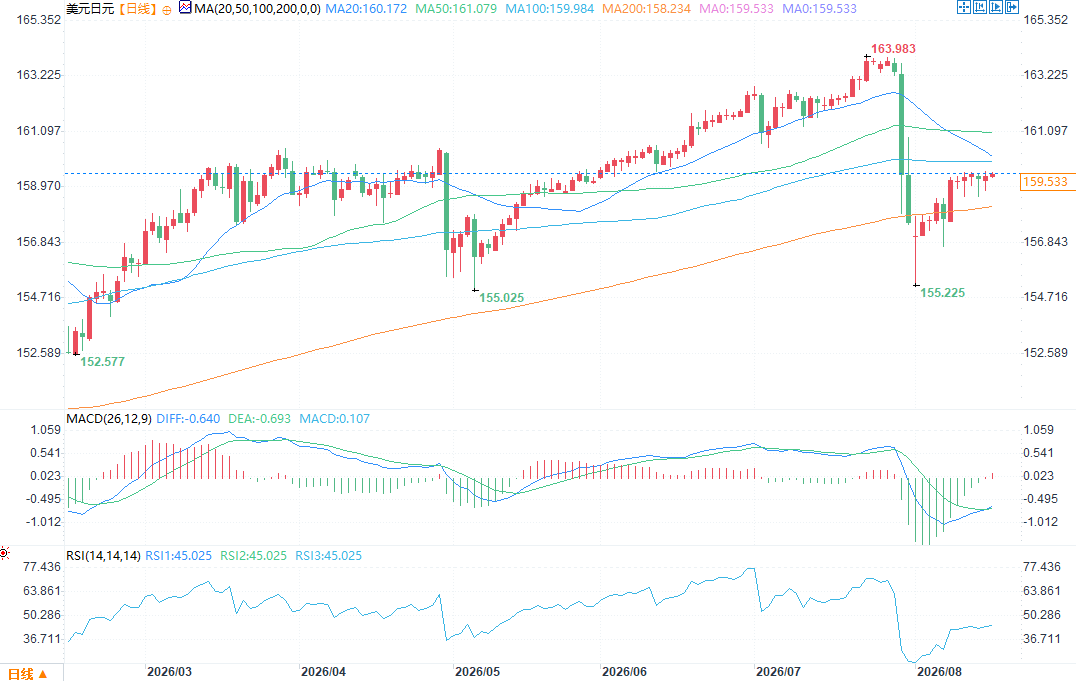 (USD/JPY daily chart, source: FX678) At 12:09 Beijing time on August 18, the USD/JPY exchange rate was 159.62/63.
The effectiveness of joint interventions is waning, and the market is testing the limits of the authorities' efforts.
Earlier this month, the USD/JPY pair approached the 165 level. Japanese authorities subsequently sought support from the US government to implement coordinated yen-buying intervention and a large-scale media campaign, pushing the exchange rate down from a high of 164 to around 155. However, within days, the USD/JPY pair rebounded above 159—even after repeated warnings from both governments about potential further action. Westpac Bank points out that this rapid reversal indicates the market is actively testing the true limits of tolerance of the US and Japanese governments. This dynamic typically keeps two-way volatility high but may not reverse the underlying trend. The bank believes that without further substantial follow-up measures, the yen may continue to weaken. However, unless Japan's economic fundamentals deteriorate significantly, a return to 165 is unlikely; a more probable outcome is for the exchange rate to fluctuate around 160 in the foreseeable future.Medium- to long-term outlook: A sustained strengthening of the yen is unlikely before the end of 2026.
Westpac's medium- to long-term outlook is equally unhurried. The bank believes that for the yen to embark on a sustained upward trend, it needs to wait for the expectation of tightening US monetary policy to subside—a turning point that is not expected until later than 2026 at the earliest. Even if the shift begins then, the bank expects the process to be quite slow, due to factors including continued market skepticism about the Bank of Japan's genuine commitment to tightening policy, and Japan's relatively limited participation in global technological expansion compared to South Korea and mainland China.Historical reference: Even after years of adjustments, the yen is still far below its long-term average.
Westpac Bank forecasts that the USD/JPY exchange rate will only fall to 154 by the end of 2027, and further to 146 by the end of 2028. The bank notes that even at the latter level, the USD/JPY exchange rate will still be about 32% higher than the 30-year average from 1990 to 2019—a deviation the bank describes as "truly historic." This projected trajectory implies that even after several years of slow adjustment, the yen will remain historically weak by pre-2020 standards, reflecting a profound shift in the structural relationship between the two currencies, rather than any short-term return to normalcy.Summarize
Westpac's assessment sends a clear signal: the deterrent effect of joint US-Japan intervention is diminishing, and the market has quickly recovered its losses after testing the limits. The bank believes that unless there is a substantial shift in US interest rate expectations (at the earliest by the end of 2026), the yen is unlikely to begin a sustained appreciation trend. Even if the USD/JPY exchange rate falls to 146 by the end of 2028, it will still be more than 30% higher than the 30-year average—the correction of this historical deviation may take longer than the market expects. For yen bulls, a real turnaround may have to wait until the Fed's policy path becomes clearer. (USD/JPY daily chart, source: FX678) At 12:09 Beijing time on August 18, the USD/JPY exchange rate was 159.62/63.
- Risk Warning and Disclaimer
- The market involves risk, and trading may not be suitable for all investors. This article is for reference only and does not constitute personal investment advice, nor does it take into account certain users’ specific investment objectives, financial situation, or other needs. Any investment decisions made based on this information are at your own risk.