Rising expectations of a September rate hike by the Bank of Japan are putting downward pressure on the USD/JPY pair, which is hovering around 159.50.
2026-08-18 14:25:01
The USD/JPY pair remained around 159.50 in early Asian trading on Tuesday, near a two-week low. The exchange rate is currently facing pressure from divergent expectations regarding monetary policy between Japan and the US: market expectations for a further rate hike by the Bank of Japan in September remain high, while recent weak US economic data has narrowed the dollar's interest rate advantage. Against this backdrop, the yen has received some support, limiting the upside potential for the USD/JPY pair.  Market bets on a September rate hike by the Bank of Japan (BOJ) remain high, with pricing indicating an approximately 80% probability of a 25 basis point increase. If this expectation persists, the narrowing interest rate differential between Japan and the US will further enhance the relative attractiveness of the yen. The BOJ's recent opinion summary also shows that some members favor further tightening of monetary policy in the near term, with some believing that the central bank should accelerate the pace of policy normalization in the face of upward inflation risks. The BOJ's hawkish signals are a key factor currently supporting the yen. If Japanese inflation continues to be resilient and wage growth remains sustainable, the BOJ may gradually reduce the stimulus from its easing policies, which would further increase market pricing for subsequent rate hikes and prompt a reallocation of funds in yen assets. However, Japanese economic data presents some challenges to this policy expectation. Japan's real GDP grew by 0.3% quarter-on-quarter in the second quarter, lower than the market expectation of 0.5% and significantly lower than the 0.5% growth in the first quarter. Economic growth was mainly contributed by net exports, government consumption, and private inventories, while domestic private demand remained relatively weak. This structure suggests that Japan's economic recovery still has some fragility. If domestic demand fails to improve sustainably, the Bank of Japan will need to consider economic growth risks when considering further interest rate hikes. Therefore, while the market is currently heavily betting on a September rate hike, future policy actions will depend on whether inflation, wage, and consumption data can continue to provide support. From the US perspective, the dollar also lacks strong upward momentum in the short term. The Federal Reserve previously maintained the federal funds rate in the 3.50%-3.75% range, and the policy meeting did not provide clear forward guidance. The market is currently awaiting the minutes of the July meeting to determine the true assessment of Fed officials regarding inflation, employment, and the future path of interest rates. If the minutes show that some officials have begun to worry about slowing economic growth and support a gradual shift towards easing policies, the dollar may face further pressure, and USD/JPY will face greater downward pressure. Conversely, if the minutes emphasize that inflation remains sticky, or that policymakers are not in a hurry to cut interest rates, the dollar may receive short-term support. Currently, the USD/JPY exchange rate is exhibiting a dual pattern of "yen receiving policy support, dollar awaiting meeting minutes." The market has not formed extreme one-sided expectations, but the yen's interest rate advantage is gradually improving, significantly increasing upward pressure on the exchange rate. From a risk appetite perspective, geopolitical risks may still cause short-term disturbances. If global risk sentiment suddenly deteriorates, the US dollar, as a safe-haven currency, may see inflows, thus limiting the decline of USD/JPY. However, the Japanese yen also possesses traditional safe-haven attributes, so in extreme risk environments, the flow of funds between the two currencies will be influenced by US yields, Japanese policy expectations, and market positioning. Currently, it is particularly important to pay attention to the Bank of Japan's policy signals, the Federal Reserve meeting minutes, and changes in US Treasury yields. If US yields continue to decline, and the Bank of Japan further signals interest rate hikes, USD/JPY may gradually test important technical support levels; if US Treasury yields rise again, while Japanese economic data continues to be weak, the exchange rate may retest the 160 level. From a daily chart perspective, USD/JPY is currently trading around 159.50, and the price is still under pressure from a dense resistance formed by multiple Fibonacci retracement levels. The 50% retracement level around 159.80 is the first key resistance level, while the 61.8% retracement level around 160.67 constitutes a more significant upward pressure. The Relative Strength Index (RSI) for the 14-day period is approximately 44.70, below the 50 midline, indicating a recent weakening of bullish momentum and a cautiously bearish technical outlook for the market. If the exchange rate breaks through 159.80 and stabilizes above the $160 level, the bulls may regain control, with further attention focused on the 61.8% Fibonacci retracement level around 160.67. A decisive break above 160.67 would target the 78.6% Fibonacci retracement level around 162.14, followed by the previous high around 164.01. On the downside, the first support level to watch is the 38.2% Fibonacci retracement level around 158.61, which is currently the most immediate technical support. A break below 158.61 could open up further downside potential, testing the 23.6% Fibonacci retracement level around 157.33. A breach of this level would significantly weaken the medium-term uptrend in USD/JPY. From a 4-hour chart perspective, USD/JPY is currently in a consolidation phase after a pullback from its highs, with intense competition between bulls and bears around 159.50. If the price breaks above 159.80 again, it may correct towards the 160.00-160.67 area in the short term; however, if it continues to be suppressed by 159.80 and falls below 158.61, the bears may further gain the upper hand. Overall, the 4-hour structure leans towards a weak, range-bound movement, and the short-term breakout direction will mainly be determined by the Fed meeting minutes and changes in US yields.
 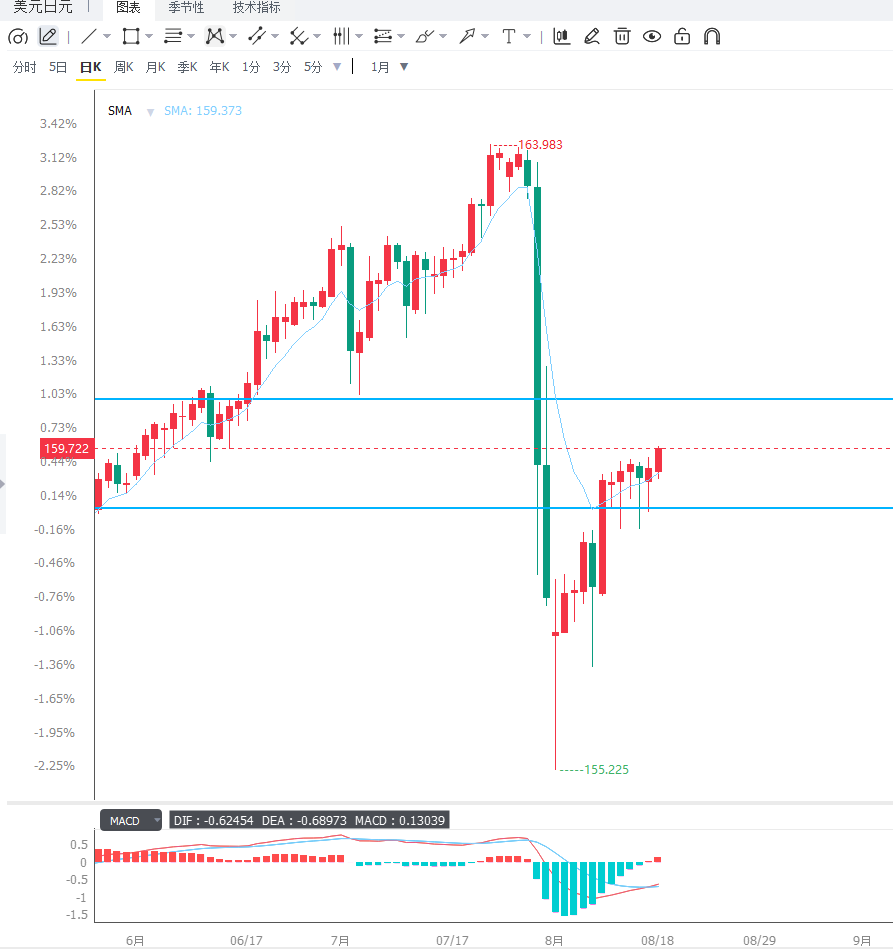 The core contradiction in the USD/JPY exchange rate is the rebalancing between expectations of a Bank of Japan (BOJ) rate hike and the outlook for US monetary policy. Approximately 80% of BOJ rate hike expectations for September are supporting the yen, while slowing Japanese economic growth limits the certainty of further yen appreciation. Future exchange rate direction will primarily depend on the Fed meeting minutes, BOJ policy signals, and changes in the USD/JPY interest rate differential. If the Fed releases dovish signals while the BOJ maintains its rate hike expectations, USD/JPY may test 157.33 after breaking below 158.61; conversely, if US yields rise and Japanese economic data remains weak, the exchange rate may retest 160.67.
Market bets on a September rate hike by the Bank of Japan (BOJ) remain high, with pricing indicating an approximately 80% probability of a 25 basis point increase. If this expectation persists, the narrowing interest rate differential between Japan and the US will further enhance the relative attractiveness of the yen. The BOJ's recent opinion summary also shows that some members favor further tightening of monetary policy in the near term, with some believing that the central bank should accelerate the pace of policy normalization in the face of upward inflation risks. The BOJ's hawkish signals are a key factor currently supporting the yen. If Japanese inflation continues to be resilient and wage growth remains sustainable, the BOJ may gradually reduce the stimulus from its easing policies, which would further increase market pricing for subsequent rate hikes and prompt a reallocation of funds in yen assets. However, Japanese economic data presents some challenges to this policy expectation. Japan's real GDP grew by 0.3% quarter-on-quarter in the second quarter, lower than the market expectation of 0.5% and significantly lower than the 0.5% growth in the first quarter. Economic growth was mainly contributed by net exports, government consumption, and private inventories, while domestic private demand remained relatively weak. This structure suggests that Japan's economic recovery still has some fragility. If domestic demand fails to improve sustainably, the Bank of Japan will need to consider economic growth risks when considering further interest rate hikes. Therefore, while the market is currently heavily betting on a September rate hike, future policy actions will depend on whether inflation, wage, and consumption data can continue to provide support. From the US perspective, the dollar also lacks strong upward momentum in the short term. The Federal Reserve previously maintained the federal funds rate in the 3.50%-3.75% range, and the policy meeting did not provide clear forward guidance. The market is currently awaiting the minutes of the July meeting to determine the true assessment of Fed officials regarding inflation, employment, and the future path of interest rates. If the minutes show that some officials have begun to worry about slowing economic growth and support a gradual shift towards easing policies, the dollar may face further pressure, and USD/JPY will face greater downward pressure. Conversely, if the minutes emphasize that inflation remains sticky, or that policymakers are not in a hurry to cut interest rates, the dollar may receive short-term support. Currently, the USD/JPY exchange rate is exhibiting a dual pattern of "yen receiving policy support, dollar awaiting meeting minutes." The market has not formed extreme one-sided expectations, but the yen's interest rate advantage is gradually improving, significantly increasing upward pressure on the exchange rate. From a risk appetite perspective, geopolitical risks may still cause short-term disturbances. If global risk sentiment suddenly deteriorates, the US dollar, as a safe-haven currency, may see inflows, thus limiting the decline of USD/JPY. However, the Japanese yen also possesses traditional safe-haven attributes, so in extreme risk environments, the flow of funds between the two currencies will be influenced by US yields, Japanese policy expectations, and market positioning. Currently, it is particularly important to pay attention to the Bank of Japan's policy signals, the Federal Reserve meeting minutes, and changes in US Treasury yields. If US yields continue to decline, and the Bank of Japan further signals interest rate hikes, USD/JPY may gradually test important technical support levels; if US Treasury yields rise again, while Japanese economic data continues to be weak, the exchange rate may retest the 160 level. From a daily chart perspective, USD/JPY is currently trading around 159.50, and the price is still under pressure from a dense resistance formed by multiple Fibonacci retracement levels. The 50% retracement level around 159.80 is the first key resistance level, while the 61.8% retracement level around 160.67 constitutes a more significant upward pressure. The Relative Strength Index (RSI) for the 14-day period is approximately 44.70, below the 50 midline, indicating a recent weakening of bullish momentum and a cautiously bearish technical outlook for the market. If the exchange rate breaks through 159.80 and stabilizes above the $160 level, the bulls may regain control, with further attention focused on the 61.8% Fibonacci retracement level around 160.67. A decisive break above 160.67 would target the 78.6% Fibonacci retracement level around 162.14, followed by the previous high around 164.01. On the downside, the first support level to watch is the 38.2% Fibonacci retracement level around 158.61, which is currently the most immediate technical support. A break below 158.61 could open up further downside potential, testing the 23.6% Fibonacci retracement level around 157.33. A breach of this level would significantly weaken the medium-term uptrend in USD/JPY. From a 4-hour chart perspective, USD/JPY is currently in a consolidation phase after a pullback from its highs, with intense competition between bulls and bears around 159.50. If the price breaks above 159.80 again, it may correct towards the 160.00-160.67 area in the short term; however, if it continues to be suppressed by 159.80 and falls below 158.61, the bears may further gain the upper hand. Overall, the 4-hour structure leans towards a weak, range-bound movement, and the short-term breakout direction will mainly be determined by the Fed meeting minutes and changes in US yields. The core contradiction in the USD/JPY exchange rate is the rebalancing between expectations of a Bank of Japan (BOJ) rate hike and the outlook for US monetary policy. Approximately 80% of BOJ rate hike expectations for September are supporting the yen, while slowing Japanese economic growth limits the certainty of further yen appreciation. Future exchange rate direction will primarily depend on the Fed meeting minutes, BOJ policy signals, and changes in the USD/JPY interest rate differential. If the Fed releases dovish signals while the BOJ maintains its rate hike expectations, USD/JPY may test 157.33 after breaking below 158.61; conversely, if US yields rise and Japanese economic data remains weak, the exchange rate may retest 160.67.
- Risk Warning and Disclaimer
- The market involves risk, and trading may not be suitable for all investors. This article is for reference only and does not constitute personal investment advice, nor does it take into account certain users’ specific investment objectives, financial situation, or other needs. Any investment decisions made based on this information are at your own risk.