The dollar index fell below 100 and remained weak after expectations of a Fed rate hike cooled and fiscal concerns weighed on it.
2026-08-18 14:29:00
The US dollar index rebounded slightly in Asian trading on Tuesday, trading around 99.60, temporarily supported by safe-haven flows after three consecutive days of decline. The current dollar market exhibits a clear divergence between bulls and bears: on the one hand, tensions between the US and Iran provide traditional safe-haven demand for the dollar; on the other hand, weaker US employment and inflation data have further reduced market expectations for short-term tightening by the Federal Reserve, thus weakening the dollar's interest rate advantage.  Recent US macroeconomic data has been the core driver of the dollar's weakness. The unexpected decline in US non-farm payrolls in July, followed by a lack of significant acceleration in consumer inflation data, has led the market to reassess the outlook for US economic growth and monetary policy. Currently, the market's pricing in a rate hike at the next Federal Reserve meeting has fallen to around 35%, a significant drop from approximately 47% a month ago. This means that the dollar's previous reliance on high interest rate expectations is weakening. From the perspective of the interest rate market, investors still retain the possibility of further tightening this year, but bets have clearly decreased. Market strategists believe that the current expectation of a further tightening of around 25 basis points this year may still be too high, as recent US economic data has already released some cooling signals. If future employment, consumption, and inflation data continue to be weaker than expected, the Fed's policy stance may move further towards easing, and the dollar index will face greater downward pressure. The US fiscal situation has also become a significant constraint on the dollar's recent performance. The steepening of the US Treasury yield curve reflects increasing market concerns about fiscal deficits, government financing needs, and the sustainability of long-term debt. While higher long-term yields can theoretically enhance the attractiveness of dollar assets, the opposite effect could occur if the rise in yields stems primarily from fiscal risk premiums rather than economic growth expectations. The biggest problem currently facing the dollar is not a lack of safe-haven appeal, but rather a significant divergence between safe-haven demand and interest rate expectations. When geopolitical risks escalate, the dollar can still attract capital inflows; however, if the market perceives a shift towards looser US monetary policy while fiscal risks continue to accumulate, medium-term valuation pressures on the dollar will persist. Recent geopolitical developments have provided temporary support for the dollar. The failure of the US-Iran agreement to continue has brought renewed market attention to related maritime transport and regional security risks. Typically, escalating geopolitical risks drive capital flows to traditional safe-haven assets such as the dollar and US Treasuries, thus directly linking the dollar index's temporary stabilization after a period of decline. However, the dollar's safe-haven advantage is also indirectly affected by changes in oil prices. If energy prices continue to rise and reignite global inflation expectations, the market may readjust the Fed's policy path, thus benefiting the dollar in the short term. But if oil price increases are primarily driven by supply disruption risks while US economic data remains weak, the dollar may struggle to sustain a rebound. Looking at the performance of major currencies, the recent weakening of the US dollar has provided some upside potential for non-dollar currencies such as the euro and the pound sterling. Especially given that economic data from Europe and the UK have not deteriorated significantly, the policy expectations between the Federal Reserve and other major central banks may further influence capital flows. Therefore, whether the US dollar index can regain its footing above 100 will be a crucial signal for determining whether the short-term trend of the dollar has changed. Market sentiment is currently cautiously bearish on the dollar. The dollar index has seen a technical rebound after its continuous decline, but a trend reversal signal has not yet formed. Investors will focus on the Fed meeting minutes, US employment and inflation data, and changes in US Treasury yields. If the meeting minutes further confirm a decline in the willingness to tighten policy, the dollar's rebound potential may be limited; if policymakers re-emphasize inflation risks, the dollar may gain short-term upward momentum. From a daily chart perspective, the dollar index is currently maintaining a bearish trend, with the spot price around 99.60, continuing to trade below the 9-period exponential moving average at 99.79 and the 50-period exponential moving average at 100.21. Both short-term and medium-term moving averages are above the price, indicating that the dollar's short-term rebound is still significantly suppressed. The Relative Strength Index (RSI) for the 14th was approximately 37.51, below the 50 midline, but not yet in clearly oversold territory, indicating that the market still has room for further downside, while also retaining the possibility of a technical rebound. The first resistance level to watch is the 9-period moving average around 99.80, followed by the 50-period moving average around 100.20 and the 100.80 area. If the US dollar index can break through 100.20 again and hold, the short-term bearish structure will ease, and it may further test the 101.00 area. Conversely, if the index fails to recover 99.80 and falls below 99.30 again, the weak structure may continue, and the market will further test the 99.00 or even 98.50 area. From the 4-hour chart, the US dollar index has shown slight stabilization after continuous declines, but the rebound strength remains limited. 99.80 is the first level that the bulls need to break through in the short term. Only by regaining and stabilizing in this area can the rebound momentum be further strengthened. If the rebound is blocked again and falls below 99.30, the bears may regain control. Overall, the 4-hour structure is still weak, and the current rise is more of a technical correction after an oversold condition, not enough to confirm a trend reversal.
 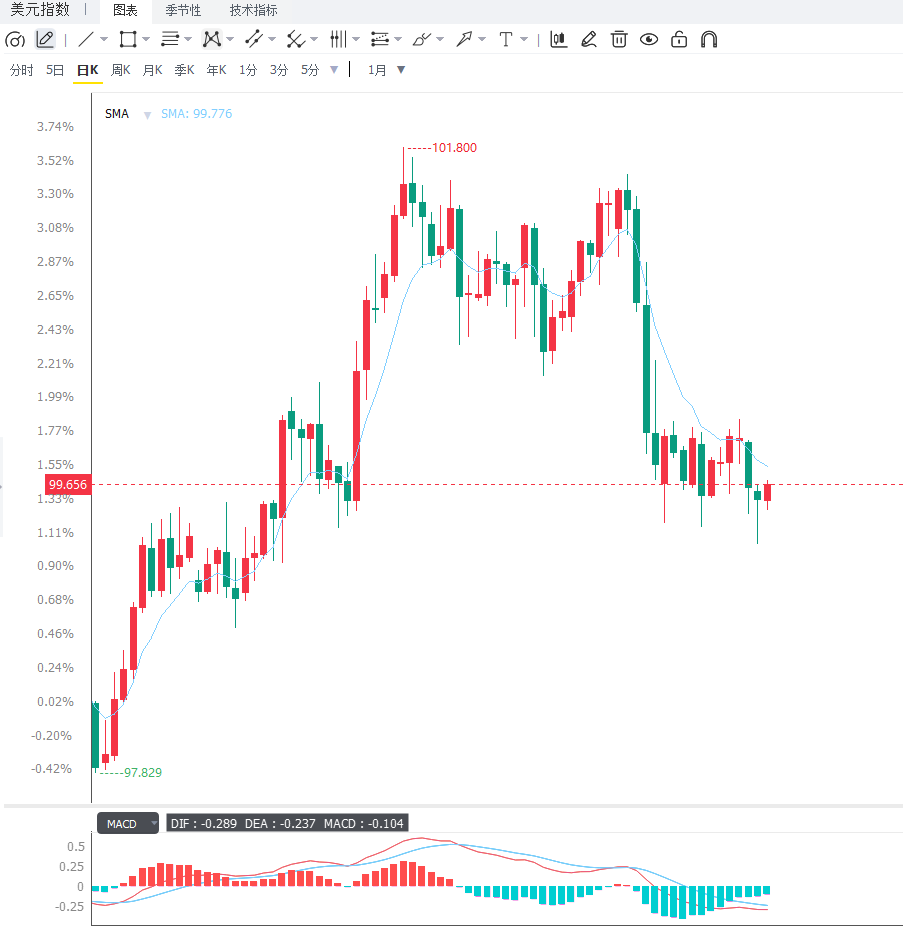 Editor's Summary: The US dollar index is currently in a phase of interplay between weakening interest rate expectations, concerns about fiscal risks, and geopolitical safe-haven demand. A significant cooling of expectations for US interest rate hikes is the main factor suppressing the dollar, while geopolitical risks provide a temporary buffer. Therefore , although the dollar may experience a short-term rebound, its medium-term weakness remains unchanged. Going forward, the market will need to focus on the Fed meeting minutes, US inflation and employment data, US Treasury yields, and changes in the geopolitical situation. If US economic data continues to cool and the Fed further signals a policy shift, the dollar index may fall below 99.30 and extend towards the 99.00 and 98.50 areas; if geopolitical risks escalate significantly or the Fed re-emphasizes inflation risks, the dollar may retest 100.20.
Recent US macroeconomic data has been the core driver of the dollar's weakness. The unexpected decline in US non-farm payrolls in July, followed by a lack of significant acceleration in consumer inflation data, has led the market to reassess the outlook for US economic growth and monetary policy. Currently, the market's pricing in a rate hike at the next Federal Reserve meeting has fallen to around 35%, a significant drop from approximately 47% a month ago. This means that the dollar's previous reliance on high interest rate expectations is weakening. From the perspective of the interest rate market, investors still retain the possibility of further tightening this year, but bets have clearly decreased. Market strategists believe that the current expectation of a further tightening of around 25 basis points this year may still be too high, as recent US economic data has already released some cooling signals. If future employment, consumption, and inflation data continue to be weaker than expected, the Fed's policy stance may move further towards easing, and the dollar index will face greater downward pressure. The US fiscal situation has also become a significant constraint on the dollar's recent performance. The steepening of the US Treasury yield curve reflects increasing market concerns about fiscal deficits, government financing needs, and the sustainability of long-term debt. While higher long-term yields can theoretically enhance the attractiveness of dollar assets, the opposite effect could occur if the rise in yields stems primarily from fiscal risk premiums rather than economic growth expectations. The biggest problem currently facing the dollar is not a lack of safe-haven appeal, but rather a significant divergence between safe-haven demand and interest rate expectations. When geopolitical risks escalate, the dollar can still attract capital inflows; however, if the market perceives a shift towards looser US monetary policy while fiscal risks continue to accumulate, medium-term valuation pressures on the dollar will persist. Recent geopolitical developments have provided temporary support for the dollar. The failure of the US-Iran agreement to continue has brought renewed market attention to related maritime transport and regional security risks. Typically, escalating geopolitical risks drive capital flows to traditional safe-haven assets such as the dollar and US Treasuries, thus directly linking the dollar index's temporary stabilization after a period of decline. However, the dollar's safe-haven advantage is also indirectly affected by changes in oil prices. If energy prices continue to rise and reignite global inflation expectations, the market may readjust the Fed's policy path, thus benefiting the dollar in the short term. But if oil price increases are primarily driven by supply disruption risks while US economic data remains weak, the dollar may struggle to sustain a rebound. Looking at the performance of major currencies, the recent weakening of the US dollar has provided some upside potential for non-dollar currencies such as the euro and the pound sterling. Especially given that economic data from Europe and the UK have not deteriorated significantly, the policy expectations between the Federal Reserve and other major central banks may further influence capital flows. Therefore, whether the US dollar index can regain its footing above 100 will be a crucial signal for determining whether the short-term trend of the dollar has changed. Market sentiment is currently cautiously bearish on the dollar. The dollar index has seen a technical rebound after its continuous decline, but a trend reversal signal has not yet formed. Investors will focus on the Fed meeting minutes, US employment and inflation data, and changes in US Treasury yields. If the meeting minutes further confirm a decline in the willingness to tighten policy, the dollar's rebound potential may be limited; if policymakers re-emphasize inflation risks, the dollar may gain short-term upward momentum. From a daily chart perspective, the dollar index is currently maintaining a bearish trend, with the spot price around 99.60, continuing to trade below the 9-period exponential moving average at 99.79 and the 50-period exponential moving average at 100.21. Both short-term and medium-term moving averages are above the price, indicating that the dollar's short-term rebound is still significantly suppressed. The Relative Strength Index (RSI) for the 14th was approximately 37.51, below the 50 midline, but not yet in clearly oversold territory, indicating that the market still has room for further downside, while also retaining the possibility of a technical rebound. The first resistance level to watch is the 9-period moving average around 99.80, followed by the 50-period moving average around 100.20 and the 100.80 area. If the US dollar index can break through 100.20 again and hold, the short-term bearish structure will ease, and it may further test the 101.00 area. Conversely, if the index fails to recover 99.80 and falls below 99.30 again, the weak structure may continue, and the market will further test the 99.00 or even 98.50 area. From the 4-hour chart, the US dollar index has shown slight stabilization after continuous declines, but the rebound strength remains limited. 99.80 is the first level that the bulls need to break through in the short term. Only by regaining and stabilizing in this area can the rebound momentum be further strengthened. If the rebound is blocked again and falls below 99.30, the bears may regain control. Overall, the 4-hour structure is still weak, and the current rise is more of a technical correction after an oversold condition, not enough to confirm a trend reversal. Editor's Summary: The US dollar index is currently in a phase of interplay between weakening interest rate expectations, concerns about fiscal risks, and geopolitical safe-haven demand. A significant cooling of expectations for US interest rate hikes is the main factor suppressing the dollar, while geopolitical risks provide a temporary buffer. Therefore , although the dollar may experience a short-term rebound, its medium-term weakness remains unchanged. Going forward, the market will need to focus on the Fed meeting minutes, US inflation and employment data, US Treasury yields, and changes in the geopolitical situation. If US economic data continues to cool and the Fed further signals a policy shift, the dollar index may fall below 99.30 and extend towards the 99.00 and 98.50 areas; if geopolitical risks escalate significantly or the Fed re-emphasizes inflation risks, the dollar may retest 100.20.
- Risk Warning and Disclaimer
- The market involves risk, and trading may not be suitable for all investors. This article is for reference only and does not constitute personal investment advice, nor does it take into account certain users’ specific investment objectives, financial situation, or other needs. Any investment decisions made based on this information are at your own risk.