Safe-haven buying versus policy shifts: who will be the next "manipulator" of the US dollar?
2026-08-18 14:50:59
On Tuesday (August 18) during Asian trading hours, the US dollar index rebounded slightly after two consecutive days of decline, currently trading around 99.65. Geopolitical tensions between the US and Iran provided safe-haven buying support for the dollar, but the continued cooling of expectations for a Federal Reserve rate hike and concerns about the US fiscal situation continue to weigh on the dollar's medium-term outlook. 
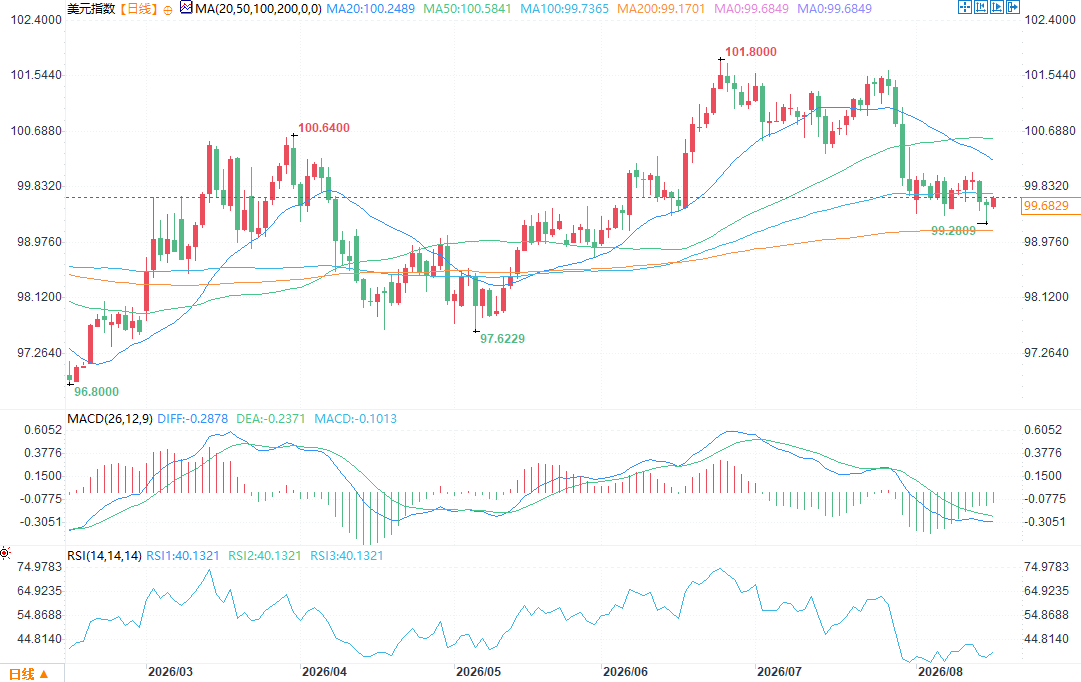 (US Dollar Index Daily Chart, Source: EasyForex) At 14:47 Beijing time on August 18, the US Dollar Index was at 99.67.
Geopolitics: Escalating US-Iran standoff provides safe-haven buying support for the US dollar.
The US dollar index rebounded slightly after three consecutive days of decline, mainly benefiting from safe-haven demand triggered by geopolitical tensions between the US and Iran. US President Trump announced he had no intention of extending the expiring agreement with Iran, citing the US maritime blockade of Iranian ports as evidence of Washington's leverage in exerting pressure, while reiterating his claim to the Strait of Hormuz as US territory under complete US control. Iranian Foreign Ministry spokesman Bagai stated that the agreement had been delayed due to the complex security situation and "obstructive actions by destructive factors," emphasizing that the US must first lift the blockade. The tough statements from both sides maintained a persistent geopolitical risk premium, providing safe-haven buying support for the dollar in the short term. However, the impact of geopolitics on the dollar is two-sided—on the one hand, safe-haven sentiment directly benefits the dollar; on the other hand, rising energy prices may exacerbate inflation concerns, thereby affecting the Federal Reserve's policy path, making this transmission chain more complex.Monetary Policy: Expectations for interest rate hikes continue to cool, putting pressure on the US dollar in the medium term.
The biggest headwind facing the US dollar index comes from a shift in monetary policy expectations. Unexpectedly weak US non-farm payroll data in July, coupled with modest consumer price inflation data released last week, has significantly weakened market expectations for a Federal Reserve rate hike next month. The CME FedWatch tool shows that market expectations for a rate hike at the September meeting have fallen from 47% the previous month to 35%. Scotiabank strategists noted that "the dollar suffered a significant blow last week, and the dollar trend continued to weaken across the board on Monday," pushing the dollar index "below the bottom of the August consolidation range, to its lowest level since early June." The bank believes that "weak US data reports are dampening expectations of Fed tightening," and emphasizes that "from our perspective, the market is pricing in too much tightening of 25 basis points by the end of the year." At the same time, Scotiabank also noted "clear signs of market concern about US fiscal dynamics," believing that this concern is "reflected in the steepening of the US Treasury yield curve." The dual pressures of fiscal concerns and a shift in monetary policy expectations constitute the fundamental background for the dollar's medium-term downward pressure.Institutional Views
In its latest research report dated August 14, HSBC noted that the recent weakening of the US dollar was mainly supported by yen intervention and the impact of Federal Reserve policy risks, but believes the dollar is poised to regain upward momentum. Supporting factors include the continued resilience of US economic growth and the still advantageous interest rate differential with other major economies. HSBC expects the dollar to gradually strengthen against most G10 currencies and some emerging market currencies, but emphasizes that conditions for further significant gains are not yet present, especially lacking the key driver of a rapid Fed rate hike cycle. HSBC believes the dollar has room for a "slow climb," but the market may experience volatile movements during the release of key US data before the September FOMC meeting, and investors should be wary of short-term fluctuations. UBS stated that it expects the dollar to weaken in the medium to long term. Key drags include escalating US fiscal concerns: the 30-year Treasury yield rose to 5.216% (the highest since 2001), with investors demanding higher compensation to absorb the expanding deficit; meanwhile, investor allocation to dollar assets is already high, constituting a structural headwind. The agency said that as U.S. data becomes more dovish in the coming months, the Federal Reserve may signal that it will keep interest rates unchanged, which would push yields down and lead to a broader weakening of the dollar.Summarize
The US dollar index is currently in a complex, mixed state. Geopolitical tensions between the US and Iran are providing safe-haven buying support for the dollar, but this positive factor is being offset by rapidly fading expectations of a Fed rate hike. Weak US employment data, moderate inflation, and market concerns about fiscal conditions collectively constitute the fundamental logic for the dollar's medium-term downward pressure. Scotiabank believes that the year-end tightening of 25 basis points is "too much," suggesting further downside risks for the dollar. This week's FOMC meeting minutes will be a key catalyst in determining whether the dollar can stabilize and rebound. (US Dollar Index Daily Chart, Source: EasyForex) At 14:47 Beijing time on August 18, the US Dollar Index was at 99.67.
- Risk Warning and Disclaimer
- The market involves risk, and trading may not be suitable for all investors. This article is for reference only and does not constitute personal investment advice, nor does it take into account certain users’ specific investment objectives, financial situation, or other needs. Any investment decisions made based on this information are at your own risk.