The UK job market is cooling further, with the pound hovering around 1.35. However, the market's real focus is not on the unemployment rate.
2026-08-18 15:51:00
On Tuesday, August 18th, the latest UK employment data continued to signal a cooling labor market. The preliminary figure for July's payroll employment was down by 13,000, with the June decline also revised from the previously reported 4,000 to 13,000. The unemployment rate for the three months to June remained at 4.9%, higher than the market's previous expectation of 4.8%. Job vacancies for the three months to July further decreased to 707,000. Meanwhile, the Bank of England is currently maintaining its policy rate at 3.75%. The most noteworthy aspect of this data is not the 4.9% unemployment rate itself, but rather the simultaneous weakening of payroll employment, job vacancies, and private sector wages. The preliminary figure for July's payroll employment was down by 13,000, and job vacancies fell to 707,000, the lowest level since 2021; if the impact of special periods is excluded, the current level of job vacancies is already close to the lowest levels since 2014. The official economic statistics official stated that the labor market remains somewhat softened, with the decline in job vacancies primarily driven by small businesses, which cited labor and operating costs as key reasons for reducing hiring or not filling vacancies.  This indicates that the job market is exhibiting a typical low-mobility state. While companies are not engaging in widespread layoffs, their willingness to hire new employees is insufficient, and labor demand is gradually being released through a decrease in job vacancies and a decline in the payroll. For monetary policy, this structure is more critical than short-term unemployment rate fluctuations, as persistently weak hiring demand typically means that wage bargaining power is unlikely to strengthen sustainably. In the three months to June, private sector regular wages rose by 2.8% year-on-year, the lowest level since October 2020, while overall regular wage growth was 3.5%. In contrast, public sector wage growth reached approximately 6.1%, showing a clear divergence. Public sector data is also affected by base effects such as changes in the timing of healthcare wage adjustments. For the Bank of England, private sector wages are more important than simply observing overall wage figures. This is because private sector wages more directly reflect corporate labor costs and the sustainability of wage transmission to service prices. The current 2.8% increase suggests a weakening ability of the labor market to generate a second round of inflationary pressure. However, policy constraints have not disappeared. The Bank of England's July meeting maintained the policy rate at 3.75% by a 6-3 vote, with three members advocating for a rate hike to 4%, reflecting policymakers' continued vigilance regarding the spillover of energy price shocks into the domestic price system. Therefore, the market is not simply facing the logic of "weak employment equals loose policy," but rather the simultaneous existence of a cooling labor market and energy cost pressures. This is a key reason why current policy expectations are difficult to reach a high degree of consensus. Weak employment does not necessarily mean that the UK economy has entered a significant contraction. Previous data showed that real GDP growth in the first quarter of 2026 was 0.6%, with the service sector remaining the main driver; recent employment data indicates that while the economy is maintaining some growth, businesses remain cautious about expanding their workforce. This forms a key characteristic of the current UK macroeconomic environment: a certain degree of disconnect between output performance and labor demand. From a business perspective, this phenomenon may mean that increasing the utilization rate of existing staff, controlling fixed costs, and postponing expansionary hiring are becoming more common business choices. Decreasing job vacancies, insufficient hiring intentions from small businesses, and a slowdown in private sector wage growth actually point to the same issue: businesses are actively controlling new labor costs. For the pound, this combination means the market needs to simultaneously weigh the resilience of economic growth, the degree of employment slowdown, wage pressures, and the impact of energy prices on inflation. The explanatory power of a single data point for exchange rate valuation therefore decreases, making the relative changes between macroeconomic variables more important. Looking at the current daily chart, the pound/dollar exchange rate is around 1.3525, the Bollinger Band middle band is around 1.3440, the upper band is around 1.3596, and the lower band is around 1.3283. The price is currently above the middle band and close to the upper half of the Bollinger Bands, and the middle band continues to rise, indicating that the recent price movement has clearly shifted upwards from the previous lows.
 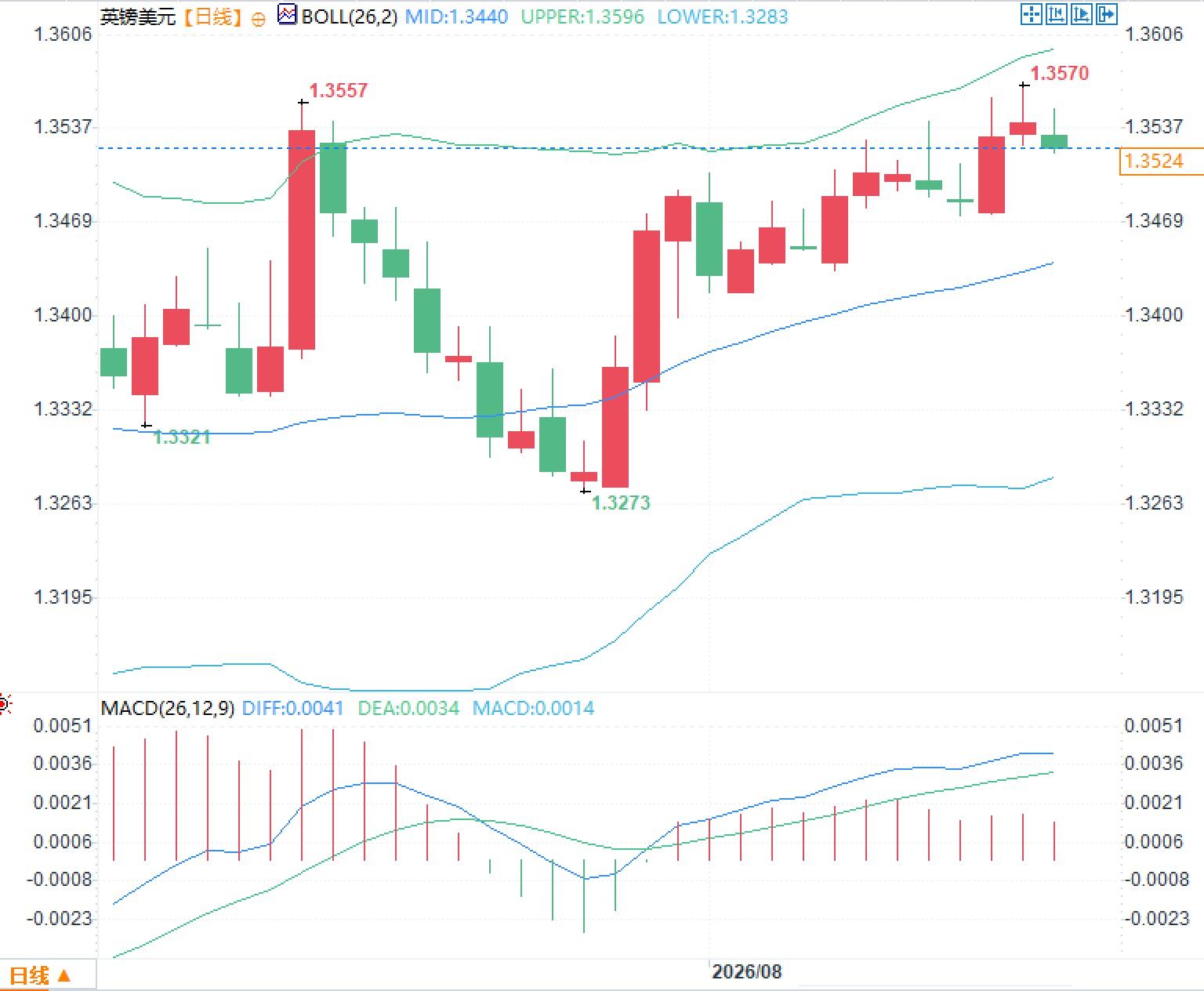 Regarding the MACD, the DIFF is approximately 0.0041, and the DEA is approximately 0.0034, both above the zero line, with the histogram at approximately 0.0014. From the indicator structure, the previous phase of correction from around 1.3273 has already been reflected in the trend indicators. It's worth noting that after the price recently approached 1.3570, the MACD histogram did not expand significantly in tandem, indicating a difference in rhythm between price fluctuations and indicator momentum. This suggests that the market has gradually moved from a relatively clear correction phase into a more sensitive area to new macroeconomic information.
This indicates that the job market is exhibiting a typical low-mobility state. While companies are not engaging in widespread layoffs, their willingness to hire new employees is insufficient, and labor demand is gradually being released through a decrease in job vacancies and a decline in the payroll. For monetary policy, this structure is more critical than short-term unemployment rate fluctuations, as persistently weak hiring demand typically means that wage bargaining power is unlikely to strengthen sustainably. In the three months to June, private sector regular wages rose by 2.8% year-on-year, the lowest level since October 2020, while overall regular wage growth was 3.5%. In contrast, public sector wage growth reached approximately 6.1%, showing a clear divergence. Public sector data is also affected by base effects such as changes in the timing of healthcare wage adjustments. For the Bank of England, private sector wages are more important than simply observing overall wage figures. This is because private sector wages more directly reflect corporate labor costs and the sustainability of wage transmission to service prices. The current 2.8% increase suggests a weakening ability of the labor market to generate a second round of inflationary pressure. However, policy constraints have not disappeared. The Bank of England's July meeting maintained the policy rate at 3.75% by a 6-3 vote, with three members advocating for a rate hike to 4%, reflecting policymakers' continued vigilance regarding the spillover of energy price shocks into the domestic price system. Therefore, the market is not simply facing the logic of "weak employment equals loose policy," but rather the simultaneous existence of a cooling labor market and energy cost pressures. This is a key reason why current policy expectations are difficult to reach a high degree of consensus. Weak employment does not necessarily mean that the UK economy has entered a significant contraction. Previous data showed that real GDP growth in the first quarter of 2026 was 0.6%, with the service sector remaining the main driver; recent employment data indicates that while the economy is maintaining some growth, businesses remain cautious about expanding their workforce. This forms a key characteristic of the current UK macroeconomic environment: a certain degree of disconnect between output performance and labor demand. From a business perspective, this phenomenon may mean that increasing the utilization rate of existing staff, controlling fixed costs, and postponing expansionary hiring are becoming more common business choices. Decreasing job vacancies, insufficient hiring intentions from small businesses, and a slowdown in private sector wage growth actually point to the same issue: businesses are actively controlling new labor costs. For the pound, this combination means the market needs to simultaneously weigh the resilience of economic growth, the degree of employment slowdown, wage pressures, and the impact of energy prices on inflation. The explanatory power of a single data point for exchange rate valuation therefore decreases, making the relative changes between macroeconomic variables more important. Looking at the current daily chart, the pound/dollar exchange rate is around 1.3525, the Bollinger Band middle band is around 1.3440, the upper band is around 1.3596, and the lower band is around 1.3283. The price is currently above the middle band and close to the upper half of the Bollinger Bands, and the middle band continues to rise, indicating that the recent price movement has clearly shifted upwards from the previous lows. Regarding the MACD, the DIFF is approximately 0.0041, and the DEA is approximately 0.0034, both above the zero line, with the histogram at approximately 0.0014. From the indicator structure, the previous phase of correction from around 1.3273 has already been reflected in the trend indicators. It's worth noting that after the price recently approached 1.3570, the MACD histogram did not expand significantly in tandem, indicating a difference in rhythm between price fluctuations and indicator momentum. This suggests that the market has gradually moved from a relatively clear correction phase into a more sensitive area to new macroeconomic information.
- Risk Warning and Disclaimer
- The market involves risk, and trading may not be suitable for all investors. This article is for reference only and does not constitute personal investment advice, nor does it take into account certain users’ specific investment objectives, financial situation, or other needs. Any investment decisions made based on this information are at your own risk.