The dual-traffic crisis erupted, the Pentagon admitted military measures had failed, and oil geopolitical premiums soared.
2026-08-18 16:34:57
On Tuesday (August 18), international oil prices remained strong during the Asian and European sessions, holding onto Monday's gains. WTI crude oil futures are currently trading around $84.34 per barrel. As a key chokepoint for global oil trade, the Strait of Hormuz and the adjacent Bab el-Mandeb Strait have recently been plagued by attacks on ships, sluggish traffic, and protracted diplomatic negotiations. With the expiration of the US-Iran memorandum of understanding in June without a valid extension, traffic across the straits has failed to return to normal, geopolitical premiums continue to rise, and expectations for the global oil supply chain are being profoundly reshaped. 
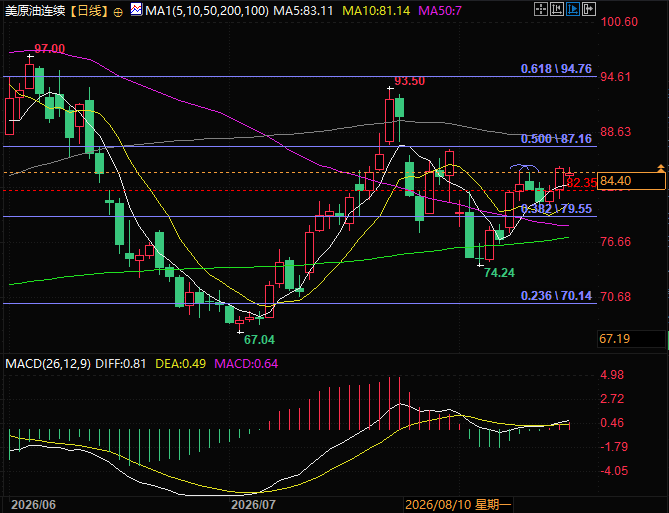 (WTI crude oil futures daily chart, source: EasyTrade) At 16:29 Beijing time, WTI crude oil futures were trading at $84.34 per barrel.
Attacks on merchant ships in the Strait and the seizure of oil tankers exacerbate market panic.
On August 18, a merchant ship was attacked by an unidentified projectile while exiting the Strait of Hormuz, resulting in damage to the engine room and injuries to the crew. The UK Maritime Trade Operations Office (UKMTO) has issued an alert, and the Omani Coast Guard has launched a rescue operation. No marine pollution has been reported so far. This incident comes after Iran seized a UAE oil tanker, further highlighting the security risks in the waterway.General aviation data is at a low level, and "invisible passage" increases market variables.
According to Kpler, a shipping data service provider, traffic volume in the Bab el-Mandeb Strait remains sluggish. On the first statistical day after the expiration of the memorandum of understanding, only six merchant ships transited the strait, compared to an average of only 11 ships per day over the previous 10 days. Furthermore, almost none of the passing vessels were VLCCs or LNG carriers. In addition, some vessels chose to disable their AIS transponders and operate covertly, resulting in an implicit variable in the actual volume of traffic. Meanwhile, the Bab el-Mandeb Strait in the Red Sea is also under pressure. The Houthi rebels in Yemen claimed responsibility for attacking Saudi targets in the Bab el-Mandeb Strait, causing ships to catch fire. Iranian media also reported a drone attack on Saudi Aramco's Jizan oil refinery. Two key energy chokepoints in the Middle East are simultaneously in a high-risk situation, with multiple geopolitical risks compounded.Iran and Afghanistan negotiate a new framework for air travel; the US's tough stance suppresses room for mediation.
Iran and Oman are currently refining the details of a transitional navigation route map for the Strait of Hormuz, with the proposed plan involving separate routes on the north and south sides and no toll fees. However, negotiations are progressing slowly, and the US's frequent expressions of a hardline stance and even extreme military threats have significantly reduced Oman's space for neutral mediation. Although there are secret communication channels between the US and Iran, statements from the Pentagon and senior US officials indicate that the likelihood of the two sides reaching a substantial consensus in the short term is extremely low.Pentagon assessment exposes strategic dilemma
An internal Pentagon assessment indicates that the U.S. military's existing contingency plans are insufficient to guarantee absolute passage through the Strait of Hormuz without obstruction. The U.S. maritime presence is insufficient to fully suppress Iran's asymmetric warfare capabilities, leading to a strategic stalemate for the U.S. in the Persian Gulf. This sends a strong signal to commodity markets: military means alone cannot quickly sever oil supply bottlenecks; the market must continue to price in the risk of supply disruptions at the tail end.Institutional View: Geopolitical premiums boost short-term expectations, financial markets amplify pricing risks of supply disruptions.
Faced with the dual crises of the Strait of Hormuz and the Bab el-Mandeb Strait, major international financial institutions and industry authorities have adjusted their oil price forecasts. At the investment banking level, geopolitical risks are reshaping market valuation models. Barclays has explicitly maintained its high forecast of $96 per barrel for Brent crude in 2026, believing that supply chain frictions caused by shipping disruptions are unlikely to subside in the short term, implying a WTI price around $90. Bank of America (BofA) warns that if the extreme situation of a Strait blockade or attack continues into the second half of the year, geopolitical panic could easily push oil prices to the extreme range of $130 per barrel, implying a WTI price around $124. Although institutions such as Goldman Sachs have warned of the potential recovery risks on the long-term supply side, given the current strategic stalemate in military affairs and the US military's inability to guarantee navigation safety, mainstream institutions generally believe that the "tail risk of shipping lane disruption" has become the most crucial pricing support for oil prices.Summary and Technical Analysis
After the expiration of the 60-day ceasefire memorandum between the US and Iran, the situation returned to a standoff. The US maintained its blockade and economic sanctions against Iranian oil tankers, while Iran retaliated by controlling the Strait of Hormuz and coordinating with the Houthi rebels to pressure the Bab el-Mandeb Strait, taking advantage of rising oil prices. Coupled with threats to Saudi energy facilities, supply-side concerns have intensified. A Pentagon assessment report further confirmed the reality that the game is unlikely to be resolved in the short term, boosting bullish sentiment in the market. Technically: WTI crude oil has strongly broken through the previous daily double-top resistance and gap resistance, clearly establishing a bullish trend. The first resistance level to watch is 87.16; if a pullback occurs, the effective support range is expected to be between $81.50 and $82.00 per barrel. (WTI crude oil futures daily chart, source: EasyTrade) At 16:29 Beijing time, WTI crude oil futures were trading at $84.34 per barrel.
- Risk Warning and Disclaimer
- The market involves risk, and trading may not be suitable for all investors. This article is for reference only and does not constitute personal investment advice, nor does it take into account certain users’ specific investment objectives, financial situation, or other needs. Any investment decisions made based on this information are at your own risk.