Long-term interest rates surge, putting downward pressure on gold prices! But the term structure hints at a potential gold rebound.
2026-08-19 16:16:59
On Wednesday (August 19), spot gold rebounded during the Asian and European sessions. Following a sharp correction in the US equity market last night, gold prices fell by 1.85% during the New York session, currently trading at $4355 per ounce. Recently, global markets have been simultaneously impacted by multiple disturbances including Middle East geopolitical conflicts, the supply shock of US Treasury bonds, and the interplay of monetary policy expectations. The closure of the US-Iran negotiations window, increased shipping risks in the Strait of Hormuz, and the pullback in long-term US Treasury yields have all contributed to a shift in the pricing logic of various assets. 
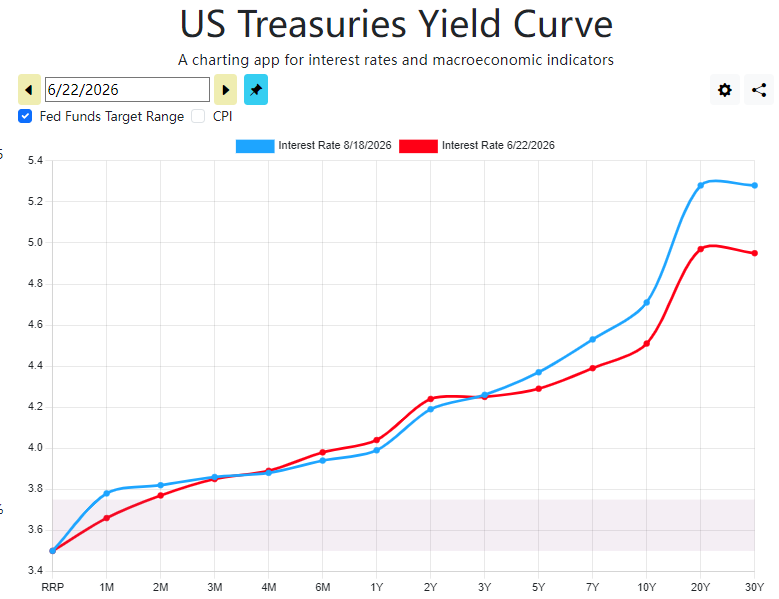 (Chart showing the term premium of US Treasury yields, source: Federal Reserve)
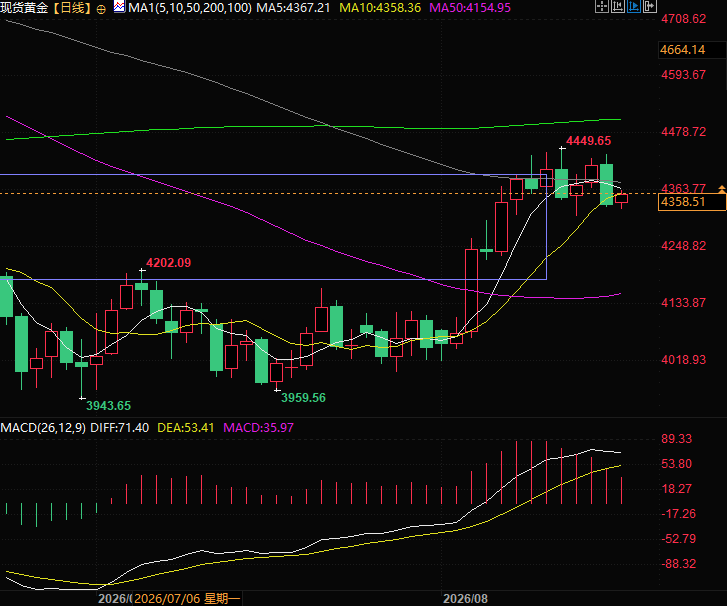 (Spot gold daily chart, source: EasyTrade) At 16:11 Beijing time, spot gold is currently trading at $4361 per ounce.
The window for US-Iran negotiations has expired, and the Middle East conflict has reached a stalemate.
The 60-day window for negotiations on the memorandum of understanding previously reached between the US and Iran has expired. No new agreement was reached, and there are no plans for renewal, essentially dashing the prospects for peace talks. The US has shifted to using maritime blockades and economic sanctions as its main means of pressure, reducing direct military retaliation; however, Iran has not compromised, and attacks on shipping in the Strait of Hormuz have continued to increase. Several UAE-affiliated merchant ships have been attacked this month, with some attacks resulting in crew casualties. Gulf allies are caught in a dilemma, unwilling to see the conflict escalate further, yet worried about the US's restrained response. The Strait of Hormuz has missed another potential opening point, and concerns about energy inflation have increased expectations of a Federal Reserve interest rate hike, putting pressure on gold prices. Impacted by the attacks, the volume of merchant ship traffic in the Strait of Hormuz has significantly decreased, far below levels seen during periods of relative calm. Many shipping companies, for security reasons, have turned off their transponders and are using alternative routes, with very low participation in the southern route promoted by the US. The UAE is using a shuttle transport model to maintain its crude oil exports, but its affiliated vessels continue to be frequently attacked. As a key global energy corridor, the Strait of Hormuz is experiencing ongoing risks that directly drive up crude oil prices. The market is beginning to price in the possibility of a resurgence of energy-driven inflation, which also adds new uncertainty to the Federal Reserve's interest rate decisions.US Treasury yields fluctuated sharply: long-term yields eased after a surge.
As geopolitical risks escalated, the US Treasury market experienced significant volatility. Previously, a concentrated sell-off of US Treasuries pushed the 30-year Treasury yield to a near 20-year high, dragging down global long-term government bond yields in tandem. This rise in long-term yields reflected both market concerns about a rebound in energy inflation and a heightened risk premium due to the massive supply of US Treasury bonds. This explains why the US dollar did not rise in tandem; typically, higher US Treasury yields increase the attractiveness of Treasuries, thus strengthening the dollar. However, this time, the rise in yields was not driven by hawkish Fed policy but by concerns about excessive US debt issuance, which weakened the dollar. High long-term yields increased the opportunity cost of holding non-interest-bearing assets, putting direct pressure on precious metals. Subsequently, the sell-off in US Treasuries eased, and long-term yields stabilized and declined from their highs, alleviating some of the tightening pressure emanating from the bond market. Observing the term premium structure of US Treasury bonds, it can be seen that due to the decline in US labor and inflation data, short-term interest rates such as 2-year bonds have not risen significantly. The main interest rate pressure lies in the long term. This structure has limited suppression on gold prices. Gold prices may rebound rapidly after the long-term interest rate pullback, that is, the overall trend may show a bull steepening pattern, which is beneficial to the rebound of gold (that is, the fading expectation of interest rate cuts is beneficial to gold prices, while the rise in long-term inflation concerns is not entirely negative for gold prices). (Chart showing the term premium of US Treasury yields, source: Federal Reserve)The market awaits a signal from the Federal Reserve, and institutional investors' willingness to allocate gold has increased.
On the macro level, the market is awaiting more clues about Federal Reserve policy. The minutes of the July FOMC meeting will be released on Wednesday, and Fed Chairman Warsh's public speech at the Jackson Hole Economic Symposium next week will be a key indicator for the market's judgment on the future path of interest rates. Bank of America's latest fund manager survey shows that the percentage of fund managers who believe gold is undervalued has risen to its highest level since March 2023. Continued gold purchases by central banks in China and other countries are also providing medium- to long-term support for gold prices; however, the marginal growth rate of capital inflows into precious metals has slowed.With bullish and bearish factors pulling in opposite directions, gold prices have entered a period of wide-range fluctuation.
Contraction in risk appetite put pressure on both equities and precious metals. However, while both the job market and economic data showed signs of cooling, the impact on equities and gold was significantly less. Geopolitical conflicts fueled safe-haven buying, central bank gold purchases continued, and institutional allocation intentions rebounded, providing support. However, the lack of a peaceful resolution between the US and Iran pushed up oil prices, raising concerns about energy inflation and reopening the possibility of a Fed rate hike. Coupled with high-level fluctuations in long-term US Treasury yields, this continued to suppress the upside potential of gold prices. On Tuesday, gold prices recorded their biggest single-day drop in nearly a month, followed by a rebound as the US Treasury market stabilized, briefly rising above $4360/ounce. In the short term, gold prices are likely to maintain a wide range of fluctuations. Future trends will depend on whether long-term US Treasury yields can continue to decline, whether the situation in the Strait of Hormuz deteriorates further, and the policy signals released by Fed officials. Technically, the $4375 level is a key level for gold prices recently. If it can be recovered, gold prices are likely to continue to rebound. If gold prices weaken, watch for support around $4280. (Spot gold daily chart, source: EasyTrade) At 16:11 Beijing time, spot gold is currently trading at $4361 per ounce.
- Risk Warning and Disclaimer
- The market involves risk, and trading may not be suitable for all investors. This article is for reference only and does not constitute personal investment advice, nor does it take into account certain users’ specific investment objectives, financial situation, or other needs. Any investment decisions made based on this information are at your own risk.