US Treasury yields soared and interest rate differentials widened, but the dollar fell instead of rising.
2026-08-19 22:00:58
In mid-August 2026, a rare divergence occurred in global financial markets, breaking the established correlation between US Treasury bonds and the US dollar. Conventional market logic dictates that rising US Treasury yields would attract global capital inflows through interest rate differentials, pushing up the US dollar index. However, recent market movements have been completely opposite: global US Treasury yields have continued to soar, with the yield on the 30-year US Treasury bond climbing to a multi-decade high since 2007, while the US dollar index has remained under pressure, hovering at multi-month lows, and even brief, slight rebounds have failed to reverse its weak trend. The main reason for this is the imbalance between supply and demand for US fiscal debt, and subsequent intervention by the Treasury Department further exacerbated the dollar index's decline. 
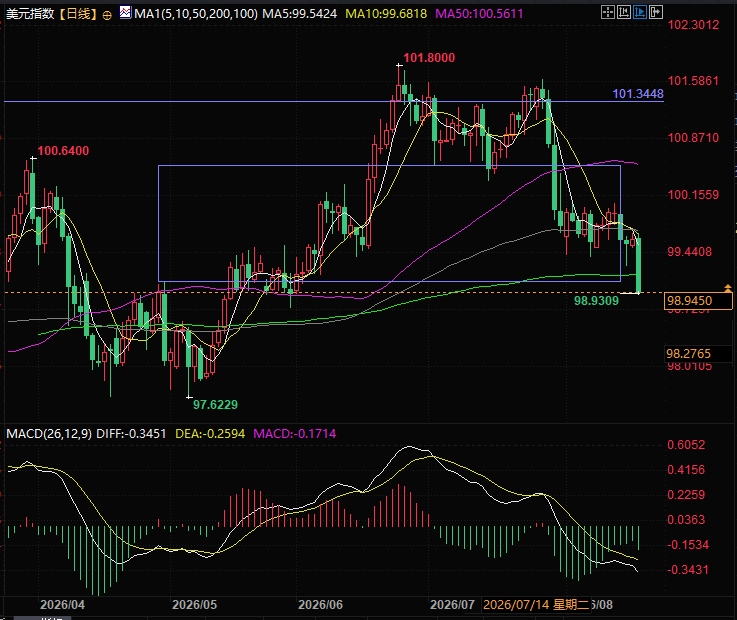 (US Dollar Index Daily Chart, Source: FX678) At 21:57 Beijing time, the US Dollar Index is currently trading at 98.93.
The fundamental difference in market conditions: rising yields stem from debt risk, not monetary tightening.
The current rise in US Treasury yields is fundamentally different from past interest rate hikes driven by monetary policy. Previously, rising US Treasury yields were mostly a result of the Federal Reserve tightening monetary policy, raising interest rates, and reducing its balance sheet, indicating a tightening of US monetary policy and an increase in the value of dollar assets, naturally leading to capital inflows and pushing up the dollar. However, the current surge in long-term US Treasury yields is entirely a passive rise driven by oversupply and concerns about debt risk. The continuously expanding US fiscal deficit has led to a massive issuance of Treasury bonds, with the supply of medium- and long-term bonds far exceeding the demand for funds. Coupled with market concerns about excessive US debt issuance and a weakening marginal debt repayment capacity, investors have been selling off long-term US Treasuries, forcing yields to rise passively.The Treasury's large-scale bond-buying intervention became a key driver of the dollar's weakness.
The latest large-scale intervention in the US Treasury market has become a key driver of the dollar's decline, directly exacerbating downward pressure on the dollar index. To alleviate the liquidity crunch in the long-term Treasury market and curb runaway long-term yields, the US Treasury officially announced a significant expansion of its long-term Treasury repurchase program, doubling the single operation size for both 10-20 year and 20-30 year maturities from $2 billion to over $4 billion. The new rules will officially take effect on September 9, 2026, and will continue until the end of the current financing quarter on November 4. Further optimization of the repurchase mechanism is planned. From the policy's initial intention, the Treasury's large-scale repurchase of long-term bonds aims to absorb excess Treasury supply, restore market liquidity, and suppress soaring long-term yields. However, market interpretation has focused entirely on the hidden risks behind the policy, triggering a chain reaction of dollar depreciation. On the one hand, the market questions the source of funds for the large-scale bond purchases, generally believing that the Treasury will support the operation by issuing new bonds and releasing liquidity in disguise, which is essentially injecting massive dollar liquidity into the market and directly diluting the dollar's credit and purchasing power. On the other hand, this intervention also confirms that the supply and demand in the US long-term bond market is seriously imbalanced and the debt risk has reached a point where intervention is urgently needed, further shaking global investors' long-term confidence in dollar assets.The cooling of interest rate hike expectations has completely severed the positive correlation between US Treasury bonds and the US dollar.
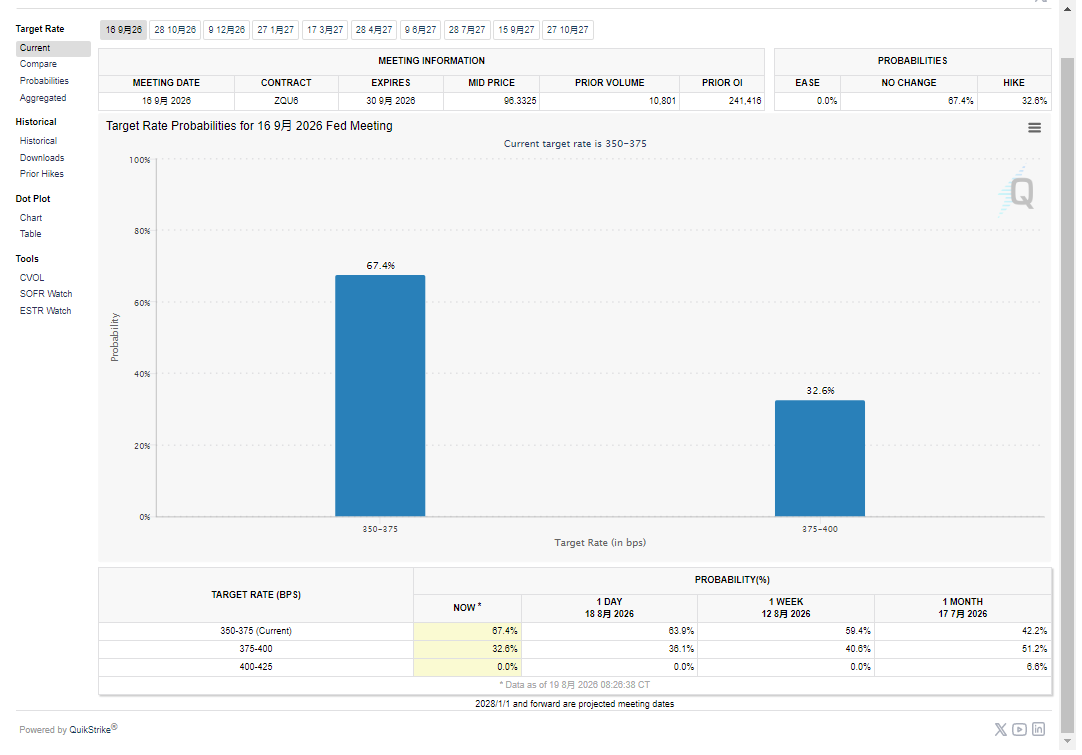
Meanwhile, the weakening US economy has further diminished expectations of a Federal Reserve rate hike, completely severing the positive correlation between yields and the dollar. Recent weak US economic data, including unexpected job losses and a moderate decline in inflation, have led the market to significantly lower its forecast for a Fed rate hike. CME FedWatch data shows that the probability of a rate hike at the Fed's September meeting has plummeted from 52% a week ago to 32%. This means that this round of interest rate increases lacks support from monetary policy, instead highlighting the US fiscal turmoil and insufficient economic resilience. This not only fails to attract foreign investment to the dollar but also continues to erode market confidence in dollar assets, becoming the core reason for the weakening dollar index.Institutional Analysis: The Pricing Logic of the Bond Market and the Foreign Exchange Market is Completely Separated
Market analysts have clearly pointed out the core logical flaw in this market movement. Matt Simpson, senior market analyst at StoneX, stated that the pricing logic of the bond and currency markets is completely disconnected. Bond market traders are focusing on long-term inflation and debt risks, while currency market traders are directly confronting the core issues of weakening dollar credibility and excessive liquidity. Once the long-term risks priced into the bond market materialize, the current weakness and correction in the dollar is likely to deepen further.Market Summary and Outlook
Looking at this round of market movements, the historic divergence between the US dollar and US Treasury bonds is an inevitable result of disorderly US fiscal expansion, accumulated debt risks, and passive policy intervention. Unlike the strong dollar cycle driven by Fed rate hikes, this yield increase is a passive consequence of rising risk premiums. The Treasury's bailout operations further released liquidity and diluted the dollar's value, ultimately creating the rare pattern of "rising interest rates and a weakening dollar." In the short term, Middle East geopolitical conflicts may provide temporary support for US Treasury yields, but the imbalance between US debt supply and demand and the loose liquidity environment are unlikely to reverse, and the weak and volatile trend of the US dollar index is likely to continue. (US Dollar Index Daily Chart, Source: FX678) At 21:57 Beijing time, the US Dollar Index is currently trading at 98.93.
- Risk Warning and Disclaimer
- The market involves risk, and trading may not be suitable for all investors. This article is for reference only and does not constitute personal investment advice, nor does it take into account certain users’ specific investment objectives, financial situation, or other needs. Any investment decisions made based on this information are at your own risk.