A chart shows that the Baltic Dry Index has continued to weaken, freight rates for large vessels have fallen sharply, and the market is showing a structural divergence.
2026-08-20 02:08:57
The latest data shows that the Baltic Dry Index (BDI) was at 2776 points on August 19, 2026, a new low since July 31, 2026, down 1.39% month-on-month, marking the second consecutive day of decline (including zero growth). Looking at the short-term charts, the BDI has seen positive growth 4 times, negative growth 7 times, and zero growth in the last 11 BDI data points. Specifically, the Panamax Freight Index (BPI) was at 2107 points, down 2.23% from the previous value; the Capesize Freight Index (BCI) was at 4376 points, down 1.71%; and the Supramax Freight Index (BSI) was at 1634 points, up 0.18%. For detailed charts of the latest 720-day and 10-year trends of the Baltic Dry Index and its three main sub-indices, please refer to the charts specially created by FX678. 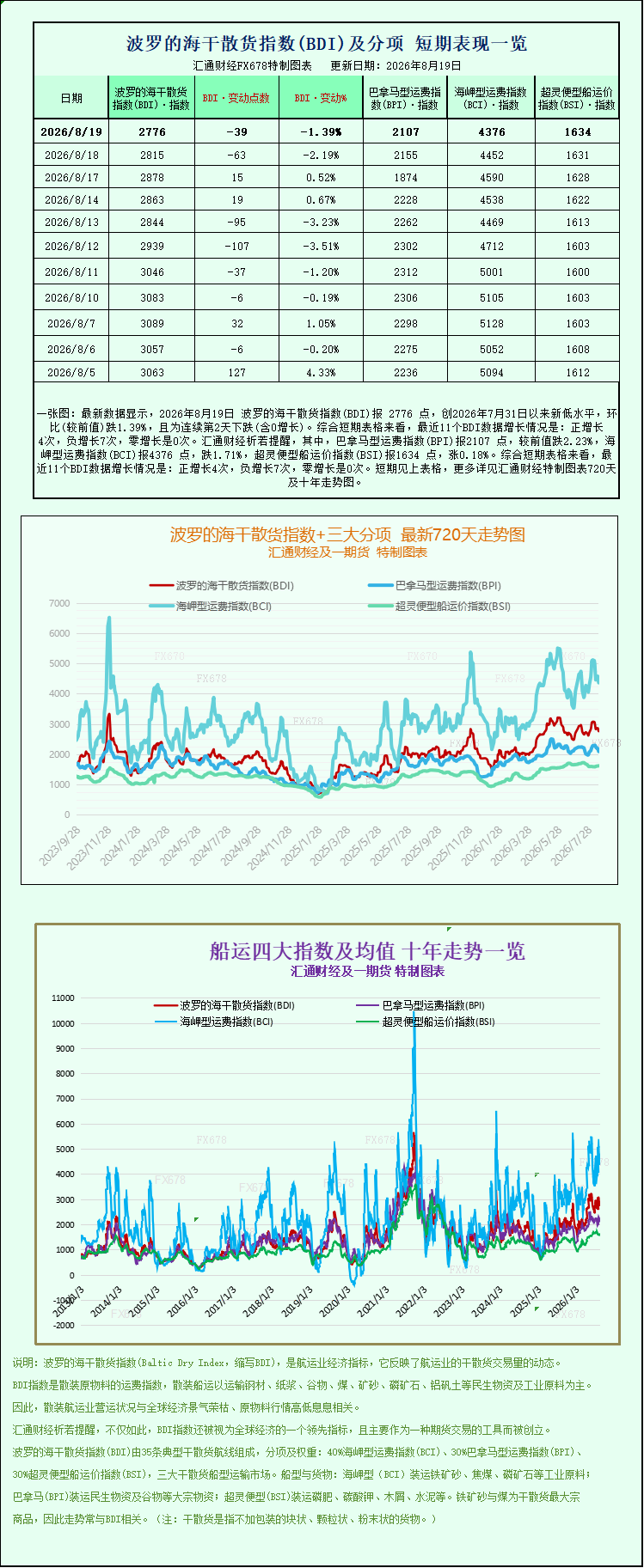 In mid-August 2026, the global dry bulk shipping market entered a period of adjustment. On that day, the Baltic Dry Index (BDI) declined again, marking its second consecutive day of losses. Freight rates for major vessel types and large vessels simultaneously fell to their lowest levels in over two weeks. The shipping market, which had briefly recovered earlier, officially entered a consolidation phase. The market was significantly dragged down by freight rates for large vessels, while smaller vessels bucked the trend with slight increases. Overall, the market exhibited characteristics of weakening overall performance, structural differentiation, and a clear separation between strong and weak performers, directly reflecting the complex interplay between global commodity trade and shipping supply and demand. The Baltic Dry Index (BDI) is a core indicator of the global dry bulk shipping market, covering freight rate trends for different tonnage vessel types. It accurately reflects the activity level of global industrial raw material shipping and is an important leading indicator for assessing the global real economy. The composite index, which integrates the market trends of the three major vessel types—Capesize, Panamax, and Supramax—has extremely strong market reference value. Data shows that on August 19th, the index fell 39 points, a drop of 1.4%, closing at 2776 points, the lowest closing level since July 31st, completely ending the volatile recovery in early August, and market pessimism has intensified in the short term. This round of continuous decline in the index is not a sudden short-term fluctuation, but an inevitable result of the continued weakening of market fundamentals. In early August, the release of global restocking demand and a temporary tightness in ocean shipping capacity drove a slight recovery in the shipping index. However, after mid-August, the positive support faded completely, and multiple negative factors such as weak end-user demand, ample shipping capacity, and volatility in the commodity market combined to cause freight rates to continue to decline, the industry's short-term prosperity steadily cooled, and the overall market was clearly under pressure. As a core component of the market, Capesize vessels became the main drag on the index this time. Data shows that the Capesize index fell sharply by 76 points in a single day, a drop of 2%, closing at 4376 points, also hitting a two-week low, significantly underperforming the broader market. These vessels, with a deadweight tonnage of approximately 150,000 tons, primarily transport core industrial raw materials such as iron ore, thermal coal, and metallurgical coal. They mainly operate on transoceanic long-haul routes, and their freight rates are deeply tied to the global steel and energy industry's prosperity, making them a core indicator for monitoring the industrial supply chain. In terms of profitability, the average daily revenue of standard 150,000-ton Capesize vessels decreased by $691 to $36,181, indicating a continued contraction in shipowners' profit margins. Industry analysts point out that the core reason for this round of sharp declines in large-vessel freight rates is the continued weakness in China's iron ore end-user demand. Currently, the domestic steel industry is in a period of adjustment. The high temperatures in August led to the traditional off-season for construction and machinery industries, resulting in sluggish steel consumption, high inventory levels, and pressure on steel mill profits. To control costs, most steel mills have proactively reduced blast furnace operating rates and reduced capacity, significantly weakening their willingness to replenish raw material inventories. The continued contraction in iron ore import demand has directly led to a sharp decrease in ocean-going cargo, shifting the supply-demand balance of Capesize vessels from tight to loose, and consequently causing freight rates to decline. This market exhibits a typical structural divergence: while ocean freight rates continued to decline, iron ore futures prices rose against the trend. This price rebound was primarily driven by escalating supply-side risks at Australian ports. Wage negotiations between global mining giant BHP Billiton and workers at the Port of Hedland broke down again, significantly increasing the risk of a port strike. Market concerns about disruptions to the iron ore export supply chain fueled a short-term price increase. As a core global iron ore export hub, the Port of Hedland handles over 60% of Australia's iron ore exports, and its operational stability directly impacts the global iron ore supply structure. However, this short-term, event-driven positive on the supply side cannot offset the long-term weakness in demand. The market generally believes that this price increase is merely a speculative short-term phenomenon. The core fundamentals of weak end-user demand in China's steel industry have not improved, and the medium- to long-term outlook for iron ore consumption remains weak. Therefore, it is difficult to support a recovery in ocean freight rates, ultimately resulting in a market divergence of "rising ore prices and falling freight rates." The simultaneous weakening of the medium-tonnage Panamax vessel market further dragged down the overall market performance. Data shows that the Panamax index (.BPNI) fell 48 points, or 2.2%, to close at 2107 points, also hitting a new low since July 31, with a decline even exceeding that of Capesize vessels. These vessels mainly carry 60,000 to 70,000 tons of bulk cargo such as coal and grain, covering multiple major routes in the Atlantic and Pacific Oceans, and are well-suited to the industrial energy and food trade transportation needs. On that day, the average daily revenue of Panamax vessels decreased by $427 to $18,964, resulting in a significant reduction in shipowner profits. The pressure on Panamax freight rates stemmed from two main factors: firstly, the slowdown in global coal trade and the gradual passing of the peak summer electricity consumption in the Northern Hemisphere, leading to a marginal decrease in power plant restocking demand; secondly, the South American grain export peak season was nearing its end, with the new season's grain not yet concentrated on the market, resulting in a temporary contraction in cargo supply. Furthermore, the continued improvement in the Panama Canal's navigation conditions and increased efficiency also alleviated regional capacity constraints to some extent, putting downward pressure on freight rates. In stark contrast to large vessels, the small vessel sector performed relatively well. The Supramax vessel index bucked the trend, rising 3 points, or 0.2%, to close at 1634 points, its highest level since July 28. Supramax vessels typically have a deadweight tonnage of around 50,000 tons, offering high flexibility and primarily serving short-haul regional routes to Southeast Asia, the Middle East, and the Mediterranean, carrying diversified cargoes such as steel, cement, fertilizer, and minor minerals. The strengthening of freight rates for this type of vessel reflects relatively healthy regional trade activity and resilient demand in some emerging markets, providing some support for smaller vessels. From the supply side, the global dry bulk fleet is still in an expansion cycle. According to Clarkson Research data, new ship deliveries will remain high in the first half of 2026, while scrapping will be relatively limited, resulting in a significant net increase in market capacity. With demand failing to expand in tandem, the pressure of overcapacity is gradually emerging, becoming a structural factor suppressing freight rate increases. Furthermore, operating cost pressures such as fluctuating fuel costs and increasingly stringent carbon emission regulations are also continuously squeezing shipowners' profit margins. Looking ahead, market analysts generally believe that the dry bulk shipping market will maintain a weak and volatile pattern in the short term. As the world's largest importer of iron ore and consumer of coal, China's macroeconomic trends and infrastructure investment will directly determine the fundamental demand for ocean shipping. Currently, the domestic real estate market adjustment is not yet over, infrastructure investment growth is slowing, and the peak season for steel demand still needs to be confirmed by the traditional "golden September and silver October" period. Before a substantial improvement in end-user demand, Capesize and Panamax freight rates are unlikely to gain sustained upward momentum. However, there are also potential supporting factors in the market. As the Northern Hemisphere enters autumn, the traditional peak construction season is approaching, and steel consumption is expected to rebound month-on-month, leading to a phased release of iron ore restocking demand. Meanwhile, if the labor negotiations at Port Hedland remain deadlocked, supply-side disruptions may provide intermittent support for ore prices and market sentiment. Furthermore, in terms of global grain trade, the new season of corn and soybeans in the Northern Hemisphere is about to enter the harvest season, and Panamax vessels are expected to receive a new round of cargo support. Overall, the current dry bulk shipping market is in a complex phase with mixed bullish and bearish sentiment. The divergence in performance between large and small vessels highlights the profound adjustments in the global trade structure. Until there are clear signs of demand recovery, the market may continue to exhibit characteristics of "overall pressure and structural differentiation." Investors need to closely monitor Chinese macroeconomic data, major mine supply dynamics, and changes in global grain trade flows.
In mid-August 2026, the global dry bulk shipping market entered a period of adjustment. On that day, the Baltic Dry Index (BDI) declined again, marking its second consecutive day of losses. Freight rates for major vessel types and large vessels simultaneously fell to their lowest levels in over two weeks. The shipping market, which had briefly recovered earlier, officially entered a consolidation phase. The market was significantly dragged down by freight rates for large vessels, while smaller vessels bucked the trend with slight increases. Overall, the market exhibited characteristics of weakening overall performance, structural differentiation, and a clear separation between strong and weak performers, directly reflecting the complex interplay between global commodity trade and shipping supply and demand. The Baltic Dry Index (BDI) is a core indicator of the global dry bulk shipping market, covering freight rate trends for different tonnage vessel types. It accurately reflects the activity level of global industrial raw material shipping and is an important leading indicator for assessing the global real economy. The composite index, which integrates the market trends of the three major vessel types—Capesize, Panamax, and Supramax—has extremely strong market reference value. Data shows that on August 19th, the index fell 39 points, a drop of 1.4%, closing at 2776 points, the lowest closing level since July 31st, completely ending the volatile recovery in early August, and market pessimism has intensified in the short term. This round of continuous decline in the index is not a sudden short-term fluctuation, but an inevitable result of the continued weakening of market fundamentals. In early August, the release of global restocking demand and a temporary tightness in ocean shipping capacity drove a slight recovery in the shipping index. However, after mid-August, the positive support faded completely, and multiple negative factors such as weak end-user demand, ample shipping capacity, and volatility in the commodity market combined to cause freight rates to continue to decline, the industry's short-term prosperity steadily cooled, and the overall market was clearly under pressure. As a core component of the market, Capesize vessels became the main drag on the index this time. Data shows that the Capesize index fell sharply by 76 points in a single day, a drop of 2%, closing at 4376 points, also hitting a two-week low, significantly underperforming the broader market. These vessels, with a deadweight tonnage of approximately 150,000 tons, primarily transport core industrial raw materials such as iron ore, thermal coal, and metallurgical coal. They mainly operate on transoceanic long-haul routes, and their freight rates are deeply tied to the global steel and energy industry's prosperity, making them a core indicator for monitoring the industrial supply chain. In terms of profitability, the average daily revenue of standard 150,000-ton Capesize vessels decreased by $691 to $36,181, indicating a continued contraction in shipowners' profit margins. Industry analysts point out that the core reason for this round of sharp declines in large-vessel freight rates is the continued weakness in China's iron ore end-user demand. Currently, the domestic steel industry is in a period of adjustment. The high temperatures in August led to the traditional off-season for construction and machinery industries, resulting in sluggish steel consumption, high inventory levels, and pressure on steel mill profits. To control costs, most steel mills have proactively reduced blast furnace operating rates and reduced capacity, significantly weakening their willingness to replenish raw material inventories. The continued contraction in iron ore import demand has directly led to a sharp decrease in ocean-going cargo, shifting the supply-demand balance of Capesize vessels from tight to loose, and consequently causing freight rates to decline. This market exhibits a typical structural divergence: while ocean freight rates continued to decline, iron ore futures prices rose against the trend. This price rebound was primarily driven by escalating supply-side risks at Australian ports. Wage negotiations between global mining giant BHP Billiton and workers at the Port of Hedland broke down again, significantly increasing the risk of a port strike. Market concerns about disruptions to the iron ore export supply chain fueled a short-term price increase. As a core global iron ore export hub, the Port of Hedland handles over 60% of Australia's iron ore exports, and its operational stability directly impacts the global iron ore supply structure. However, this short-term, event-driven positive on the supply side cannot offset the long-term weakness in demand. The market generally believes that this price increase is merely a speculative short-term phenomenon. The core fundamentals of weak end-user demand in China's steel industry have not improved, and the medium- to long-term outlook for iron ore consumption remains weak. Therefore, it is difficult to support a recovery in ocean freight rates, ultimately resulting in a market divergence of "rising ore prices and falling freight rates." The simultaneous weakening of the medium-tonnage Panamax vessel market further dragged down the overall market performance. Data shows that the Panamax index (.BPNI) fell 48 points, or 2.2%, to close at 2107 points, also hitting a new low since July 31, with a decline even exceeding that of Capesize vessels. These vessels mainly carry 60,000 to 70,000 tons of bulk cargo such as coal and grain, covering multiple major routes in the Atlantic and Pacific Oceans, and are well-suited to the industrial energy and food trade transportation needs. On that day, the average daily revenue of Panamax vessels decreased by $427 to $18,964, resulting in a significant reduction in shipowner profits. The pressure on Panamax freight rates stemmed from two main factors: firstly, the slowdown in global coal trade and the gradual passing of the peak summer electricity consumption in the Northern Hemisphere, leading to a marginal decrease in power plant restocking demand; secondly, the South American grain export peak season was nearing its end, with the new season's grain not yet concentrated on the market, resulting in a temporary contraction in cargo supply. Furthermore, the continued improvement in the Panama Canal's navigation conditions and increased efficiency also alleviated regional capacity constraints to some extent, putting downward pressure on freight rates. In stark contrast to large vessels, the small vessel sector performed relatively well. The Supramax vessel index bucked the trend, rising 3 points, or 0.2%, to close at 1634 points, its highest level since July 28. Supramax vessels typically have a deadweight tonnage of around 50,000 tons, offering high flexibility and primarily serving short-haul regional routes to Southeast Asia, the Middle East, and the Mediterranean, carrying diversified cargoes such as steel, cement, fertilizer, and minor minerals. The strengthening of freight rates for this type of vessel reflects relatively healthy regional trade activity and resilient demand in some emerging markets, providing some support for smaller vessels. From the supply side, the global dry bulk fleet is still in an expansion cycle. According to Clarkson Research data, new ship deliveries will remain high in the first half of 2026, while scrapping will be relatively limited, resulting in a significant net increase in market capacity. With demand failing to expand in tandem, the pressure of overcapacity is gradually emerging, becoming a structural factor suppressing freight rate increases. Furthermore, operating cost pressures such as fluctuating fuel costs and increasingly stringent carbon emission regulations are also continuously squeezing shipowners' profit margins. Looking ahead, market analysts generally believe that the dry bulk shipping market will maintain a weak and volatile pattern in the short term. As the world's largest importer of iron ore and consumer of coal, China's macroeconomic trends and infrastructure investment will directly determine the fundamental demand for ocean shipping. Currently, the domestic real estate market adjustment is not yet over, infrastructure investment growth is slowing, and the peak season for steel demand still needs to be confirmed by the traditional "golden September and silver October" period. Before a substantial improvement in end-user demand, Capesize and Panamax freight rates are unlikely to gain sustained upward momentum. However, there are also potential supporting factors in the market. As the Northern Hemisphere enters autumn, the traditional peak construction season is approaching, and steel consumption is expected to rebound month-on-month, leading to a phased release of iron ore restocking demand. Meanwhile, if the labor negotiations at Port Hedland remain deadlocked, supply-side disruptions may provide intermittent support for ore prices and market sentiment. Furthermore, in terms of global grain trade, the new season of corn and soybeans in the Northern Hemisphere is about to enter the harvest season, and Panamax vessels are expected to receive a new round of cargo support. Overall, the current dry bulk shipping market is in a complex phase with mixed bullish and bearish sentiment. The divergence in performance between large and small vessels highlights the profound adjustments in the global trade structure. Until there are clear signs of demand recovery, the market may continue to exhibit characteristics of "overall pressure and structural differentiation." Investors need to closely monitor Chinese macroeconomic data, major mine supply dynamics, and changes in global grain trade flows.
- Risk Warning and Disclaimer
- The market involves risk, and trading may not be suitable for all investors. This article is for reference only and does not constitute personal investment advice, nor does it take into account certain users’ specific investment objectives, financial situation, or other needs. Any investment decisions made based on this information are at your own risk.