Gold Trading Alert: US Treasury's Unexpected Move Causes US Treasury Yields and the Dollar to Fall, Gold Prices Surge Over 4% to a Two-Month High
2026-08-20 07:28:57
On Wednesday (August 19), the global gold market experienced a rapid surge. Spot gold prices jumped more than 4% in a single day, reaching a high of $4,524.08 per ounce, and finally closing near $4,522.78, the highest level since early June. US gold futures also rose by about 2.8%, closing at $4,545.30. This sudden gold price rally was not due to a full-blown outbreak of traditional safe-haven demand, but was directly triggered by an unexpected liquidity support measure from the US Treasury: doubling the scale of its long-term Treasury bond repurchase operations. This move quickly lowered long-term US Treasury yields, dragging down the dollar and opening up upward space for dollar-denominated gold. The market quickly shifted from bond sell-off panic to a gold rush, a shift driven by multiple factors including fiscal pressure, geopolitical uncertainty, and monetary policy maneuvering. On Thursday (August 20) in early Asian trading, spot gold fluctuated at high levels, currently trading around $4,520 per ounce. 
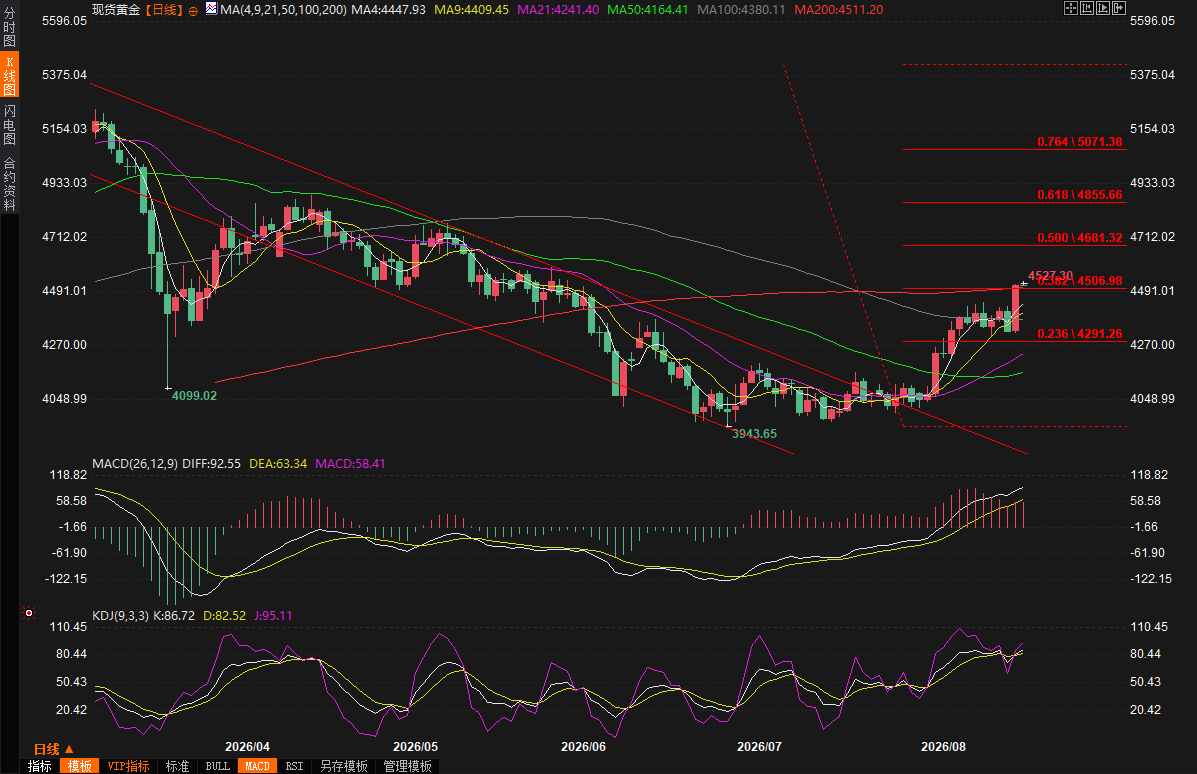 (Spot gold daily chart. Source: FX678) At 07:24 Beijing time, spot gold is currently trading at $4518.04 per ounce.
How an unexpected move instantly ignited gold prices
This surge in gold prices came quite suddenly. Technically, spot gold successfully broke through the 100-day moving average near $4385, forming a breakout signal. Industry expert Robert Gottlieb, former head of precious metals at Koch Supply and Trading, stated that this was completely unexpected. Lower long-term Treasury yields, potentially pushing down the dollar exchange rate, are a significant positive for gold. At the heart of this surge is the U.S. Treasury's announcement on Wednesday of an expanded repurchase program. Faced with the 30-year Treasury yield hitting a 19-year high of 5.34% the previous day, and the reality of U.S. public debt exceeding $40 trillion, the Treasury decided to double the repurchase program for 10- to 30-year Treasury bonds, with each operation requiring at least $4 billion, applicable to both 10- to 20-year and 20- to 30-year maturities, effective from September 9th to November 4th. This increases the originally planned repurchase amount by at least $14 billion, bringing the maximum total repurchase amount during the relevant period to approximately $83 billion. This move directly boosted market demand for long-term US Treasury bonds. The 30-year Treasury yield fell sharply from its high, last quoted at around 5.184%; the 10-year Treasury yield also fell by about 6 basis points to around 4.66%. The US dollar index fell 0.86% to 98.78, a near three-month low. A weaker dollar means lower costs for investors holding other currencies to buy gold, further amplifying the upward momentum in gold prices. Global bond selling sentiment cooled significantly as a result, and yields on longer-term Eurozone bonds also fell from multi-year highs, indirectly easing upward pressure on US borrowing costs.Ministry of Finance intervenes: Is it to stabilize public sentiment or a stopgap measure?
This move by the U.S. Treasury is essentially providing stronger liquidity support for long-term nominal bonds. Market participants have previously shown strong demand for bonds of these maturities, and the continued rise in yields has not only pushed up government interest costs but also increased the financing burden on the private sector, potentially keeping mortgage rates high and triggering broader financial market turmoil. Rene Albrecht, senior analyst at DZ Bank in Germany, pointed out that the authorities are clearly concerned about the pain of long-term government bond yields reaching 5% or higher, especially with only about three months left before the midterm elections. Dan Gottlander, global head of USD and CAD swaps at Citigroup, believes that this move will have a significant impact on long-term government bonds but may prompt the Treasury to issue more short-term debt. Repurchasing long-term bonds does not change the deficit itself; the Treasury still needs to continue issuing bonds, which may increase the issuance of short-term Treasury bills or five- to ten-year government bonds. Analysts at Evercore ISI commented that current Treasury Secretary Bessant once again demonstrated his skill in actively intervening in the market, suddenly expanding the repurchase program during a period of relatively thin liquidity in August, effectively striking at investors shorting bonds. However, they also questioned the sustainability of the effect—the Treasury still needs to raise funds for a large amount of maturing debt and the fiscal deficit. The additional $2 billion in one-time repurchase quota is a drop in the ocean compared to the total size of the more than $32 trillion Treasury bond market and the approximately $5.5 trillion in outstanding 20- to 30-year Treasury bonds. For the past two years, the Treasury has been repurchasing earlier-issued "non-new bonds" before their maturity dates as planned to provide liquidity support. This expansion is merely an addition to this framework, not a fundamental change in the supply and demand structure. Anshul Sharma, Chief Investment Officer of Savvy Wealth, holds a representative view: this move cannot solve fundamental problems such as deficits, inflation, or the supply of Treasury bonds, but it buys time and, more importantly, sends a signal to the market that the Treasury has available tools and is willing to use them if necessary. US President Trump has publicly stated that the public need not worry about bond market volatility. Meanwhile, the demand for a 20-year Treasury auction was mediocre, with a declining bid-to-cover ratio and a relatively high winning interest rate, also suggesting that the market's ability to absorb long-term debt remains questionable. Thomas Simons, chief U.S. economist at Jefferies, noted that the timing of Wednesday's announcement was unusual, as it was not part of the regular quarterly refinancing announcement, suggesting that the Treasury Department might make further adjustments at any time. This has fueled market expectations that the size of the long-term bond auction may ultimately be reduced.The "outdated" Federal Reserve meeting minutes and the independent logic behind gold prices
On the same day that gold prices surged, the Federal Reserve released the minutes of its policy meeting held on July 28-29. The minutes revealed that policymakers' concerns about inflation had deepened. "Many" participants believed that further tightening of policy might be necessary if inflation failed to fall back to the 2% target level; officials supporting interest rate hikes pointed out that price pressures had become widespread, and without action, larger and more costly tightening measures might be necessary in the future. Three officials voted against a 25 basis point rate hike, and the final interest rate remained in the 3.50% to 3.75% range. This was the second policy meeting since Chairman Warsh took office, and discussions also covered future balance sheet management and whether to reduce the number of policy meetings from eight to six per year, but no decisions were made. Notably, the minutes did not generate much of a reaction in the financial markets. This is because economic data released since the meeting has rendered the economic situation reflected in the minutes outdated. Recent weak US economic data, unexpected job cuts by companies in July, and some easing of inflation have led the market to lower its expectations for interest rate hikes. The CME Group's FedWatch tool shows that the market expects a 65% probability that the Federal Reserve will keep interest rates unchanged at its September 15-16 meeting. The interest rate futures market indicates that the probability of a rate hike starting at the end of October has exceeded 50%, and if this does not happen as expected, a December rate hike is highly likely. The core driver of this round of gold price increases comes more from the immediate reaction of yields and the dollar than from the direct pricing of a hawkish stance from the Fed. Geopolitical factors provide background noise: efforts to end the US-Israel conflict with Iran remain stalled, oil and gas transport through the Strait of Hormuz continues to be restricted, crude oil prices have risen slightly, and concerns about the deteriorating US fiscal situation have previously driven a large-scale sell-off in global government bonds. As a traditional safe-haven asset, gold naturally becomes the preferred destination for funds due to the dual benefits of declining yields and a weakening dollar.Looking back and looking ahead: Can gold's recent success continue?
In summary, the gold price surge on August 19th was a liquidity and exchange rate rally driven by unexpected policy developments. The US Treasury, by expanding its long-term Treasury bond repurchase program, successfully curbed further yield increases, stabilized market sentiment, and unexpectedly created an excellent window for gold to rise. Spot gold broke through the 100-day moving average, reaching a new high in over two months, with technical and fundamental factors converging. However, analysts generally warn that this is not a permanent solution. The relatively large debt pool remains limited, and deficit, inflation, and supply pressures have not disappeared. The Treasury may have to continue adjusting its bond issuance structure in the future, and even take more unconventional measures. For gold, the current environment remains bullish. A weaker dollar lowers holding costs, and if long-term real yields remain low, they will continue to support its attractiveness. Geopolitical uncertainty and the backdrop of high global debt also provide fertile ground for safe-haven demand. However, investors need to be wary that once the market digests the short-term positive impact of the expanded repurchase program, or if economic data re-strengthens expectations of interest rate hikes, the upward slope of gold prices may slow. From a technical perspective, the pullback and confirmation after the breakout will be key observation points. This gold price surge reminds the market that in an era of high debt, high interest rates, and geopolitical friction, every minor adjustment to policy tools can instantly rewrite the narrative of asset prices. Gold's more than 3% single-day gain once again demonstrates its sensitivity and resilience in complex macroeconomic games. The actual pace of the Treasury's actions, the Federal Reserve's reaction to data, and the evolution of the geopolitical situation will jointly determine whether this rally is a short-lived impulse or the start of a new medium-term trend. In addition, the latest news shows that US President Trump announced the toughest economic sanctions in history against Iran on the Truth social media platform. Investors need to pay attention to related news and changes in market sentiment; today's trading also requires attention to changes in US initial jobless claims and speeches by Federal Reserve officials. (Spot gold daily chart. Source: FX678) At 07:24 Beijing time, spot gold is currently trading at $4518.04 per ounce.
- Risk Warning and Disclaimer
- The market involves risk, and trading may not be suitable for all investors. This article is for reference only and does not constitute personal investment advice, nor does it take into account certain users’ specific investment objectives, financial situation, or other needs. Any investment decisions made based on this information are at your own risk.